
Commentary
Abstract
Neurodegeneration, along with amyloid and tau, define the AT(N) framework of Alzheimer’s disease that has shaped the development of diagnostics and therapeutics. Yet, biomarker development for neurodegeneration has lagged behind that for amyloid and tau, with limited definition of its heterogeneous microstructural aspects that may each serve as critical measures. In this issue of the JCI, Gong et al. leveraged diffusion MRI to derive a unique measure of axonal injury or axonal density index (ADI). Through cross-sectional and longitudinal analyses, they demonstrated that the ADI has superior performance in detecting, tracking, and predicting clinical impairment compared with prior diffusion MRI methods to evaluate axonal health and standard biomarkers of amyloid and tau. As such, the ADI measure may serve as an important expansion of the neurodegeneration biomarker repertoire.
Authors
Ryn Flaherty, Arjun V. Masurkar
Abstract
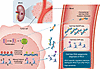
Circulating tumor DNA detection in renal cell carcinoma has long been limited by the disease’s low DNA shedding. An aggressive subtype termed translocation renal cell carcinoma (tRCC) is notably more difficult to detect than the common type, clear-cell RCC, in part due to interindividual variability of gene fusions of the transcription factor TFE3, the driving factor in tRCC. In this issue of the JCI, Garinet et al. reported on an epigenomic liquid biopsy approach that identified a TFE3 fusion–associated chromatin signature specific to tRCC. This work demonstrated that fusion-driven epigenomic alterations can be captured noninvasively and used to distinguish tRCC from other renal cancer subtypes. Beyond its diagnostic potential, the approach described by Garinet et al. may enable disease monitoring and subtype classification in other genetically quiet tumors. Epigenomic liquid biopsy is a promising framework to improve diagnostic accuracy and guide personalized management for tRCC.
Authors
Katsuhiro Ito, David A. Braun
Abstract
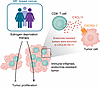
A major unmet need in estrogen receptor–positive (ER+) breast cancer is understanding the mechanisms that underlie resistance to endocrine therapy. Although accumulating evidence suggests an association between the tumor immune microenvironment (TIME) and endocrine response, the specific role of the TIME in mediating endocrine resistance remains unclear. In this issue of the JCI, Napolitano et al. analyzed tumor biopsies from patients with ER+ breast cancer and reported that endocrine-resistant tumors exhibited heightened CD8+ T cell infiltration and activation of the CXCL11 — CXCR3/-7 axis. Spatial and coculture analyses of these tumors demonstrated that the CD8+ T cell–associated chemokine CXCL11 drove estrogen-independent tumor growth. These findings identify an immune-mediated mechanism of endocrine resistance in breast cancer and identify CXCL11 as a potential biomarker and therapeutic vulnerability.
Authors
Tim Kong, Cynthia X. Ma
Abstract
CRISPR/Cas9 base editing holds the potential to treat disease caused by single-nucleotide variants. In contrast with conventional CRISPR/Cas9 approaches, base editing enzymatically induces precise DNA alterations and can directly correct disease-causing variants. In this issue of JCI, Reever et al. used base editing to treat a mouse model of a severe neurodevelopmental disorder caused by a pathogenic missense variant in the voltage-gated sodium channel gene SCN8A. This work represents a starting point for the further refinement of base editing to treat genetic epilepsy.
Authors
Sophie F. Hill, Ethan M. Goldberg
Abstract
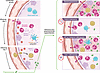
Alveolar macrophages (AMs) help defend the lungs against infection, but during pneumonia many alveolar macrophages die. In this issue of the JCI, Malainou et al. explored the mechanism underpinning AM death during viral pneumonia and its effect on the outcomes of bacterial superinfection, a secondary infection that occurs before the first infection is cleared. In mouse models of influenza A infection, recruited neutrophils secreted TNF superfamily member 14 (TNFSF14), and AMs increased expression of the TNFSF14 receptors TNFSFR14 and type I transmembrane lymphotoxin β receptor (LTβR). TNFSF14 signaling via the LTβR was sufficient to cause AM apoptosis. TNFSF14 deficiency or blockade preserved AMs during influenza infection and diminished bacterial burdens and mouse mortality during pneumococcal superinfection. The adoptive transfer of AMs decreased the severity of pneumococcal superinfections, if those AMs lacked the LTβR. Thus, preserving AMs by interrupting TNFRSF14-LTβR interactions can make virus-infected lungs less susceptible to severe bacterial superinfection.
Authors
Elise M.R. Armstrong, Joseph P. Mizgerd

Abstract
Transplantation of allogeneic islets of Langerhans, which include the insulin-producing β cells of the endocrine pancreas, holds curative potential for type 1 diabetes (T1D). However, protecting the allograft from the host immune system has long been a challenge impeding wider use of this therapy. Inducing mixed hematopoietic chimerism via allogeneic hematopoietic stem cell transplantation (HSCT) can achieve long-lasting donor-specific immune tolerance, but the toxicities of conventional HSCT conditioning agents limit the use of this approach. In this issue of the JCI, Bhagchandani et al. have used the JAK1/2 inhibitor baricitinib to optimize a nonmyeloablative antibody-based HSCT conditioning regimen, achieving multilineage hematopoietic engraftment, which enabled curative islet allotransplantation in a mouse model of T1D.
Authors
Stephen P. Persaud, John F. DiPersio
Abstract
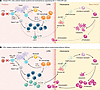
Chimeric antigen receptor T cell (CAR-T) therapy has transformed the treatment of hematologic malignancies, yet, severe inflammatory toxicities continue to limit its broader use. In this issue of the JCI, Goala et al. uncovered a mechanistic link between IFN-γ–driven inflammation and disrupted neutrophil homeostasis, revealing that cytokine release syndrome (CRS) and immune cell–associated hematologic toxicity (ICAHT) stem from a shared biological pathway. Using IL-2Ra–deficient mice and patient samples, they showed that IFN-γ suppressed IL-17A and granulocyte colony-stimulating factor (G-CSF), disrupting granulopoiesis and neutrophil survival. Strikingly, IFN-γ blockade eased both CRS and neutropenia without diminishing CAR-T efficacy, suggesting a path toward safer, better-tolerated cell therapies.
Authors
Stefanie R. Bailey, Marcela V. Maus

Abstract
Pancreatic cancer cells “live on the edge,” starved of nutrients, compressed by abundant stiff stroma, and deprived of oxygen. In this issue, Xu et al. leveraged human pancreas organoid–based CRISPR screens to identify new driver genes in pancreatic ductal adenocarcinoma (PDAC) development. Neurofibromatosis type 2 (NF2) emerged as the top tumor suppressor, whose loss enhances PDAC malignancy. Inactivation of NF2, which encodes the protein Merlin, promoted growth factor independence and enhanced macropinocytosis upon nutrient deprivation. Thus, NF2 status dictates the adaptability of pancreatic tumors under nutrient limitation, with NF2 inactivation endowing PDACs with the ability to survive the constraints of the harsh tumor microenvironment.
Authors
Sofia Ferreira, Laura D. Attardi
Abstract
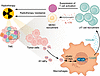
Radiotherapy is a key treatment modality in many malignancies, but radiation-induced immunosuppression can undermine its outcomes and diminish the efficacy of combinatorial strategies, like radioimmunotherapy. In this issue of the JCI, Deng et al. implicate cGAS/STING signaling in the recruitment of γδ T cells that drive downstream radioresistance. Radiation-induced microparticles containing double-stranded tumor DNA led to activation of the cGAS/STING pathway in macrophages, promoting γδ T cell recruitment through CCL20 signaling. In mouse models, γδ T cell–dependent recruitment of myeloid-derived suppressor cells and T cell suppression curbed radiotherapy efficacy and drove antitumor immunity. Ablation of γδ T cells improved the efficacy of radiotherapy alone and radiotherapy combined with immune checkpoint inhibitors in mouse models, supporting further investigation of γδ T cell targeting to improve clinical outcomes with radioimmunotherapy. The findings also add complexity to the function of the cGAS/STING pathway in setting the balance between antitumor immunity and immunosuppression.
Authors
Brooke C. Braman, David R. Raleigh

Abstract
Chronic pain etiology involves a shared genetic profile, but its cellular context is poorly defined. In a study published in this issue of the JCI, Toikumo et al. integrated a chronic pain GWAS meta-analysis (n >1.2 million) with single-cell omics data from human brain and dorsal root ganglia. Genetic risk was predominantly enriched in central glutamatergic neurons, particularly those in the prefrontal cortex, hippocampus, and amygdala. In the periphery, the C-fiber nociceptor subtype hPEP.TRPV1/A1.2 was highlighted. Implicated genes converged on involvement in synaptic function and neuron projection development. This work identifies specific central and peripheral cell types that define the genetic architecture of chronic pain, providing a foundation for targeted translational research.
Authors
Erick J. Rodríguez-Palma, Rajesh Khanna
No posts were found with this tag.


Copyright © 2026 American Society for Clinical Investigation
ISSN: 0021-9738 (print), 1558-8238 (online)