
Commentary
Abstract
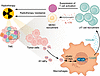
Radiotherapy is a key treatment modality in many malignancies, but radiation-induced immunosuppression can undermine its outcomes and diminish the efficacy of combinatorial strategies, like radioimmunotherapy. In this issue of the JCI, Deng et al. implicate cGAS/STING signaling in the recruitment of γδ T cells that drive downstream radioresistance. Radiation-induced microparticles containing double-stranded tumor DNA led to activation of the cGAS/STING pathway in macrophages, promoting γδ T cell recruitment through CCL20 signaling. In mouse models, γδ T cell–dependent recruitment of myeloid-derived suppressor cells and T cell suppression curbed radiotherapy efficacy and drove antitumor immunity. Ablation of γδ T cells improved the efficacy of radiotherapy alone and radiotherapy combined with immune checkpoint inhibitors in mouse models, supporting further investigation of γδ T cell targeting to improve clinical outcomes with radioimmunotherapy. The findings also add complexity to the function of the cGAS/STING pathway in setting the balance between antitumor immunity and immunosuppression.
Authors
Brooke C. Braman, David R. Raleigh

Abstract
Chronic pain etiology involves a shared genetic profile, but its cellular context is poorly defined. In a study published in this issue of the JCI, Toikumo et al. integrated a chronic pain GWAS meta-analysis (n >1.2 million) with single-cell omics data from human brain and dorsal root ganglia. Genetic risk was predominantly enriched in central glutamatergic neurons, particularly those in the prefrontal cortex, hippocampus, and amygdala. In the periphery, the C-fiber nociceptor subtype hPEP.TRPV1/A1.2 was highlighted. Implicated genes converged on involvement in synaptic function and neuron projection development. This work identifies specific central and peripheral cell types that define the genetic architecture of chronic pain, providing a foundation for targeted translational research.
Authors
Erick J. Rodríguez-Palma, Rajesh Khanna
Abstract
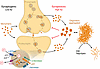
Studies of amyloid-β (Aβ) in Alzheimer’s disease pathology have revealed the peptide’s complex roles in synaptic function. The study by Siddu et al. in this issue clarifies the contexts in which Aβ peptides may be synaptogenic or synaptotoxic. This commentary integrates the study’s major findings with the salient findings of others that, over recent years, have redefined Aβ from a troublesome waste product into a physiological agent of the innate immune response and a modulator of synaptic homeostasis. Convergent evidence demonstrates how free, nonaggregated Aβ supports synaptic structure and activity, whereas oligomeric assemblies enact an adaptive brake on excitatory drive that can become maladaptive with age and inflammation. This redefined perspective on Aβ function emphasizes an evolutionarily conserved feedback loop linking neuronal activity, amyloid generation, and synaptic tuning that protects energy balance under stress but, when dysregulated, promotes proteostatic failure, persistent neuroinflammation, and network dysfunction characteristic of Alzheimer’s disease.
Authors
Joachim Herz
Abstract
Approximately 80% of Merkel cell carcinoma (MCC) cases are caused by Merkel cell polyomavirus (MCV), driven by its T antigen oncogene. Why MCV drives MCC, a skin cancer that displays the neuroendocrine Merkel cell phenotype, remains unclear. In this issue of the JCI, Miao et al. demonstrated that MCC tumor survival requires neuroendocrine-lineage transcription factors, which are recruited to superenhancers (SEs) with the viral small T antigen oncoprotein to promote the neuroendocrine Merkel cell lineage of the cancer. Surprisingly, SEs mapped near the MCV integration site in MCC, and two SE-associated neuroendocrine transcription factors drove viral T antigen gene expression. MCV oncogene and neuroendocrine transcriptional network interactions rendered this viral tumorigenesis dependent on the Merkel cell lineage. Together with reports from other groups, the findings explain why MCV-associated cancer is specifically linked to the Merkel cell phenotype and identify epigenetic strategies targeting of lineage-dependent oncogene circuitry to treat virus-positive MCC.
Authors
Masahiro Shuda

Abstract
The aryl hydrocarbon receptor (AhR) is increasingly recognized as a physiologic modulator of the immune response, a function that extends beyond its established role as a sensor for environmental xenobiotics. In a recent report published in the JCI, Cros et al. demonstrate that the AhR restrains tonic, microbiota-driven inflammatory cytokine production in monocytes. Through the combined use of murine models, human ex vivo systems, and the analysis of patient-derived data, Cros and coworkers established that the AhR limits stimulator of IFN gene–induced (STING-induced) proinflammatory signals. These findings define cell type–specific physiologic roles for the AhR in the regulation of innate immunity and underscore its potential as a therapeutic target for the treatment of inflammatory and autoimmune diseases.
Authors
Jessica E. Kenison, Francisco J. Quintana
Abstract
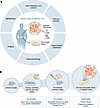
Loss of circulating insulin resulting from autoimmune destruction of β cells is the defining characteristic of type 1 diabetes (T1D), but islet dysfunction in T1D affects both β cells and α cells. Advances in multiomic analyses and the systematic collection of diseased human pancreata are enabling new approaches for diabetes research; hypotheses can be generated from observations in the affected human tissue and then tested in human islets, stem cell–derived islets, or humanized mice. The study by dos Santos and colleagues that appears in this issue of the JCI is an excellent example of the advantages and challenges posed by this approach. Through integrated analyses that combined electrophysiological and transcriptomic profiling, the authors provided detailed insights into the mechanisms leading to α cell dysfunction in islets from individuals with T1D.
Authors
Decio L. Eizirik, Priscila L. Zimath

Abstract
Type 2 diabetes mellitus affects over 38 million Americans, with diabetic kidney disease as a major complication partly driven by lipotoxicity. Fatty acid transport protein 2 (FATP2) regulates uptake and activation of long-chain fatty acids, making it a therapeutic target in metabolic disease. In this issue of the JCI, Khan et al. investigated FATP2 in glycemic control. In db/db mice, global FATP2 deletion reduced plasma glucose via sustained insulin secretion, with expression restricted to pancreatic α cells. FATP2-deficient db/db mice also showed suppressed glucagon and reduced alanine-stimulated gluconeogenesis, implicating α cell FATP2 in systemic glucose regulation. The FATP2-specific inhibitor lipofermata enhanced α cell–derived glucagon-like peptide 1 (GLP-1) secretion, expanded GLP-1–positive α cell mass, and promoted paracrine insulin release — effects reversed by GLP-1 receptor antagonism. These findings identify FATP2 as a key regulator linking lipid handling to α cell hormone secretion and glucose control, positioning its inhibition as a potential complement to incretin-based therapies.
Authors
Paul N. Black, Concetta C. DiRusso

Abstract
Estrogen receptor α (ESR1) is a pivotal regulator of endometrial homeostasis and reproductive function, yet the coregulators that fine tune its transcriptional activity remain incompletely defined. In this issue of the JCI, Hewitt et al. identified Zinc finger MIZ-type containing 1 (ZMIZ1) as an ESR1 coregulator that is essential for stromal proliferation, decidualization, and overall endometrial integrity. ZMIZ1 deficiency was associated with endometriosis and endometrial cancer, and conditional ablation of Zmiz1 using the PgrCre mouse led to infertility and accelerated fibrosis due to impaired estrogen responsiveness. These findings position ZMIZ1 as a key modulator of estrogen signaling with translational potential as both a biomarker and a therapeutic target in uterine disorders.
Authors
Md Saidur Rahman, Kyeong A So, Jae-Wook Jeong

Abstract
Invasive fungal infections carry high morbidity and mortality, but there are no fungal vaccines. In this issue of the JCI, Okaa et al. report that endonuclease 2 (Eng2), an antigen shared by the Blastomyces, Histoplasma, and Coccidioides species of fungi, elicits protective immunity in mice against blastomycosis, histoplasmosis, and coccidioidomycosis. These results establish a common antigen that can elicit protection against multiple mycoses, encouraging the development of a pan-fungal vaccine. The road to fungal vaccines is made difficult by the need for effectiveness in immunocompromised individuals, the sporadic nature of fungal disease, and the economics of vaccine development. Despite these hurdles, there is optimism that such vaccines can be developed and perhaps find usefulness as adjuncts to antifungal therapy.
Authors
Arturo Casadevall

Abstract
DNA damage and repair are central to the onset of cancer, aging, and aging-related diseases. Rare genetic defects in the nucleotide excision repair pathway, such as those causing the cancer-prone disorder xeroderma pigmentosum (XP) or the progeroid condition Cockayne syndrome, highlight the dramatic consequences of unrepaired DNA lesions. In this issue of the JCI, two related papers from Ogi and coworkers — Fassihi et al. and Nakazawa et al. — describe a new XP clinical entity, XP-J, linked to a pathogenic variant in the p52 subunit of the transcription-repair complex TFIIH. The studies’ characterization of XP-J and the p52ΔC variant opened unexpected possibilities to ameliorate the molecular defect in another subunit of TFIIH that causes a different, more severe repair syndrome: trichothiodystrophy. This commentary provides a broader historical, medical, and molecular context for the intricate genotype-phenotype relationship between compromised repair and its clinical consequences and discusses next steps for the advances reported.
Authors
Arjan F. Theil, Jan H.J. Hoeijmakers
No posts were found with this tag.


Copyright © 2025 American Society for Clinical Investigation
ISSN: 0021-9738 (print), 1558-8238 (online)