
The cGAS-STING pathway: DNA sensing in health and disease
Series edited by Alexander Stegh
The cyclic GMP-AMP synthase (cGAS)–stimulator of interferon genes (STING) pathway is a key component of innate immunity, linking DNA detection to inflammatory and antiviral responses. Originally identified as a sensor for microbial DNA, cGAS is now understood to also respond to endogenous cytosolic DNA, and the pathway has been implicated in a wide range of physiological and pathological processes, including cancer, autoimmunity, neuroinflammation, and aging. This review series, organized by Dr. Alex Stegh, consolidates current knowledge and highlights emerging developments that may lead to therapeutic targeting of the cGAS-STING pathway across a range of disorders.
Articles in series
Abstract
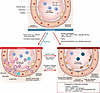
Identification of the genetic mutations underlying the ultrarare monogenic conditions STING-associated vasculopathy with onset in infancy (SAVI) and coatomer protein complex subunit alpha (COPA) syndrome revealed a role for the stimulator of interferon genes (STING) immune pathway in the pathogenesis of interstitial lung disease (ILD) in these conditions. STING-focused therapeutics could be a potential avenue for the treatment of SAVI and COPA syndrome in the future, yet the relevance of STING to more common types of ILD is not clear. Here, we provide an overview of SAVI and COPA syndrome, the nature of ILD in these conditions, and current evidence regarding STING activity in their pathogenesis. We discuss data from studies of a variety of other ILDs and model systems and explore the potential role for STING in more common forms of ILD.
Authors
Prasad Palani Velu, Gaofeng Zhu, Karen J. Mackenzie
Abstract
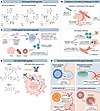
The cyclic GMP-AMP synthase–stimulator of interferon genes (cGAS-STING) pathway is a central regulator of innate immunity that links cytosolic DNA sensing to type I IFN and inflammatory responses. While initially viewed as a uniformly beneficial antiviral and antitumor signaling axis, emerging evidence reveals that cGAS-STING functions as a context-dependent immune rheostat whose impact is dictated by signal magnitude, timing, cellular origin, subcellular localization of signaling components, and tissue context. These parameters explain why pathway activation can promote tumor rejection, vaccine efficacy, and host defense in some settings yet drive immune suppression, metastasis, neuroinflammation, or autoinflammatory disease in others. In this Review, we synthesize mechanistic and clinical insights across agonist and antagonist strategies targeting the cGAS-STING pathway in cancer, infectious disease, neurodegeneration, and interferonopathies. We highlight why first-generation STING agonists have underperformed clinically and how next-generation delivery systems and cGAS-directed approaches may overcome these limitations. We propose a disease-centric framework that integrates spatial delivery, dosing architecture, and pharmacodynamic biomarker discovery to enable rational modulation of cGAS-STING, repositioning the pathway as a tunable immunologic control node for precision therapy rather than a binary on/off switch.
Authors
Akanksha S. Mahajan, Connor M. Forsyth, Cao Dai Phung, Xinhe Shen, Rachel Jarvis, Alexander H. Stegh
Abstract
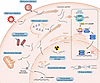
The cGAS/STING pathway enables cells to sense cytosolic DNA and mount rapid innate immune responses to infection, cellular stress, and tissue damage. While essential for host defense and immune surveillance, inappropriate or sustained activation of this pathway can drive chronic inflammation, autoimmunity, and disease-associated immune dysfunction, which can promote cancer growth. Effective immunity therefore depends on precise regulatory control that restrains cGAS/STING activity under homeostatic conditions while preserving the capacity for swift and robust responses to diverse danger signals. In this Review, we synthesize emerging principles that regulate cGAS/STING signaling across cellular contexts to control signal initiation, amplification, and termination. We discuss how disruption, persistence, or pathological rewiring of these regulatory processes contributes to immune imbalance across health and disease, promoting chronic inflammation, immunosuppression, and tissue pathology, with particular relevance to tumor progression and therapeutic resistance. Finally, we consider how restoring appropriate cGAS/STING regulation, rather than simply enhancing or inhibiting pathway activity, may reestablish immune homeostasis and improve therapeutic outcomes in cancer and other inflammatory diseases, framing the pathway as a dynamic regulatory circuit rather than a simple linear signaling cascade.
Authors
Min-Guk Cho, Rachel Lee, Jaycee Johnson, Gaorav P. Gupta
Abstract
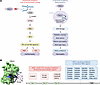
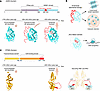
Breakthroughs in rare genetic disease research elucidate the relationships among cytosolic DNA sensing, genome instability, and autoimmune disease phenotypes. Cytosolic self-DNA is a potent trigger of innate immunity, activating the DNA sensor cyclic GMP-AMP synthase (cGAS) and its downstream effector stimulator of interferon genes (STING). This pathway is negatively regulated by the DNA-degrading enzyme three-prime repair exonuclease 1 (TREX1); loss-of-function TREX1 variants lead to accumulation of cytosolic DNA, resulting in STING-mediated autoinflammation. Similarly, STING gain-of-function mutations cause STING-associated vasculopathy with onset in infancy, another disease characterized by multi-organ damage, disability, and premature death. The TREX1-cGAS-STING pathway has also been implicated in regulation of genome stability. Indeed, DNA damage lies at the heart of a separate TREX1-mediated disease, known as retinal vasculopathy with cerebral leukoencephalopathy, where the aberrant nuclear activity of mislocalized TREX1 damages genomic DNA, resulting in multi-organ degeneration syndrome with features of autoimmunity. Thus, monogenic autoimmune diseases and DNA damage syndromes sometimes overlap clinically, and the study of these diseases has created pathways for developing first-in-class small molecule therapeutics.
Authors
Debby J. Park, Kate M. Jones, Jessica B. Anderson, Amanda V. Finck, Jonathan J. Miner
Abstract
The cyclic GMP-AMP synthase–stimulator of interferon genes (cGAS-STING) pathway is a central mediator of cytosolic DNA–induced innate immune responses, driving the production of type I IFNs and pro-inflammatory cytokines. Beyond its canonical role in cytosolic DNA sensing, increasing attention has been directed toward the noncanonical functions of cGAS and STING, particularly within the nucleus. Recent studies implicate dysregulated cGAS-STING signaling in neurodegenerative diseases and brain aging, with a prominent contribution to glial activation–associated neuroinflammation, a hallmark of many neurological disorders. In this Review, we first summarize the molecular mechanisms underlying the canonical cGAS-STING pathway in DNA sensing and innate immune activation. We then discuss emerging noncanonical roles of cGAS in chromatin organization and RNA metabolism, drawing on insights from evolutionary conservation and protein interactome analyses. Finally, we outline the involvement of cGAS-STING signaling in diverse aspects of brain function, including glial state regulation, neuronal homeostasis, blood-brain barrier integrity, and peripheral immune surveillance, highlighting their contributions to neuroinflammation and neuropathology. We also summarize current pharmacological inhibitors targeting cGAS and STING and discuss their therapeutic potential for modulating cGAS-STING signaling to manage brain disorders.
Authors
Weixi Feng, Abulimiti Aikedan, Subhash C. Sinha, Li Gan
Abstract
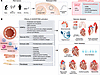
Cardiovascular diseases (CVDs) remain the leading cause of mortality and morbidity worldwide, highlighting the need for novel therapeutic approaches. Inflammation plays a key role in CVD pathogenesis, and accumulating evidence has implicated the cyclic GMP-AMP synthase/stimulator of IFN genes (cGAS/STING) pathway in this process. The cGAS/STING pathway recognizes both non-self- and self-DNA, including mitochondrial and nuclear DNA, to activate its downstream proinflammatory signaling molecules, including TANK-binding kinase 1, IFN regulatory factor 3, and NF-κB. Various pathological stressors have been shown to induce self-DNA release into the cytosol and bloodstream from damaged cells in the cardiovascular system, indicating that circulating cell-free DNA is a useful biomarker of CVDs; however, how this contributes to the inflammatory signaling, cell death, and fibrosis that characterize CVDs remains unclear. Here, we discuss the current understanding on the roles of self-DNA and the cGAS/STING pathway in the pathophysiology of CVDs and the therapeutic potential of targeting this pathway.
Authors
Wataru Saitoh, Yasutomi Higashikuni, Oyunbileg Bavuu, Masataka Sata, Daiju Fukuda


Copyright © 2026 American Society for Clinical Investigation
ISSN: 0021-9738 (print), 1558-8238 (online)