
Go to JCI Insight
  • About
  • Editors
  • Consulting Editors
  • For authors
  • Journal stats
  • Publication ethics
  • Publication alerts by email
  • Advertising
  • Job board
  • Contact
  • Clinical Research and Public Health
  • Current issue
  • Past issues
  • By specialty
    • COVID-19
    • Cardiology
    • Gastroenterology
    • Immunology
    • Metabolism
    • Nephrology
    • Neuroscience
    • Oncology
    • Pulmonology
    • Vascular biology
    • All ...
  • Videos
    • ASCI Milestone Awards
    • Video Abstracts
    • Conversations with Giants in Medicine
  • Reviews
    • View all reviews ...
    • The cGAS-STING pathway: DNA sensing in health and disease (Jun 2026)
    • Neurodegeneration (Mar 2026)
    • Clinical innovation and scientific progress in GLP-1 medicine (Nov 2025)
    • Pancreatic Cancer (Jul 2025)
    • Complement Biology and Therapeutics (May 2025)
    • Evolving insights into MASLD and MASH pathogenesis and treatment (Apr 2025)
    • Microbiome in Health and Disease (Feb 2025)
    • View all review series ...
  • Viewpoint
  • Collections
    • In-Press Preview
    • Clinical Research and Public Health
    • Research Letters
    • Letters to the Editor
    • Editorials
    • Commentaries
    • Editor's notes
    • Reviews
    • Viewpoints
    • 100th anniversary
    • Top read articles

  • Current issue
  • Past issues
  • Specialties
  • Reviews
  • Review series
  • ASCI Milestone Awards
  • Video Abstracts
  • Conversations with Giants in Medicine
  • In-Press Preview
  • Clinical Research and Public Health
  • Research Letters
  • Letters to the Editor
  • Editorials
  • Commentaries
  • Editor's notes
  • Reviews
  • Viewpoints
  • 100th anniversary
  • Top read articles
  • About
  • Editors
  • Consulting Editors
  • For authors
  • Journal stats
  • Publication ethics
  • Publication alerts by email
  • Advertising
  • Job board
  • Contact

Submit a comment

Single-cell analysis of fetal testis reveals dysfunction of human Leydig cells in Klinefelter syndrome
Tong Yan, Guancheng Chen, Jie Zhang, Wenjing Jia, Nan Lu, Shuping Jin, Haotian Zhang, Yichen Zhao, Lu Jiang, Jing Wu, Qing Liu, Chenghao Situ, Hui Zhu, Yan Li, Quan Wang, Xiaoyu Yang, Chao Qin, Xiaofeng Song, Qing Cheng, Xuejiang Guo
View: Text | PDF
Research Article Cell biology Reproductive biology

Single-cell analysis of fetal testis reveals dysfunction of human Leydig cells in Klinefelter syndrome

  • Text
  • PDF
Abstract

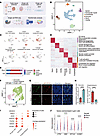
Klinefelter syndrome (KS), the most common sex chromosome aneuploidy (affecting approximately 1 in 650 live male births), causes severe infertility. The extra X chromosome can impair the development of fetal germ cells, but its effects on somatic cells, especially Leydig cells, are still not well known. We performed single-cell RNA-sequencing analysis of fetal KS and control testicular cells and found 2 clusters of KS Sertoli cells, with the XIST-negative cluster showing distinct gene expression pattern and abnormally increased G2/M ratio. Fetal KS Leydig cells showed increased proliferation and immature differentiation with high level of MAPK signaling pathway and X-linked EIF1AX. Inhibition of MAPK signaling partially rescued overproliferation and defective differentiation and androgen secretion in KS Leydig cells, while overexpression of EIF1AX recapitulated the phenotypes of increased proliferation and decline in testosterone synthesis capacity in the Leydig cell line. These findings reveal the early pathological mechanisms of KS somatic cells and lay the groundwork for developing early intervention strategies.

Authors

Tong Yan, Guancheng Chen, Jie Zhang, Wenjing Jia, Nan Lu, Shuping Jin, Haotian Zhang, Yichen Zhao, Lu Jiang, Jing Wu, Qing Liu, Chenghao Situ, Hui Zhu, Yan Li, Quan Wang, Xiaoyu Yang, Chao Qin, Xiaofeng Song, Qing Cheng, Xuejiang Guo

×

Guidelines

The Editorial Board will only consider comments that are deemed relevant and of interest to readers. The Journal will not post data that have not been subjected to peer review; or a comment that is essentially a reiteration of another comment.

  • Comments appear on the Journal’s website and are linked from the original article’s web page.
  • Authors are notified by email if their comments are posted.
  • The Journal reserves the right to edit comments for length and clarity.
  • No appeals will be considered.
  • Comments are not indexed in PubMed.

Specific requirements

  • Maximum length, 400 words
  • Entered as plain text or HTML
  • Author’s name and email address, to be posted with the comment
  • Declaration of all potential conflicts of interest (even if these are not ultimately posted); see the Journal’s conflict-of-interest policy
  • Comments may not include figures
This field is required

Copyright © 2026 American Society for Clinical Investigation
ISSN: 0021-9738 (print), 1558-8238 (online)

Sign up for email alerts