
Advertisement
Commentary
Open Access |  10.1172/JCI203222
Tumor-intrinsic chromatin programs enforce immune evasion in glioblastoma
Raymond Sun,1,2 Chao Gao,1,2 and Rongze Olivia Lu1,2,3
1Department of Neurological Surgery and
2Helen Diller Comprehensive Cancer Center, UCSF, San Francisco, California, USA.
3Parker Institute for Cancer Immunotherapy, San Francisco, California, USA.
Address correspondence to: Rongze Olivia Lu, Helen Diller Comprehensive Cancer Center, University of California, San Francisco, 1450 3rd St., Helen Diller Cancer Building, San Francisco, California 94158, USA. Email: rongze.lu@ucsf.edu.
Authorship note: RS and CG contributed equally to this work.
Find articles by Sun, R. in: PubMed | Google Scholar
1Department of Neurological Surgery and
2Helen Diller Comprehensive Cancer Center, UCSF, San Francisco, California, USA.
3Parker Institute for Cancer Immunotherapy, San Francisco, California, USA.
Address correspondence to: Rongze Olivia Lu, Helen Diller Comprehensive Cancer Center, University of California, San Francisco, 1450 3rd St., Helen Diller Cancer Building, San Francisco, California 94158, USA. Email: rongze.lu@ucsf.edu.
Authorship note: RS and CG contributed equally to this work.
Find articles by Gao, C. in: PubMed | Google Scholar
1Department of Neurological Surgery and
2Helen Diller Comprehensive Cancer Center, UCSF, San Francisco, California, USA.
3Parker Institute for Cancer Immunotherapy, San Francisco, California, USA.
Address correspondence to: Rongze Olivia Lu, Helen Diller Comprehensive Cancer Center, University of California, San Francisco, 1450 3rd St., Helen Diller Cancer Building, San Francisco, California 94158, USA. Email: rongze.lu@ucsf.edu.
Authorship note: RS and CG contributed equally to this work.
Find articles by Lu, R. in: PubMed | Google Scholar
Published March 2, 2026 - More info
J Clin Invest. 2026;136(5):e203222. https://doi.org/10.1172/JCI203222.
© 2026 Sun et al. This work is licensed under the Creative Commons Attribution 4.0 International License. To view a copy of this license, visit http://creativecommons.org/licenses/by/4.0/.

Related article:
Abstract
Glioblastomas (GBMs) are highly lethal brain tumors with limited treatment options and resistance to immune checkpoint inhibitors due to their immunosuppressive tumor microenvironment. Here, we identify OLIG2 as a key regulator of immune evasion in GBM stem-like cells, which inhibits CD8+ T cell–dependent antitumor immunity while promoting protumor macrophage polarization. Mechanistically, OLIG2 recruited HDAC7 to repress CXCL10 transcription, inducing STAT3 activation in tumor-associated macrophages (TAMs) and decreasing CD8+ T cell infiltration and activation. Genetic deletion of OLIG2 significantly increased CXCL10 secretion, shifting TAMs toward an antitumor phenotype and enhancing CD8+ T cell activities. Furthermore, upregulated OLIG2 expression was correlated with resistance to immune checkpoint inhibitors in patients with GBMs. OLIG2 inhibition by either genetic deficiency or pharmacological targeting with CT-179 sensitized GBM tumors to anti–PD-L1 therapy, enhancing antitumor immune responses and prolonging survival. Our findings reveal OLIG2+ glioma stem-like cells as critical mediators of immune evasion and identify the OLIG2/HDAC7/CXCL10 axis as a potential therapeutic target to enhance immune checkpoint inhibitor efficacy and improve immunotherapy outcomes in aggressive GBMs.
Authors
Xinchun Zhang, Jinjiang Xue, Cunyan Zhao, Chenqiuyue Zeng, Jiacheng Zhong, Gangfeng Yu, Xi Yang, Yao Ling, Dazhen Li, Jiaxiao Yang, Yun Xiu, Hongda Li, Shiyuan Hong, Liangjun Qiao, Song Chen, Q. Richard Lu, Yaqi Deng, Zhaohua Tang, Fanghui Lu
-
OLIG2 suppresses immune recruitment by repressing CXCL10 transcription
In this issue of the JCI, Zhang and colleagues identified the oligodendrocyte lineage transcription factor OLIG2 as a central regulator of immune evasion in GBM (4). OLIG2 is widely expressed in glioma stem-like cells (GSCs) and has been extensively studied for its role in tumor proliferation, lineage maintenance, and phenotypic plasticity (5–7). The work by Zhang et al. substantially extends this paradigm by demonstrating that OLIG2 also actively suppresses antitumor immunity. In investigations incorporating genomic data and immune scores from patients, human GBM cells, and mouse models, Zhang et al. uncovered that, mechanistically, OLIG2 recruited HDAC7 to repress transcription of the chemokine CXCL10, thereby limiting CD8+ T cell infiltration and activation while promoting immunosuppressive tumor-associated macrophage polarization. Genetic or pharmacologic inhibition of OLIG2 restored CXCL10 expression, reprogrammed the tumor microenvironment toward an immunostimulatory state, and significantly prolonged survival in multiple GBM models (Figure 1).
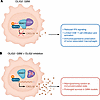 Figure 1
OLIG2 promotes immune suppression in GBM. (A) OLIG2 is an oligodendrocyte transcription factor with known roles in tumor proliferation and phenotypic plasticity. Zhang et al. (4) have extended OLIG2’s contribution to GBM by demonstrating its role in limiting antitumor immunity. They reported that OLIG2 recruits HDAC7 to remove H3K27ac enhancers from CXCL10. The resulting decrease in CXCL10 signaling led to reductions in IFN signaling and CD8+ T cell infiltration as well as immunosuppressive polarization of tumor-associated macrophages, contributing to the “cold” immune phenotype that characterizes GBM. (B) In mouse models of GBM, the brain-penetrant OLIG2 inhibitor CT-179 enhanced CD8+ T cell activity and sensitized GBM tumors to PD-1/PD-L1 blockade in vivo, prolonging survival. OLIG2 targeting thus represents a potential strategy for reprogramming GBM to overcome immune resistance.
OLIG2 is a basic helix–loop–helix transcription factor that regulates oligodendrocyte lineage commitment and maturation during neural development and is broadly expressed in gliomas, where it marks stem-like tumor cell states (5, 8–11). In this article, the findings reposition OLIG2 from a purely tumor-intrinsic driver of growth to a transcriptional gatekeeper that couples glioma lineage identity to immune invisibility (4). Previous models of immune evasion in GBM have largely focused on mesenchymal cell states, inflammatory stress responses, or paracrine signaling from tumor-associated myeloid cells (3, 12). By contrast, this work demonstrates that the OLIG2+ stem-like state can actively enforce immune exclusion through direct chromatin-level repression of chemokine signaling. Consistent with this model, Zhang et al. demonstrated that OLIG2hi human GBM samples exhibited reduced interferon signaling and diminished T cell activation, while spatial transcriptomic analyses revealed preferential localization of T cells in OLIG2lo tumor regions (4).
Genetic context further sharpens the model for OLIG2-enforced immune exclusion. OLIG2 is also expressed in isocitrate dehydrogenase–mutant (IDH-mutant) lower-grade glioma, and OLIG2 overexpression is a good surrogate marker for IDH mutation (13, 14). Given the global CpG island hypermethylation characteristic of IDH-mutant gliomas (15), it will be important to determine whether OLIG2 cooperates with IDH-driven epigenetic programs to reinforce silencing of immune regulatory pathways. Such cooperation could further constrain chemokine expression and immune infiltration, helping to explain the immune-excluded phenotype observed even in lower-grade IDH-mutant tumors.


Copyright © 2026 American Society for Clinical Investigation
ISSN: 0021-9738 (print), 1558-8238 (online)