
Abstract
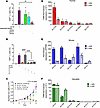
Interrupting glucagon signaling decreases gluconeogenesis and the fractional extraction of amino acids by liver from blood, resulting in lower glycemia. The resulting hyperaminoacidemia stimulates α cell proliferation and glucagon secretion via a liver/α cell axis. We hypothesized that α cells detect and respond to circulating amino acids’ levels via a unique amino acid transporter repertoire. We found that Slc7a2/SLC7A2 is the most highly expressed cationic amino acid transporter in α cells, with its expression being 3-fold greater in α than β cells in both mouse and human. Employing cell culture, zebrafish, and knockout mouse models, we found that the cationic amino acid arginine and SLC7A2 are required for α cell proliferation in response to interrupted glucagon signaling. Ex vivo and in vivo assessment of islet function in Slc7a2–/– mice showed decreased arginine-stimulated glucagon and insulin secretion. We found that arginine activation of mTOR signaling and induction of the glutamine transporter SLC38A5 was dependent on SLC7A2, showing that the role of both in α cell proliferation is dependent on arginine transport and SLC7A2. Finally, we identified single nucleotide polymorphisms in SLC7A2 associated with HbA1c. Together, these data indicate a central role for SLC7A2 in amino acid–stimulated α cell proliferation and islet hormone secretion.
Authors
Erick Spears, Jade E. Stanley, Matthew Shou, Linlin Yin, Xuan Li, Chunhua Dai, Amber Bradley, Katelyn Sellick, Greg Poffenberger, Katie C. Coate, Shristi Shrestha, Anna Marie R. Schornack, Taverlyn Shepard, Madushika Wimalarathne, Regina Jenkins, Kyle W. Sloop, Keith T. Wilson, Alan D. Attie, Mark P. Keller, Wenbiao Chen, Alvin C. Powers, E. Danielle Dean
This file is in Adobe Acrobat (PDF) format. If you have not installed and configured the Adobe Acrobat Reader on your system.
Having trouble reading a PDF?
PDFs are designed to be printed out and read, but if you prefer to read them online, you may find it easier if you increase the view size to 125%.
Having trouble saving a PDF?
Many versions of the free Acrobat Reader do not allow Save. You must instead save the PDF from the JCI Online page you downloaded it from. PC users: Right-click on the Download link and choose the option that says something like "Save Link As...". Mac users should hold the mouse button down on the link to get these same options.
Having trouble printing a PDF?
- Try printing one page at a time or to a newer printer.
- Try saving the file to disk before printing rather than opening it "on the fly." This requires that you configure your browser to "Save" rather than "Launch Application" for the file type "application/pdf", and can usually be done in the "Helper Applications" options.
- Make sure you are using the latest version of Adobe's Acrobat Reader.
Supplemental data - Download (1.64 MB)


Copyright © 2026 American Society for Clinical Investigation
ISSN: 0021-9738 (print), 1558-8238 (online)