Go to JCI Insight
  • About
  • Editors
  • Consulting Editors
  • For authors
  • Publication ethics
  • Publication alerts by email
  • Advertising
  • Job board
  • Contact
  • Clinical Research and Public Health
  • Current issue
  • Past issues
  • By specialty
    • COVID-19
    • Cardiology
    • Gastroenterology
    • Immunology
    • Metabolism
    • Nephrology
    • Neuroscience
    • Oncology
    • Pulmonology
    • Vascular biology
    • All ...
  • Videos
    • ASCI Milestone Awards
    • Video Abstracts
    • Conversations with Giants in Medicine
  • Reviews
    • View all reviews ...
    • Neurodegeneration (Mar 2026)
    • Clinical innovation and scientific progress in GLP-1 medicine (Nov 2025)
    • Pancreatic Cancer (Jul 2025)
    • Complement Biology and Therapeutics (May 2025)
    • Evolving insights into MASLD and MASH pathogenesis and treatment (Apr 2025)
    • Microbiome in Health and Disease (Feb 2025)
    • Substance Use Disorders (Oct 2024)
    • View all review series ...
  • Viewpoint
  • Collections
    • In-Press Preview
    • Clinical Research and Public Health
    • Research Letters
    • Letters to the Editor
    • Editorials
    • Commentaries
    • Editor's notes
    • Reviews
    • Viewpoints
    • 100th anniversary
    • Top read articles

  • Current issue
  • Past issues
  • Specialties
  • Reviews
  • Review series
  • ASCI Milestone Awards
  • Video Abstracts
  • Conversations with Giants in Medicine
  • In-Press Preview
  • Clinical Research and Public Health
  • Research Letters
  • Letters to the Editor
  • Editorials
  • Commentaries
  • Editor's notes
  • Reviews
  • Viewpoints
  • 100th anniversary
  • Top read articles
  • About
  • Editors
  • Consulting Editors
  • For authors
  • Publication ethics
  • Publication alerts by email
  • Advertising
  • Job board
  • Contact

Distal wound healing is regulated by peritoneal macrophages via endocrine release

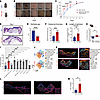
In this episode, Guido Beldi and Lilian Salm explain how their findings suggest that large peritoneal macrophages (LPMs), strategically positioned in the peritoneal cavity, serve as a source of circulating fibronectin, promoting matrix formation and accelerating wound healing at distant sites.

Published May 1, 2026, by JCI Staff

Video Abstracts

Related articles

Peritoneal macrophages regulate distal wound healing via endocrine release of plasma fibronectin
Lilian Salm, Simone N. Zwicky, Daniel Spari, Tural Yarahmadov, Marie Siwicki, Fernanda Vargas e Silva Castanheira, Jonas Zbinden, Deborah Stroka, Joel Zindel, Antoine Dufour, Paul Kubes, Guido Beldi
View: Text | PDF
Research Article Cell biology Immunology

Peritoneal macrophages regulate distal wound healing via endocrine release of plasma fibronectin

  • Text
  • PDF
Abstract

The peritoneal cavity contains a large population of GATA6-expressing large peritoneal macrophages (LPMs), known to support healing of intraabdominal organs. In this study, we aimed to explore their full sphere of influence by examining their ability to perform wound healing at distant sites outside the cavity. In a mouse model combining a remote skin injury with peritoneal stimulation we observed a significant acceleration of skin wound healing in response to LPM activation. Tracking GATA6-expressing LPMs, we demonstrated that LPMs do not migrate to distant wound sites following peritoneal activation. Using parabiosis experiments and administration of activated peritoneal contents indicated an important role of molecules secreted by LPMs in remote skin wound healing. More specifically, proteomic and transcriptomic analyses identified fibronectin as a key factor produced by activated LPMs. In fact, depletion of LPMs or genetic knockout of fibronectin in myeloid cells eliminated the enhanced healing effect. These findings highlight the endocrine function of LPMs in systemic tissue repair, challenging the traditional perspective of plasma fibronectin being exclusively liver derived. Our results suggest that LPMs, strategically positioned in the peritoneal cavity, serve as a source of circulating fibronectin, promoting matrix formation and accelerating wound healing at distant sites.

Authors

Lilian Salm, Simone N. Zwicky, Daniel Spari, Tural Yarahmadov, Marie Siwicki, Fernanda Vargas e Silva Castanheira, Jonas Zbinden, Deborah Stroka, Joel Zindel, Antoine Dufour, Paul Kubes, Guido Beldi

×
Advertisement

Copyright © 2026 American Society for Clinical Investigation
ISSN: 0021-9738 (print), 1558-8238 (online)

Sign up for email alerts