
Advertisement
Commentary
Open Access |  10.1172/JCI211265
Resolving the links between efferocytosis and DNMT3A mutation–driven clonal hematopoiesis in atherosclerosis
Aarti Asnani
Beth Israel Deaconess Medical Center and Harvard Medical School, Boston, Massachusetts, USA.
Address correspondence to: Aarti Asnani, Beth Israel Deaconess Medical Center, 3 Blackfan Circle, Center for Life Science, Room 911, Boston, Massachusetts, 02115, USA. Phone: 617.667.8800; Email: aasnani10@gmail.com.
Find articles by Asnani, A. in: PubMed | Google Scholar
Published October 15, 2026 - More info
J Clin Invest. 2026;136(20):e211265. https://doi.org/10.1172/JCI211265.
© 2026 Asnani This work is licensed under the Creative Commons Attribution 4.0 International License. To view a copy of this license, visit http://creativecommons.org/licenses/by/4.0/.

Related article:
Abstract
Efferocytosis, the clearance of apoptotic cells by macrophages, promotes tissue resolution. Efficient resolution requires efferocytosis-induced macrophage proliferation (EIMP) to expand pro-resolving macrophages. Here, we show that efferocytosis activates base excision repair (BER) to remove 8-OHdG from DNA, enabling EIMP. Mechanistically, efferocytosis promotes poly(ADP-ribose) polymerase 1 (PARP1) chromatin binding and PARylation to facilitate DNA repair complex assembly and increases nuclear MutT homolog 1 (MTH1) (gene NUDT1), which hydrolyzes 8-OHdG. Both processes require DNA-methyltransferase-3A (DNMT3A), which is activated during efferocytosis. Using a model in which dexamethasone-induced thymocyte apoptosis triggers efferocytosis-mediated thymic repair, we showed that DNMT3A was required for increases in nuclear PARP1/MTH1, oxidized DNA suppression, EIMP in thymic macrophages, and thymic repair. We next studied a human-relevant model of atherosclerosis regression, whereby efferocytosis drove protective lesional fibrous cap thickening. We compared WT mice with a model of DNMT3A clonal hematopoiesis (CH), in which loss-of-function DNMT3A mutations promoted atherosclerotic disease. Atherosclerosis regression in WT mice led to decreased nuclear 8-OHdG and increased nuclear PARP1/MTH1 and EIMP in lesional macrophages and fibrous cap thickening, all of which were impaired in DNMT3A-CH regression. These findings reveal that efferocytosis initiates a BER pathway to allow macrophage proliferation for tissue resolution, with possible therapeutic relevance to atherosclerosis regression and DNMT3A-CH.
Authors
Kleopatra Avrampou, Santosh R. Sukka, David Ngai, Patrick B. Ampomah, Xiaobo Wang, George Kuriakose, Jacob Glass, Bernhard Dorweiler, Hanna Winter, Lars Maegdefessel, Hanrui Zhang, Aaron D. Viny, Ira Tabas
-
Efferocytosis activates DNTM3A-mediated base excision repair in atherosclerosis
In this issue of the JCI, Avrampou and colleagues build upon these prior observations to establish a role for DNMT3A-mediated DNA methylation in efferocytosis in atherosclerotic plaques (11). In mouse and human macrophages, they unexpectedly observed that efferocytosis activated base excision repair to remove 8-hydroxy-2’-deoxyguanosine (8-OHdG) from DNA in a DNMT3A-dependent manner, thereby promoting efferocytosis-induced macrophage proliferation. Efferocytosis also enhanced chromatin binding of poly(ADP-ribose) polymerase 1 (PARP1) to facilitate formation of the base excision repair complex and increased nuclear MutT homolog 1 (MTH1) to hydrolyze excise 8-OHdG. Both of these processes required DNMT3A. Using dexamethasone-induced thymocyte apoptosis to model efferocytosis-induced tissue resolution, they demonstrated that the DNMT3A-dependent efferocytosis pathway was integral to thymic repair.
Finally, the authors set out to determine how this DNMT3A-dependent mechanism affects atherosclerosis progression. They developed an Ldlr–/– mouse model of DNMT3A-CH to highlight the relevance of this pathway in atherosclerotic regression–induced cap thickening, an endpoint of LDL-lowering treatments that reflects plaque stabilization. Use of an LDL-lowering regimen led to marked thickening of the fibrous cap and elevated expression of pro-resolving plaque macrophage markers in atherosclerotic WT mice, whereas atherosclerotic DNMT3A-CH mice demonstrated markedly less cap thickening and low-to-no increase in marker expression (Figure 1). Taken together, these findings implicate DNA repair as a mechanism linking apoptotic cell–derived methionine to DNMT3A-mediated DNA methylation and pro-resolving macrophage proliferation in the context of atherosclerosis.
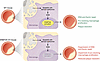 Figure 1
DNMT3A activation is linked to DNA repair, efferocytosis, and plaque resolution in a mouse model of atherosclerosis. Avrampou et al. (11) observed that efferocytosis stimulated proliferation of pro-resolving macrophages through a base excision repair pathway that requires DNMT3A activation. Noting that DNMT3A mutation–driven clonal hematopoiesis (DNMT3A-CH) is associated with coronary heart disease and atherosclerosis (7, 8), the authors found that LDL-lowering regimens failed to induce atherosclerotic plaque stabilization in DNMT3A-CH mice. These findings solidify the connection between DNMTA3 function, efferocytosis, and resolution within plaques. SAM, S-adenosylmethionine.


Copyright © 2026 American Society for Clinical Investigation
ISSN: 0021-9738 (print), 1558-8238 (online)