
Go to JCI Insight
  • About
  • Editors
  • Consulting Editors
  • For authors
  • Publication ethics
  • Publication alerts by email
  • Advertising
  • Job board
  • Contact
  • Clinical Research and Public Health
  • Current issue
  • Past issues
  • By specialty
    • COVID-19
    • Cardiology
    • Gastroenterology
    • Immunology
    • Metabolism
    • Nephrology
    • Neuroscience
    • Oncology
    • Pulmonology
    • Vascular biology
    • All ...
  • Videos
    • ASCI Milestone Awards
    • Video Abstracts
    • Conversations with Giants in Medicine
  • Reviews
    • View all reviews ...
    • The cGAS-STING pathway: DNA sensing in health and disease (Jun 2026)
    • Neurodegeneration (Mar 2026)
    • Clinical innovation and scientific progress in GLP-1 medicine (Nov 2025)
    • Pancreatic Cancer (Jul 2025)
    • Complement Biology and Therapeutics (May 2025)
    • Evolving insights into MASLD and MASH pathogenesis and treatment (Apr 2025)
    • Microbiome in Health and Disease (Feb 2025)
    • View all review series ...
  • Viewpoint
  • Collections
    • In-Press Preview
    • Clinical Research and Public Health
    • Research Letters
    • Letters to the Editor
    • Editorials
    • Commentaries
    • Editor's notes
    • Reviews
    • Viewpoints
    • 100th anniversary
    • Top read articles

  • Current issue
  • Past issues
  • Specialties
  • Reviews
  • Review series
  • ASCI Milestone Awards
  • Video Abstracts
  • Conversations with Giants in Medicine
  • In-Press Preview
  • Clinical Research and Public Health
  • Research Letters
  • Letters to the Editor
  • Editorials
  • Commentaries
  • Editor's notes
  • Reviews
  • Viewpoints
  • 100th anniversary
  • Top read articles
  • About
  • Editors
  • Consulting Editors
  • For authors
  • Publication ethics
  • Publication alerts by email
  • Advertising
  • Job board
  • Contact
Chronotherapy to reinforce circadian rhythms improves poststroke outcomes and glymphatic function in mice
Emma Waight, Yuxi Zhu, Ashley Caudell, Velia S. Vizcarra, Evan Newbold, Michael J. Giannetto, Evalien Duyvestyn, Estephanie Balbuena, Wei Song, Tanzil M. Arefin, Yuki Mori, Maiken Nedergaard, Lauren M. Hablitz
View: Text | PDF
Research Article Cell biology Neuroscience

Chronotherapy to reinforce circadian rhythms improves poststroke outcomes and glymphatic function in mice

  • Text
  • PDF
Abstract

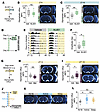
Stroke remains a leading cause of morbidity and mortality worldwide, with few effective interventions to promote recovery. Targeting circadian timing and glymphatic function may represent viable therapeutic strategies. Here, we show that the small-molecule clock modulator, KL001; high-dose melatonin; acute light pulses; and active-phase time-restricted feeding were each sufficient to enhance glymphatic function in mice. Moreover, initiating treatment with either KL001 or active-phase time-restricted feeding 3 days after preclinical models of stroke improved motor outcomes, reduced lesion volume, increased glymphatic flow, and lowered poststroke brain cytokine burden. These findings suggest that reinforcing normal daily rhythmicity after stroke can markedly enhance neurological recovery, even when interventions are initiated several days after stroke onset.

Authors

Emma Waight, Yuxi Zhu, Ashley Caudell, Velia S. Vizcarra, Evan Newbold, Michael J. Giannetto, Evalien Duyvestyn, Estephanie Balbuena, Wei Song, Tanzil M. Arefin, Yuki Mori, Maiken Nedergaard, Lauren M. Hablitz

×

Supporting data values - Download (310.58 KB)

No preview available for this file type: xlsx
Use the download link to access the file.
Advertisement

Copyright © 2026 American Society for Clinical Investigation
ISSN: 0021-9738 (print), 1558-8238 (online)

Sign up for email alerts