
Advertisement
Research ArticleCell biologyMicrobiologyVirology
Open Access |  10.1172/JCI200225
Targeting the host factor HGS–viral membrane protein interaction in coronavirus infection
Xubing Long,1,2 Rongrong Chen,3,4 Rong Bai,2,4,5 Buyun Tian,1,2 Yu Cao,2 Kangying Chen,2 Fuyu Li,2 Yiliang Wang,2 Yongjie Tang,2 Qi Yang,2 Liping Ma,2 Fan Wang,6 Maoge Zhou,2 Xianjie Qiu,1,2 Yongzhi Lu,1,2 Jie Zheng,7 Peng Zhou,2 Xinwen Chen,2 Qian Liu,2 Xuepeng Wei,2 Yongxia Shi,6 Yanhong Xue,3 Jincun Zhao,2 Wei Ji,3 Liqiao Hu,2 Jinsai Shang,1,2 Tao Xu,2,3,4 and Zonghong Li1,2
1The First Affiliated Hospital of Guangzhou Medical University, Guangzhou Medical University, Guangzhou, Guangdong, China.
2Guangzhou National Laboratory, Guangzhou, China.
3Key Laboratory of Biomacromolecules (CAS), National Laboratory of Biomacromolecules, Institute of Biophysics, Chinese Academy of Sciences, Beijing, China.
4College of Life Sciences, University of Chinese Academy of Sciences, Beijing, China.
5Wuhan Institute of Virology, Chinese Academy of Sciences, Wuhan, China.
6State Key Laboratory of Respiratory Disease, Health Quarantine Institute of IQTC, Guangzhou Customs District, Guangzhou, China.
7Shanghai Institute of Virology, Shanghai Jiao Tong University School of Medicine, Shanghai, China.
Address correspondence to: Yongxia Shi, Guangzhou Customs District, 6-7/F., China’s Commodity inspection building, Guangzhou 510070 Guangdong, China. Email: 93240850@qq.com. Or to: Yanhong Xue or Wei Ji, National Laboratory of Biomacromolecules, CAS Center for Excellence in Biomacromolecules, Institute of Biophysics, Chinese Academy of Sciences, No 15 Datun Road, Chaoyang District, Beijing 100101, China. Email: xueyanhong@ibp.ac.cn (YX); jiwei@ibp.ac.cn (WJ). Or to: Jincun Zhao, Liqiao Hu, Tao Xu, Jinsai Shang, or Zonghong Li, Guangzhou National Laboratory, 96 Xingdao South Road, Guangzhou International Bio Island, Haizhu District, Guangzhou 510070 Guangdong, China. Email: zhao_jincun@gzlab.ac.cn (JZ); hu_liqiao@gzlab.ac.cn (LH); xutao@ibp.ac.cn (TX); shang_jinsai@gzlab.ac.cn (JS); li_zonghong@gzlab.ac.cn (ZL).
Authorship note: XL, RC, RB, BT, and YC contributed equally to this work.
Find articles by Long, X. in: PubMed | Google Scholar
1The First Affiliated Hospital of Guangzhou Medical University, Guangzhou Medical University, Guangzhou, Guangdong, China.
2Guangzhou National Laboratory, Guangzhou, China.
3Key Laboratory of Biomacromolecules (CAS), National Laboratory of Biomacromolecules, Institute of Biophysics, Chinese Academy of Sciences, Beijing, China.
4College of Life Sciences, University of Chinese Academy of Sciences, Beijing, China.
5Wuhan Institute of Virology, Chinese Academy of Sciences, Wuhan, China.
6State Key Laboratory of Respiratory Disease, Health Quarantine Institute of IQTC, Guangzhou Customs District, Guangzhou, China.
7Shanghai Institute of Virology, Shanghai Jiao Tong University School of Medicine, Shanghai, China.
Address correspondence to: Yongxia Shi, Guangzhou Customs District, 6-7/F., China’s Commodity inspection building, Guangzhou 510070 Guangdong, China. Email: 93240850@qq.com. Or to: Yanhong Xue or Wei Ji, National Laboratory of Biomacromolecules, CAS Center for Excellence in Biomacromolecules, Institute of Biophysics, Chinese Academy of Sciences, No 15 Datun Road, Chaoyang District, Beijing 100101, China. Email: xueyanhong@ibp.ac.cn (YX); jiwei@ibp.ac.cn (WJ). Or to: Jincun Zhao, Liqiao Hu, Tao Xu, Jinsai Shang, or Zonghong Li, Guangzhou National Laboratory, 96 Xingdao South Road, Guangzhou International Bio Island, Haizhu District, Guangzhou 510070 Guangdong, China. Email: zhao_jincun@gzlab.ac.cn (JZ); hu_liqiao@gzlab.ac.cn (LH); xutao@ibp.ac.cn (TX); shang_jinsai@gzlab.ac.cn (JS); li_zonghong@gzlab.ac.cn (ZL).
Authorship note: XL, RC, RB, BT, and YC contributed equally to this work.
Find articles by Chen, R. in: PubMed | Google Scholar
1The First Affiliated Hospital of Guangzhou Medical University, Guangzhou Medical University, Guangzhou, Guangdong, China.
2Guangzhou National Laboratory, Guangzhou, China.
3Key Laboratory of Biomacromolecules (CAS), National Laboratory of Biomacromolecules, Institute of Biophysics, Chinese Academy of Sciences, Beijing, China.
4College of Life Sciences, University of Chinese Academy of Sciences, Beijing, China.
5Wuhan Institute of Virology, Chinese Academy of Sciences, Wuhan, China.
6State Key Laboratory of Respiratory Disease, Health Quarantine Institute of IQTC, Guangzhou Customs District, Guangzhou, China.
7Shanghai Institute of Virology, Shanghai Jiao Tong University School of Medicine, Shanghai, China.
Address correspondence to: Yongxia Shi, Guangzhou Customs District, 6-7/F., China’s Commodity inspection building, Guangzhou 510070 Guangdong, China. Email: 93240850@qq.com. Or to: Yanhong Xue or Wei Ji, National Laboratory of Biomacromolecules, CAS Center for Excellence in Biomacromolecules, Institute of Biophysics, Chinese Academy of Sciences, No 15 Datun Road, Chaoyang District, Beijing 100101, China. Email: xueyanhong@ibp.ac.cn (YX); jiwei@ibp.ac.cn (WJ). Or to: Jincun Zhao, Liqiao Hu, Tao Xu, Jinsai Shang, or Zonghong Li, Guangzhou National Laboratory, 96 Xingdao South Road, Guangzhou International Bio Island, Haizhu District, Guangzhou 510070 Guangdong, China. Email: zhao_jincun@gzlab.ac.cn (JZ); hu_liqiao@gzlab.ac.cn (LH); xutao@ibp.ac.cn (TX); shang_jinsai@gzlab.ac.cn (JS); li_zonghong@gzlab.ac.cn (ZL).
Authorship note: XL, RC, RB, BT, and YC contributed equally to this work.
Find articles by Bai, R. in: PubMed | Google Scholar
1The First Affiliated Hospital of Guangzhou Medical University, Guangzhou Medical University, Guangzhou, Guangdong, China.
2Guangzhou National Laboratory, Guangzhou, China.
3Key Laboratory of Biomacromolecules (CAS), National Laboratory of Biomacromolecules, Institute of Biophysics, Chinese Academy of Sciences, Beijing, China.
4College of Life Sciences, University of Chinese Academy of Sciences, Beijing, China.
5Wuhan Institute of Virology, Chinese Academy of Sciences, Wuhan, China.
6State Key Laboratory of Respiratory Disease, Health Quarantine Institute of IQTC, Guangzhou Customs District, Guangzhou, China.
7Shanghai Institute of Virology, Shanghai Jiao Tong University School of Medicine, Shanghai, China.
Address correspondence to: Yongxia Shi, Guangzhou Customs District, 6-7/F., China’s Commodity inspection building, Guangzhou 510070 Guangdong, China. Email: 93240850@qq.com. Or to: Yanhong Xue or Wei Ji, National Laboratory of Biomacromolecules, CAS Center for Excellence in Biomacromolecules, Institute of Biophysics, Chinese Academy of Sciences, No 15 Datun Road, Chaoyang District, Beijing 100101, China. Email: xueyanhong@ibp.ac.cn (YX); jiwei@ibp.ac.cn (WJ). Or to: Jincun Zhao, Liqiao Hu, Tao Xu, Jinsai Shang, or Zonghong Li, Guangzhou National Laboratory, 96 Xingdao South Road, Guangzhou International Bio Island, Haizhu District, Guangzhou 510070 Guangdong, China. Email: zhao_jincun@gzlab.ac.cn (JZ); hu_liqiao@gzlab.ac.cn (LH); xutao@ibp.ac.cn (TX); shang_jinsai@gzlab.ac.cn (JS); li_zonghong@gzlab.ac.cn (ZL).
Authorship note: XL, RC, RB, BT, and YC contributed equally to this work.
Find articles by Tian, B. in: PubMed | Google Scholar
1The First Affiliated Hospital of Guangzhou Medical University, Guangzhou Medical University, Guangzhou, Guangdong, China.
2Guangzhou National Laboratory, Guangzhou, China.
3Key Laboratory of Biomacromolecules (CAS), National Laboratory of Biomacromolecules, Institute of Biophysics, Chinese Academy of Sciences, Beijing, China.
4College of Life Sciences, University of Chinese Academy of Sciences, Beijing, China.
5Wuhan Institute of Virology, Chinese Academy of Sciences, Wuhan, China.
6State Key Laboratory of Respiratory Disease, Health Quarantine Institute of IQTC, Guangzhou Customs District, Guangzhou, China.
7Shanghai Institute of Virology, Shanghai Jiao Tong University School of Medicine, Shanghai, China.
Address correspondence to: Yongxia Shi, Guangzhou Customs District, 6-7/F., China’s Commodity inspection building, Guangzhou 510070 Guangdong, China. Email: 93240850@qq.com. Or to: Yanhong Xue or Wei Ji, National Laboratory of Biomacromolecules, CAS Center for Excellence in Biomacromolecules, Institute of Biophysics, Chinese Academy of Sciences, No 15 Datun Road, Chaoyang District, Beijing 100101, China. Email: xueyanhong@ibp.ac.cn (YX); jiwei@ibp.ac.cn (WJ). Or to: Jincun Zhao, Liqiao Hu, Tao Xu, Jinsai Shang, or Zonghong Li, Guangzhou National Laboratory, 96 Xingdao South Road, Guangzhou International Bio Island, Haizhu District, Guangzhou 510070 Guangdong, China. Email: zhao_jincun@gzlab.ac.cn (JZ); hu_liqiao@gzlab.ac.cn (LH); xutao@ibp.ac.cn (TX); shang_jinsai@gzlab.ac.cn (JS); li_zonghong@gzlab.ac.cn (ZL).
Authorship note: XL, RC, RB, BT, and YC contributed equally to this work.
Find articles by Cao, Y. in: PubMed | Google Scholar
1The First Affiliated Hospital of Guangzhou Medical University, Guangzhou Medical University, Guangzhou, Guangdong, China.
2Guangzhou National Laboratory, Guangzhou, China.
3Key Laboratory of Biomacromolecules (CAS), National Laboratory of Biomacromolecules, Institute of Biophysics, Chinese Academy of Sciences, Beijing, China.
4College of Life Sciences, University of Chinese Academy of Sciences, Beijing, China.
5Wuhan Institute of Virology, Chinese Academy of Sciences, Wuhan, China.
6State Key Laboratory of Respiratory Disease, Health Quarantine Institute of IQTC, Guangzhou Customs District, Guangzhou, China.
7Shanghai Institute of Virology, Shanghai Jiao Tong University School of Medicine, Shanghai, China.
Address correspondence to: Yongxia Shi, Guangzhou Customs District, 6-7/F., China’s Commodity inspection building, Guangzhou 510070 Guangdong, China. Email: 93240850@qq.com. Or to: Yanhong Xue or Wei Ji, National Laboratory of Biomacromolecules, CAS Center for Excellence in Biomacromolecules, Institute of Biophysics, Chinese Academy of Sciences, No 15 Datun Road, Chaoyang District, Beijing 100101, China. Email: xueyanhong@ibp.ac.cn (YX); jiwei@ibp.ac.cn (WJ). Or to: Jincun Zhao, Liqiao Hu, Tao Xu, Jinsai Shang, or Zonghong Li, Guangzhou National Laboratory, 96 Xingdao South Road, Guangzhou International Bio Island, Haizhu District, Guangzhou 510070 Guangdong, China. Email: zhao_jincun@gzlab.ac.cn (JZ); hu_liqiao@gzlab.ac.cn (LH); xutao@ibp.ac.cn (TX); shang_jinsai@gzlab.ac.cn (JS); li_zonghong@gzlab.ac.cn (ZL).
Authorship note: XL, RC, RB, BT, and YC contributed equally to this work.
Find articles by Chen, K. in: PubMed | Google Scholar
1The First Affiliated Hospital of Guangzhou Medical University, Guangzhou Medical University, Guangzhou, Guangdong, China.
2Guangzhou National Laboratory, Guangzhou, China.
3Key Laboratory of Biomacromolecules (CAS), National Laboratory of Biomacromolecules, Institute of Biophysics, Chinese Academy of Sciences, Beijing, China.
4College of Life Sciences, University of Chinese Academy of Sciences, Beijing, China.
5Wuhan Institute of Virology, Chinese Academy of Sciences, Wuhan, China.
6State Key Laboratory of Respiratory Disease, Health Quarantine Institute of IQTC, Guangzhou Customs District, Guangzhou, China.
7Shanghai Institute of Virology, Shanghai Jiao Tong University School of Medicine, Shanghai, China.
Address correspondence to: Yongxia Shi, Guangzhou Customs District, 6-7/F., China’s Commodity inspection building, Guangzhou 510070 Guangdong, China. Email: 93240850@qq.com. Or to: Yanhong Xue or Wei Ji, National Laboratory of Biomacromolecules, CAS Center for Excellence in Biomacromolecules, Institute of Biophysics, Chinese Academy of Sciences, No 15 Datun Road, Chaoyang District, Beijing 100101, China. Email: xueyanhong@ibp.ac.cn (YX); jiwei@ibp.ac.cn (WJ). Or to: Jincun Zhao, Liqiao Hu, Tao Xu, Jinsai Shang, or Zonghong Li, Guangzhou National Laboratory, 96 Xingdao South Road, Guangzhou International Bio Island, Haizhu District, Guangzhou 510070 Guangdong, China. Email: zhao_jincun@gzlab.ac.cn (JZ); hu_liqiao@gzlab.ac.cn (LH); xutao@ibp.ac.cn (TX); shang_jinsai@gzlab.ac.cn (JS); li_zonghong@gzlab.ac.cn (ZL).
Authorship note: XL, RC, RB, BT, and YC contributed equally to this work.
Find articles by Li, F. in: PubMed | Google Scholar
1The First Affiliated Hospital of Guangzhou Medical University, Guangzhou Medical University, Guangzhou, Guangdong, China.
2Guangzhou National Laboratory, Guangzhou, China.
3Key Laboratory of Biomacromolecules (CAS), National Laboratory of Biomacromolecules, Institute of Biophysics, Chinese Academy of Sciences, Beijing, China.
4College of Life Sciences, University of Chinese Academy of Sciences, Beijing, China.
5Wuhan Institute of Virology, Chinese Academy of Sciences, Wuhan, China.
6State Key Laboratory of Respiratory Disease, Health Quarantine Institute of IQTC, Guangzhou Customs District, Guangzhou, China.
7Shanghai Institute of Virology, Shanghai Jiao Tong University School of Medicine, Shanghai, China.
Address correspondence to: Yongxia Shi, Guangzhou Customs District, 6-7/F., China’s Commodity inspection building, Guangzhou 510070 Guangdong, China. Email: 93240850@qq.com. Or to: Yanhong Xue or Wei Ji, National Laboratory of Biomacromolecules, CAS Center for Excellence in Biomacromolecules, Institute of Biophysics, Chinese Academy of Sciences, No 15 Datun Road, Chaoyang District, Beijing 100101, China. Email: xueyanhong@ibp.ac.cn (YX); jiwei@ibp.ac.cn (WJ). Or to: Jincun Zhao, Liqiao Hu, Tao Xu, Jinsai Shang, or Zonghong Li, Guangzhou National Laboratory, 96 Xingdao South Road, Guangzhou International Bio Island, Haizhu District, Guangzhou 510070 Guangdong, China. Email: zhao_jincun@gzlab.ac.cn (JZ); hu_liqiao@gzlab.ac.cn (LH); xutao@ibp.ac.cn (TX); shang_jinsai@gzlab.ac.cn (JS); li_zonghong@gzlab.ac.cn (ZL).
Authorship note: XL, RC, RB, BT, and YC contributed equally to this work.
Find articles by Wang, Y. in: PubMed | Google Scholar
1The First Affiliated Hospital of Guangzhou Medical University, Guangzhou Medical University, Guangzhou, Guangdong, China.
2Guangzhou National Laboratory, Guangzhou, China.
3Key Laboratory of Biomacromolecules (CAS), National Laboratory of Biomacromolecules, Institute of Biophysics, Chinese Academy of Sciences, Beijing, China.
4College of Life Sciences, University of Chinese Academy of Sciences, Beijing, China.
5Wuhan Institute of Virology, Chinese Academy of Sciences, Wuhan, China.
6State Key Laboratory of Respiratory Disease, Health Quarantine Institute of IQTC, Guangzhou Customs District, Guangzhou, China.
7Shanghai Institute of Virology, Shanghai Jiao Tong University School of Medicine, Shanghai, China.
Address correspondence to: Yongxia Shi, Guangzhou Customs District, 6-7/F., China’s Commodity inspection building, Guangzhou 510070 Guangdong, China. Email: 93240850@qq.com. Or to: Yanhong Xue or Wei Ji, National Laboratory of Biomacromolecules, CAS Center for Excellence in Biomacromolecules, Institute of Biophysics, Chinese Academy of Sciences, No 15 Datun Road, Chaoyang District, Beijing 100101, China. Email: xueyanhong@ibp.ac.cn (YX); jiwei@ibp.ac.cn (WJ). Or to: Jincun Zhao, Liqiao Hu, Tao Xu, Jinsai Shang, or Zonghong Li, Guangzhou National Laboratory, 96 Xingdao South Road, Guangzhou International Bio Island, Haizhu District, Guangzhou 510070 Guangdong, China. Email: zhao_jincun@gzlab.ac.cn (JZ); hu_liqiao@gzlab.ac.cn (LH); xutao@ibp.ac.cn (TX); shang_jinsai@gzlab.ac.cn (JS); li_zonghong@gzlab.ac.cn (ZL).
Authorship note: XL, RC, RB, BT, and YC contributed equally to this work.
Find articles by Tang, Y. in: PubMed | Google Scholar
1The First Affiliated Hospital of Guangzhou Medical University, Guangzhou Medical University, Guangzhou, Guangdong, China.
2Guangzhou National Laboratory, Guangzhou, China.
3Key Laboratory of Biomacromolecules (CAS), National Laboratory of Biomacromolecules, Institute of Biophysics, Chinese Academy of Sciences, Beijing, China.
4College of Life Sciences, University of Chinese Academy of Sciences, Beijing, China.
5Wuhan Institute of Virology, Chinese Academy of Sciences, Wuhan, China.
6State Key Laboratory of Respiratory Disease, Health Quarantine Institute of IQTC, Guangzhou Customs District, Guangzhou, China.
7Shanghai Institute of Virology, Shanghai Jiao Tong University School of Medicine, Shanghai, China.
Address correspondence to: Yongxia Shi, Guangzhou Customs District, 6-7/F., China’s Commodity inspection building, Guangzhou 510070 Guangdong, China. Email: 93240850@qq.com. Or to: Yanhong Xue or Wei Ji, National Laboratory of Biomacromolecules, CAS Center for Excellence in Biomacromolecules, Institute of Biophysics, Chinese Academy of Sciences, No 15 Datun Road, Chaoyang District, Beijing 100101, China. Email: xueyanhong@ibp.ac.cn (YX); jiwei@ibp.ac.cn (WJ). Or to: Jincun Zhao, Liqiao Hu, Tao Xu, Jinsai Shang, or Zonghong Li, Guangzhou National Laboratory, 96 Xingdao South Road, Guangzhou International Bio Island, Haizhu District, Guangzhou 510070 Guangdong, China. Email: zhao_jincun@gzlab.ac.cn (JZ); hu_liqiao@gzlab.ac.cn (LH); xutao@ibp.ac.cn (TX); shang_jinsai@gzlab.ac.cn (JS); li_zonghong@gzlab.ac.cn (ZL).
Authorship note: XL, RC, RB, BT, and YC contributed equally to this work.
Find articles by Yang, Q. in: PubMed | Google Scholar
1The First Affiliated Hospital of Guangzhou Medical University, Guangzhou Medical University, Guangzhou, Guangdong, China.
2Guangzhou National Laboratory, Guangzhou, China.
3Key Laboratory of Biomacromolecules (CAS), National Laboratory of Biomacromolecules, Institute of Biophysics, Chinese Academy of Sciences, Beijing, China.
4College of Life Sciences, University of Chinese Academy of Sciences, Beijing, China.
5Wuhan Institute of Virology, Chinese Academy of Sciences, Wuhan, China.
6State Key Laboratory of Respiratory Disease, Health Quarantine Institute of IQTC, Guangzhou Customs District, Guangzhou, China.
7Shanghai Institute of Virology, Shanghai Jiao Tong University School of Medicine, Shanghai, China.
Address correspondence to: Yongxia Shi, Guangzhou Customs District, 6-7/F., China’s Commodity inspection building, Guangzhou 510070 Guangdong, China. Email: 93240850@qq.com. Or to: Yanhong Xue or Wei Ji, National Laboratory of Biomacromolecules, CAS Center for Excellence in Biomacromolecules, Institute of Biophysics, Chinese Academy of Sciences, No 15 Datun Road, Chaoyang District, Beijing 100101, China. Email: xueyanhong@ibp.ac.cn (YX); jiwei@ibp.ac.cn (WJ). Or to: Jincun Zhao, Liqiao Hu, Tao Xu, Jinsai Shang, or Zonghong Li, Guangzhou National Laboratory, 96 Xingdao South Road, Guangzhou International Bio Island, Haizhu District, Guangzhou 510070 Guangdong, China. Email: zhao_jincun@gzlab.ac.cn (JZ); hu_liqiao@gzlab.ac.cn (LH); xutao@ibp.ac.cn (TX); shang_jinsai@gzlab.ac.cn (JS); li_zonghong@gzlab.ac.cn (ZL).
Authorship note: XL, RC, RB, BT, and YC contributed equally to this work.
Find articles by Ma, L. in: PubMed | Google Scholar
1The First Affiliated Hospital of Guangzhou Medical University, Guangzhou Medical University, Guangzhou, Guangdong, China.
2Guangzhou National Laboratory, Guangzhou, China.
3Key Laboratory of Biomacromolecules (CAS), National Laboratory of Biomacromolecules, Institute of Biophysics, Chinese Academy of Sciences, Beijing, China.
4College of Life Sciences, University of Chinese Academy of Sciences, Beijing, China.
5Wuhan Institute of Virology, Chinese Academy of Sciences, Wuhan, China.
6State Key Laboratory of Respiratory Disease, Health Quarantine Institute of IQTC, Guangzhou Customs District, Guangzhou, China.
7Shanghai Institute of Virology, Shanghai Jiao Tong University School of Medicine, Shanghai, China.
Address correspondence to: Yongxia Shi, Guangzhou Customs District, 6-7/F., China’s Commodity inspection building, Guangzhou 510070 Guangdong, China. Email: 93240850@qq.com. Or to: Yanhong Xue or Wei Ji, National Laboratory of Biomacromolecules, CAS Center for Excellence in Biomacromolecules, Institute of Biophysics, Chinese Academy of Sciences, No 15 Datun Road, Chaoyang District, Beijing 100101, China. Email: xueyanhong@ibp.ac.cn (YX); jiwei@ibp.ac.cn (WJ). Or to: Jincun Zhao, Liqiao Hu, Tao Xu, Jinsai Shang, or Zonghong Li, Guangzhou National Laboratory, 96 Xingdao South Road, Guangzhou International Bio Island, Haizhu District, Guangzhou 510070 Guangdong, China. Email: zhao_jincun@gzlab.ac.cn (JZ); hu_liqiao@gzlab.ac.cn (LH); xutao@ibp.ac.cn (TX); shang_jinsai@gzlab.ac.cn (JS); li_zonghong@gzlab.ac.cn (ZL).
Authorship note: XL, RC, RB, BT, and YC contributed equally to this work.
Find articles by Wang, F. in: PubMed | Google Scholar
1The First Affiliated Hospital of Guangzhou Medical University, Guangzhou Medical University, Guangzhou, Guangdong, China.
2Guangzhou National Laboratory, Guangzhou, China.
3Key Laboratory of Biomacromolecules (CAS), National Laboratory of Biomacromolecules, Institute of Biophysics, Chinese Academy of Sciences, Beijing, China.
4College of Life Sciences, University of Chinese Academy of Sciences, Beijing, China.
5Wuhan Institute of Virology, Chinese Academy of Sciences, Wuhan, China.
6State Key Laboratory of Respiratory Disease, Health Quarantine Institute of IQTC, Guangzhou Customs District, Guangzhou, China.
7Shanghai Institute of Virology, Shanghai Jiao Tong University School of Medicine, Shanghai, China.
Address correspondence to: Yongxia Shi, Guangzhou Customs District, 6-7/F., China’s Commodity inspection building, Guangzhou 510070 Guangdong, China. Email: 93240850@qq.com. Or to: Yanhong Xue or Wei Ji, National Laboratory of Biomacromolecules, CAS Center for Excellence in Biomacromolecules, Institute of Biophysics, Chinese Academy of Sciences, No 15 Datun Road, Chaoyang District, Beijing 100101, China. Email: xueyanhong@ibp.ac.cn (YX); jiwei@ibp.ac.cn (WJ). Or to: Jincun Zhao, Liqiao Hu, Tao Xu, Jinsai Shang, or Zonghong Li, Guangzhou National Laboratory, 96 Xingdao South Road, Guangzhou International Bio Island, Haizhu District, Guangzhou 510070 Guangdong, China. Email: zhao_jincun@gzlab.ac.cn (JZ); hu_liqiao@gzlab.ac.cn (LH); xutao@ibp.ac.cn (TX); shang_jinsai@gzlab.ac.cn (JS); li_zonghong@gzlab.ac.cn (ZL).
Authorship note: XL, RC, RB, BT, and YC contributed equally to this work.
Find articles by Zhou, M. in: PubMed | Google Scholar
1The First Affiliated Hospital of Guangzhou Medical University, Guangzhou Medical University, Guangzhou, Guangdong, China.
2Guangzhou National Laboratory, Guangzhou, China.
3Key Laboratory of Biomacromolecules (CAS), National Laboratory of Biomacromolecules, Institute of Biophysics, Chinese Academy of Sciences, Beijing, China.
4College of Life Sciences, University of Chinese Academy of Sciences, Beijing, China.
5Wuhan Institute of Virology, Chinese Academy of Sciences, Wuhan, China.
6State Key Laboratory of Respiratory Disease, Health Quarantine Institute of IQTC, Guangzhou Customs District, Guangzhou, China.
7Shanghai Institute of Virology, Shanghai Jiao Tong University School of Medicine, Shanghai, China.
Address correspondence to: Yongxia Shi, Guangzhou Customs District, 6-7/F., China’s Commodity inspection building, Guangzhou 510070 Guangdong, China. Email: 93240850@qq.com. Or to: Yanhong Xue or Wei Ji, National Laboratory of Biomacromolecules, CAS Center for Excellence in Biomacromolecules, Institute of Biophysics, Chinese Academy of Sciences, No 15 Datun Road, Chaoyang District, Beijing 100101, China. Email: xueyanhong@ibp.ac.cn (YX); jiwei@ibp.ac.cn (WJ). Or to: Jincun Zhao, Liqiao Hu, Tao Xu, Jinsai Shang, or Zonghong Li, Guangzhou National Laboratory, 96 Xingdao South Road, Guangzhou International Bio Island, Haizhu District, Guangzhou 510070 Guangdong, China. Email: zhao_jincun@gzlab.ac.cn (JZ); hu_liqiao@gzlab.ac.cn (LH); xutao@ibp.ac.cn (TX); shang_jinsai@gzlab.ac.cn (JS); li_zonghong@gzlab.ac.cn (ZL).
Authorship note: XL, RC, RB, BT, and YC contributed equally to this work.
Find articles by Qiu, X. in: PubMed | Google Scholar
1The First Affiliated Hospital of Guangzhou Medical University, Guangzhou Medical University, Guangzhou, Guangdong, China.
2Guangzhou National Laboratory, Guangzhou, China.
3Key Laboratory of Biomacromolecules (CAS), National Laboratory of Biomacromolecules, Institute of Biophysics, Chinese Academy of Sciences, Beijing, China.
4College of Life Sciences, University of Chinese Academy of Sciences, Beijing, China.
5Wuhan Institute of Virology, Chinese Academy of Sciences, Wuhan, China.
6State Key Laboratory of Respiratory Disease, Health Quarantine Institute of IQTC, Guangzhou Customs District, Guangzhou, China.
7Shanghai Institute of Virology, Shanghai Jiao Tong University School of Medicine, Shanghai, China.
Address correspondence to: Yongxia Shi, Guangzhou Customs District, 6-7/F., China’s Commodity inspection building, Guangzhou 510070 Guangdong, China. Email: 93240850@qq.com. Or to: Yanhong Xue or Wei Ji, National Laboratory of Biomacromolecules, CAS Center for Excellence in Biomacromolecules, Institute of Biophysics, Chinese Academy of Sciences, No 15 Datun Road, Chaoyang District, Beijing 100101, China. Email: xueyanhong@ibp.ac.cn (YX); jiwei@ibp.ac.cn (WJ). Or to: Jincun Zhao, Liqiao Hu, Tao Xu, Jinsai Shang, or Zonghong Li, Guangzhou National Laboratory, 96 Xingdao South Road, Guangzhou International Bio Island, Haizhu District, Guangzhou 510070 Guangdong, China. Email: zhao_jincun@gzlab.ac.cn (JZ); hu_liqiao@gzlab.ac.cn (LH); xutao@ibp.ac.cn (TX); shang_jinsai@gzlab.ac.cn (JS); li_zonghong@gzlab.ac.cn (ZL).
Authorship note: XL, RC, RB, BT, and YC contributed equally to this work.
Find articles by Lu, Y. in: PubMed | Google Scholar
1The First Affiliated Hospital of Guangzhou Medical University, Guangzhou Medical University, Guangzhou, Guangdong, China.
2Guangzhou National Laboratory, Guangzhou, China.
3Key Laboratory of Biomacromolecules (CAS), National Laboratory of Biomacromolecules, Institute of Biophysics, Chinese Academy of Sciences, Beijing, China.
4College of Life Sciences, University of Chinese Academy of Sciences, Beijing, China.
5Wuhan Institute of Virology, Chinese Academy of Sciences, Wuhan, China.
6State Key Laboratory of Respiratory Disease, Health Quarantine Institute of IQTC, Guangzhou Customs District, Guangzhou, China.
7Shanghai Institute of Virology, Shanghai Jiao Tong University School of Medicine, Shanghai, China.
Address correspondence to: Yongxia Shi, Guangzhou Customs District, 6-7/F., China’s Commodity inspection building, Guangzhou 510070 Guangdong, China. Email: 93240850@qq.com. Or to: Yanhong Xue or Wei Ji, National Laboratory of Biomacromolecules, CAS Center for Excellence in Biomacromolecules, Institute of Biophysics, Chinese Academy of Sciences, No 15 Datun Road, Chaoyang District, Beijing 100101, China. Email: xueyanhong@ibp.ac.cn (YX); jiwei@ibp.ac.cn (WJ). Or to: Jincun Zhao, Liqiao Hu, Tao Xu, Jinsai Shang, or Zonghong Li, Guangzhou National Laboratory, 96 Xingdao South Road, Guangzhou International Bio Island, Haizhu District, Guangzhou 510070 Guangdong, China. Email: zhao_jincun@gzlab.ac.cn (JZ); hu_liqiao@gzlab.ac.cn (LH); xutao@ibp.ac.cn (TX); shang_jinsai@gzlab.ac.cn (JS); li_zonghong@gzlab.ac.cn (ZL).
Authorship note: XL, RC, RB, BT, and YC contributed equally to this work.
Find articles by Zheng, J. in: PubMed | Google Scholar
1The First Affiliated Hospital of Guangzhou Medical University, Guangzhou Medical University, Guangzhou, Guangdong, China.
2Guangzhou National Laboratory, Guangzhou, China.
3Key Laboratory of Biomacromolecules (CAS), National Laboratory of Biomacromolecules, Institute of Biophysics, Chinese Academy of Sciences, Beijing, China.
4College of Life Sciences, University of Chinese Academy of Sciences, Beijing, China.
5Wuhan Institute of Virology, Chinese Academy of Sciences, Wuhan, China.
6State Key Laboratory of Respiratory Disease, Health Quarantine Institute of IQTC, Guangzhou Customs District, Guangzhou, China.
7Shanghai Institute of Virology, Shanghai Jiao Tong University School of Medicine, Shanghai, China.
Address correspondence to: Yongxia Shi, Guangzhou Customs District, 6-7/F., China’s Commodity inspection building, Guangzhou 510070 Guangdong, China. Email: 93240850@qq.com. Or to: Yanhong Xue or Wei Ji, National Laboratory of Biomacromolecules, CAS Center for Excellence in Biomacromolecules, Institute of Biophysics, Chinese Academy of Sciences, No 15 Datun Road, Chaoyang District, Beijing 100101, China. Email: xueyanhong@ibp.ac.cn (YX); jiwei@ibp.ac.cn (WJ). Or to: Jincun Zhao, Liqiao Hu, Tao Xu, Jinsai Shang, or Zonghong Li, Guangzhou National Laboratory, 96 Xingdao South Road, Guangzhou International Bio Island, Haizhu District, Guangzhou 510070 Guangdong, China. Email: zhao_jincun@gzlab.ac.cn (JZ); hu_liqiao@gzlab.ac.cn (LH); xutao@ibp.ac.cn (TX); shang_jinsai@gzlab.ac.cn (JS); li_zonghong@gzlab.ac.cn (ZL).
Authorship note: XL, RC, RB, BT, and YC contributed equally to this work.
Find articles by Zhou, P. in: PubMed | Google Scholar
1The First Affiliated Hospital of Guangzhou Medical University, Guangzhou Medical University, Guangzhou, Guangdong, China.
2Guangzhou National Laboratory, Guangzhou, China.
3Key Laboratory of Biomacromolecules (CAS), National Laboratory of Biomacromolecules, Institute of Biophysics, Chinese Academy of Sciences, Beijing, China.
4College of Life Sciences, University of Chinese Academy of Sciences, Beijing, China.
5Wuhan Institute of Virology, Chinese Academy of Sciences, Wuhan, China.
6State Key Laboratory of Respiratory Disease, Health Quarantine Institute of IQTC, Guangzhou Customs District, Guangzhou, China.
7Shanghai Institute of Virology, Shanghai Jiao Tong University School of Medicine, Shanghai, China.
Address correspondence to: Yongxia Shi, Guangzhou Customs District, 6-7/F., China’s Commodity inspection building, Guangzhou 510070 Guangdong, China. Email: 93240850@qq.com. Or to: Yanhong Xue or Wei Ji, National Laboratory of Biomacromolecules, CAS Center for Excellence in Biomacromolecules, Institute of Biophysics, Chinese Academy of Sciences, No 15 Datun Road, Chaoyang District, Beijing 100101, China. Email: xueyanhong@ibp.ac.cn (YX); jiwei@ibp.ac.cn (WJ). Or to: Jincun Zhao, Liqiao Hu, Tao Xu, Jinsai Shang, or Zonghong Li, Guangzhou National Laboratory, 96 Xingdao South Road, Guangzhou International Bio Island, Haizhu District, Guangzhou 510070 Guangdong, China. Email: zhao_jincun@gzlab.ac.cn (JZ); hu_liqiao@gzlab.ac.cn (LH); xutao@ibp.ac.cn (TX); shang_jinsai@gzlab.ac.cn (JS); li_zonghong@gzlab.ac.cn (ZL).
Authorship note: XL, RC, RB, BT, and YC contributed equally to this work.
Find articles by Chen, X. in: PubMed | Google Scholar
1The First Affiliated Hospital of Guangzhou Medical University, Guangzhou Medical University, Guangzhou, Guangdong, China.
2Guangzhou National Laboratory, Guangzhou, China.
3Key Laboratory of Biomacromolecules (CAS), National Laboratory of Biomacromolecules, Institute of Biophysics, Chinese Academy of Sciences, Beijing, China.
4College of Life Sciences, University of Chinese Academy of Sciences, Beijing, China.
5Wuhan Institute of Virology, Chinese Academy of Sciences, Wuhan, China.
6State Key Laboratory of Respiratory Disease, Health Quarantine Institute of IQTC, Guangzhou Customs District, Guangzhou, China.
7Shanghai Institute of Virology, Shanghai Jiao Tong University School of Medicine, Shanghai, China.
Address correspondence to: Yongxia Shi, Guangzhou Customs District, 6-7/F., China’s Commodity inspection building, Guangzhou 510070 Guangdong, China. Email: 93240850@qq.com. Or to: Yanhong Xue or Wei Ji, National Laboratory of Biomacromolecules, CAS Center for Excellence in Biomacromolecules, Institute of Biophysics, Chinese Academy of Sciences, No 15 Datun Road, Chaoyang District, Beijing 100101, China. Email: xueyanhong@ibp.ac.cn (YX); jiwei@ibp.ac.cn (WJ). Or to: Jincun Zhao, Liqiao Hu, Tao Xu, Jinsai Shang, or Zonghong Li, Guangzhou National Laboratory, 96 Xingdao South Road, Guangzhou International Bio Island, Haizhu District, Guangzhou 510070 Guangdong, China. Email: zhao_jincun@gzlab.ac.cn (JZ); hu_liqiao@gzlab.ac.cn (LH); xutao@ibp.ac.cn (TX); shang_jinsai@gzlab.ac.cn (JS); li_zonghong@gzlab.ac.cn (ZL).
Authorship note: XL, RC, RB, BT, and YC contributed equally to this work.
Find articles by Liu, Q. in: PubMed | Google Scholar
1The First Affiliated Hospital of Guangzhou Medical University, Guangzhou Medical University, Guangzhou, Guangdong, China.
2Guangzhou National Laboratory, Guangzhou, China.
3Key Laboratory of Biomacromolecules (CAS), National Laboratory of Biomacromolecules, Institute of Biophysics, Chinese Academy of Sciences, Beijing, China.
4College of Life Sciences, University of Chinese Academy of Sciences, Beijing, China.
5Wuhan Institute of Virology, Chinese Academy of Sciences, Wuhan, China.
6State Key Laboratory of Respiratory Disease, Health Quarantine Institute of IQTC, Guangzhou Customs District, Guangzhou, China.
7Shanghai Institute of Virology, Shanghai Jiao Tong University School of Medicine, Shanghai, China.
Address correspondence to: Yongxia Shi, Guangzhou Customs District, 6-7/F., China’s Commodity inspection building, Guangzhou 510070 Guangdong, China. Email: 93240850@qq.com. Or to: Yanhong Xue or Wei Ji, National Laboratory of Biomacromolecules, CAS Center for Excellence in Biomacromolecules, Institute of Biophysics, Chinese Academy of Sciences, No 15 Datun Road, Chaoyang District, Beijing 100101, China. Email: xueyanhong@ibp.ac.cn (YX); jiwei@ibp.ac.cn (WJ). Or to: Jincun Zhao, Liqiao Hu, Tao Xu, Jinsai Shang, or Zonghong Li, Guangzhou National Laboratory, 96 Xingdao South Road, Guangzhou International Bio Island, Haizhu District, Guangzhou 510070 Guangdong, China. Email: zhao_jincun@gzlab.ac.cn (JZ); hu_liqiao@gzlab.ac.cn (LH); xutao@ibp.ac.cn (TX); shang_jinsai@gzlab.ac.cn (JS); li_zonghong@gzlab.ac.cn (ZL).
Authorship note: XL, RC, RB, BT, and YC contributed equally to this work.
Find articles by Wei, X. in: PubMed | Google Scholar
1The First Affiliated Hospital of Guangzhou Medical University, Guangzhou Medical University, Guangzhou, Guangdong, China.
2Guangzhou National Laboratory, Guangzhou, China.
3Key Laboratory of Biomacromolecules (CAS), National Laboratory of Biomacromolecules, Institute of Biophysics, Chinese Academy of Sciences, Beijing, China.
4College of Life Sciences, University of Chinese Academy of Sciences, Beijing, China.
5Wuhan Institute of Virology, Chinese Academy of Sciences, Wuhan, China.
6State Key Laboratory of Respiratory Disease, Health Quarantine Institute of IQTC, Guangzhou Customs District, Guangzhou, China.
7Shanghai Institute of Virology, Shanghai Jiao Tong University School of Medicine, Shanghai, China.
Address correspondence to: Yongxia Shi, Guangzhou Customs District, 6-7/F., China’s Commodity inspection building, Guangzhou 510070 Guangdong, China. Email: 93240850@qq.com. Or to: Yanhong Xue or Wei Ji, National Laboratory of Biomacromolecules, CAS Center for Excellence in Biomacromolecules, Institute of Biophysics, Chinese Academy of Sciences, No 15 Datun Road, Chaoyang District, Beijing 100101, China. Email: xueyanhong@ibp.ac.cn (YX); jiwei@ibp.ac.cn (WJ). Or to: Jincun Zhao, Liqiao Hu, Tao Xu, Jinsai Shang, or Zonghong Li, Guangzhou National Laboratory, 96 Xingdao South Road, Guangzhou International Bio Island, Haizhu District, Guangzhou 510070 Guangdong, China. Email: zhao_jincun@gzlab.ac.cn (JZ); hu_liqiao@gzlab.ac.cn (LH); xutao@ibp.ac.cn (TX); shang_jinsai@gzlab.ac.cn (JS); li_zonghong@gzlab.ac.cn (ZL).
Authorship note: XL, RC, RB, BT, and YC contributed equally to this work.
Find articles by Shi, Y. in: PubMed | Google Scholar
1The First Affiliated Hospital of Guangzhou Medical University, Guangzhou Medical University, Guangzhou, Guangdong, China.
2Guangzhou National Laboratory, Guangzhou, China.
3Key Laboratory of Biomacromolecules (CAS), National Laboratory of Biomacromolecules, Institute of Biophysics, Chinese Academy of Sciences, Beijing, China.
4College of Life Sciences, University of Chinese Academy of Sciences, Beijing, China.
5Wuhan Institute of Virology, Chinese Academy of Sciences, Wuhan, China.
6State Key Laboratory of Respiratory Disease, Health Quarantine Institute of IQTC, Guangzhou Customs District, Guangzhou, China.
7Shanghai Institute of Virology, Shanghai Jiao Tong University School of Medicine, Shanghai, China.
Address correspondence to: Yongxia Shi, Guangzhou Customs District, 6-7/F., China’s Commodity inspection building, Guangzhou 510070 Guangdong, China. Email: 93240850@qq.com. Or to: Yanhong Xue or Wei Ji, National Laboratory of Biomacromolecules, CAS Center for Excellence in Biomacromolecules, Institute of Biophysics, Chinese Academy of Sciences, No 15 Datun Road, Chaoyang District, Beijing 100101, China. Email: xueyanhong@ibp.ac.cn (YX); jiwei@ibp.ac.cn (WJ). Or to: Jincun Zhao, Liqiao Hu, Tao Xu, Jinsai Shang, or Zonghong Li, Guangzhou National Laboratory, 96 Xingdao South Road, Guangzhou International Bio Island, Haizhu District, Guangzhou 510070 Guangdong, China. Email: zhao_jincun@gzlab.ac.cn (JZ); hu_liqiao@gzlab.ac.cn (LH); xutao@ibp.ac.cn (TX); shang_jinsai@gzlab.ac.cn (JS); li_zonghong@gzlab.ac.cn (ZL).
Authorship note: XL, RC, RB, BT, and YC contributed equally to this work.
Find articles by Xue, Y. in: PubMed | Google Scholar
1The First Affiliated Hospital of Guangzhou Medical University, Guangzhou Medical University, Guangzhou, Guangdong, China.
2Guangzhou National Laboratory, Guangzhou, China.
3Key Laboratory of Biomacromolecules (CAS), National Laboratory of Biomacromolecules, Institute of Biophysics, Chinese Academy of Sciences, Beijing, China.
4College of Life Sciences, University of Chinese Academy of Sciences, Beijing, China.
5Wuhan Institute of Virology, Chinese Academy of Sciences, Wuhan, China.
6State Key Laboratory of Respiratory Disease, Health Quarantine Institute of IQTC, Guangzhou Customs District, Guangzhou, China.
7Shanghai Institute of Virology, Shanghai Jiao Tong University School of Medicine, Shanghai, China.
Address correspondence to: Yongxia Shi, Guangzhou Customs District, 6-7/F., China’s Commodity inspection building, Guangzhou 510070 Guangdong, China. Email: 93240850@qq.com. Or to: Yanhong Xue or Wei Ji, National Laboratory of Biomacromolecules, CAS Center for Excellence in Biomacromolecules, Institute of Biophysics, Chinese Academy of Sciences, No 15 Datun Road, Chaoyang District, Beijing 100101, China. Email: xueyanhong@ibp.ac.cn (YX); jiwei@ibp.ac.cn (WJ). Or to: Jincun Zhao, Liqiao Hu, Tao Xu, Jinsai Shang, or Zonghong Li, Guangzhou National Laboratory, 96 Xingdao South Road, Guangzhou International Bio Island, Haizhu District, Guangzhou 510070 Guangdong, China. Email: zhao_jincun@gzlab.ac.cn (JZ); hu_liqiao@gzlab.ac.cn (LH); xutao@ibp.ac.cn (TX); shang_jinsai@gzlab.ac.cn (JS); li_zonghong@gzlab.ac.cn (ZL).
Authorship note: XL, RC, RB, BT, and YC contributed equally to this work.
Find articles by Zhao, J. in: PubMed | Google Scholar
1The First Affiliated Hospital of Guangzhou Medical University, Guangzhou Medical University, Guangzhou, Guangdong, China.
2Guangzhou National Laboratory, Guangzhou, China.
3Key Laboratory of Biomacromolecules (CAS), National Laboratory of Biomacromolecules, Institute of Biophysics, Chinese Academy of Sciences, Beijing, China.
4College of Life Sciences, University of Chinese Academy of Sciences, Beijing, China.
5Wuhan Institute of Virology, Chinese Academy of Sciences, Wuhan, China.
6State Key Laboratory of Respiratory Disease, Health Quarantine Institute of IQTC, Guangzhou Customs District, Guangzhou, China.
7Shanghai Institute of Virology, Shanghai Jiao Tong University School of Medicine, Shanghai, China.
Address correspondence to: Yongxia Shi, Guangzhou Customs District, 6-7/F., China’s Commodity inspection building, Guangzhou 510070 Guangdong, China. Email: 93240850@qq.com. Or to: Yanhong Xue or Wei Ji, National Laboratory of Biomacromolecules, CAS Center for Excellence in Biomacromolecules, Institute of Biophysics, Chinese Academy of Sciences, No 15 Datun Road, Chaoyang District, Beijing 100101, China. Email: xueyanhong@ibp.ac.cn (YX); jiwei@ibp.ac.cn (WJ). Or to: Jincun Zhao, Liqiao Hu, Tao Xu, Jinsai Shang, or Zonghong Li, Guangzhou National Laboratory, 96 Xingdao South Road, Guangzhou International Bio Island, Haizhu District, Guangzhou 510070 Guangdong, China. Email: zhao_jincun@gzlab.ac.cn (JZ); hu_liqiao@gzlab.ac.cn (LH); xutao@ibp.ac.cn (TX); shang_jinsai@gzlab.ac.cn (JS); li_zonghong@gzlab.ac.cn (ZL).
Authorship note: XL, RC, RB, BT, and YC contributed equally to this work.
Find articles by Ji, W. in: PubMed | Google Scholar
1The First Affiliated Hospital of Guangzhou Medical University, Guangzhou Medical University, Guangzhou, Guangdong, China.
2Guangzhou National Laboratory, Guangzhou, China.
3Key Laboratory of Biomacromolecules (CAS), National Laboratory of Biomacromolecules, Institute of Biophysics, Chinese Academy of Sciences, Beijing, China.
4College of Life Sciences, University of Chinese Academy of Sciences, Beijing, China.
5Wuhan Institute of Virology, Chinese Academy of Sciences, Wuhan, China.
6State Key Laboratory of Respiratory Disease, Health Quarantine Institute of IQTC, Guangzhou Customs District, Guangzhou, China.
7Shanghai Institute of Virology, Shanghai Jiao Tong University School of Medicine, Shanghai, China.
Address correspondence to: Yongxia Shi, Guangzhou Customs District, 6-7/F., China’s Commodity inspection building, Guangzhou 510070 Guangdong, China. Email: 93240850@qq.com. Or to: Yanhong Xue or Wei Ji, National Laboratory of Biomacromolecules, CAS Center for Excellence in Biomacromolecules, Institute of Biophysics, Chinese Academy of Sciences, No 15 Datun Road, Chaoyang District, Beijing 100101, China. Email: xueyanhong@ibp.ac.cn (YX); jiwei@ibp.ac.cn (WJ). Or to: Jincun Zhao, Liqiao Hu, Tao Xu, Jinsai Shang, or Zonghong Li, Guangzhou National Laboratory, 96 Xingdao South Road, Guangzhou International Bio Island, Haizhu District, Guangzhou 510070 Guangdong, China. Email: zhao_jincun@gzlab.ac.cn (JZ); hu_liqiao@gzlab.ac.cn (LH); xutao@ibp.ac.cn (TX); shang_jinsai@gzlab.ac.cn (JS); li_zonghong@gzlab.ac.cn (ZL).
Authorship note: XL, RC, RB, BT, and YC contributed equally to this work.
Find articles by Hu, L. in: PubMed | Google Scholar
1The First Affiliated Hospital of Guangzhou Medical University, Guangzhou Medical University, Guangzhou, Guangdong, China.
2Guangzhou National Laboratory, Guangzhou, China.
3Key Laboratory of Biomacromolecules (CAS), National Laboratory of Biomacromolecules, Institute of Biophysics, Chinese Academy of Sciences, Beijing, China.
4College of Life Sciences, University of Chinese Academy of Sciences, Beijing, China.
5Wuhan Institute of Virology, Chinese Academy of Sciences, Wuhan, China.
6State Key Laboratory of Respiratory Disease, Health Quarantine Institute of IQTC, Guangzhou Customs District, Guangzhou, China.
7Shanghai Institute of Virology, Shanghai Jiao Tong University School of Medicine, Shanghai, China.
Address correspondence to: Yongxia Shi, Guangzhou Customs District, 6-7/F., China’s Commodity inspection building, Guangzhou 510070 Guangdong, China. Email: 93240850@qq.com. Or to: Yanhong Xue or Wei Ji, National Laboratory of Biomacromolecules, CAS Center for Excellence in Biomacromolecules, Institute of Biophysics, Chinese Academy of Sciences, No 15 Datun Road, Chaoyang District, Beijing 100101, China. Email: xueyanhong@ibp.ac.cn (YX); jiwei@ibp.ac.cn (WJ). Or to: Jincun Zhao, Liqiao Hu, Tao Xu, Jinsai Shang, or Zonghong Li, Guangzhou National Laboratory, 96 Xingdao South Road, Guangzhou International Bio Island, Haizhu District, Guangzhou 510070 Guangdong, China. Email: zhao_jincun@gzlab.ac.cn (JZ); hu_liqiao@gzlab.ac.cn (LH); xutao@ibp.ac.cn (TX); shang_jinsai@gzlab.ac.cn (JS); li_zonghong@gzlab.ac.cn (ZL).
Authorship note: XL, RC, RB, BT, and YC contributed equally to this work.
Find articles by Shang, J. in: PubMed | Google Scholar
1The First Affiliated Hospital of Guangzhou Medical University, Guangzhou Medical University, Guangzhou, Guangdong, China.
2Guangzhou National Laboratory, Guangzhou, China.
3Key Laboratory of Biomacromolecules (CAS), National Laboratory of Biomacromolecules, Institute of Biophysics, Chinese Academy of Sciences, Beijing, China.
4College of Life Sciences, University of Chinese Academy of Sciences, Beijing, China.
5Wuhan Institute of Virology, Chinese Academy of Sciences, Wuhan, China.
6State Key Laboratory of Respiratory Disease, Health Quarantine Institute of IQTC, Guangzhou Customs District, Guangzhou, China.
7Shanghai Institute of Virology, Shanghai Jiao Tong University School of Medicine, Shanghai, China.
Address correspondence to: Yongxia Shi, Guangzhou Customs District, 6-7/F., China’s Commodity inspection building, Guangzhou 510070 Guangdong, China. Email: 93240850@qq.com. Or to: Yanhong Xue or Wei Ji, National Laboratory of Biomacromolecules, CAS Center for Excellence in Biomacromolecules, Institute of Biophysics, Chinese Academy of Sciences, No 15 Datun Road, Chaoyang District, Beijing 100101, China. Email: xueyanhong@ibp.ac.cn (YX); jiwei@ibp.ac.cn (WJ). Or to: Jincun Zhao, Liqiao Hu, Tao Xu, Jinsai Shang, or Zonghong Li, Guangzhou National Laboratory, 96 Xingdao South Road, Guangzhou International Bio Island, Haizhu District, Guangzhou 510070 Guangdong, China. Email: zhao_jincun@gzlab.ac.cn (JZ); hu_liqiao@gzlab.ac.cn (LH); xutao@ibp.ac.cn (TX); shang_jinsai@gzlab.ac.cn (JS); li_zonghong@gzlab.ac.cn (ZL).
Authorship note: XL, RC, RB, BT, and YC contributed equally to this work.
Find articles by Xu, T. in: PubMed | Google Scholar
1The First Affiliated Hospital of Guangzhou Medical University, Guangzhou Medical University, Guangzhou, Guangdong, China.
2Guangzhou National Laboratory, Guangzhou, China.
3Key Laboratory of Biomacromolecules (CAS), National Laboratory of Biomacromolecules, Institute of Biophysics, Chinese Academy of Sciences, Beijing, China.
4College of Life Sciences, University of Chinese Academy of Sciences, Beijing, China.
5Wuhan Institute of Virology, Chinese Academy of Sciences, Wuhan, China.
6State Key Laboratory of Respiratory Disease, Health Quarantine Institute of IQTC, Guangzhou Customs District, Guangzhou, China.
7Shanghai Institute of Virology, Shanghai Jiao Tong University School of Medicine, Shanghai, China.
Address correspondence to: Yongxia Shi, Guangzhou Customs District, 6-7/F., China’s Commodity inspection building, Guangzhou 510070 Guangdong, China. Email: 93240850@qq.com. Or to: Yanhong Xue or Wei Ji, National Laboratory of Biomacromolecules, CAS Center for Excellence in Biomacromolecules, Institute of Biophysics, Chinese Academy of Sciences, No 15 Datun Road, Chaoyang District, Beijing 100101, China. Email: xueyanhong@ibp.ac.cn (YX); jiwei@ibp.ac.cn (WJ). Or to: Jincun Zhao, Liqiao Hu, Tao Xu, Jinsai Shang, or Zonghong Li, Guangzhou National Laboratory, 96 Xingdao South Road, Guangzhou International Bio Island, Haizhu District, Guangzhou 510070 Guangdong, China. Email: zhao_jincun@gzlab.ac.cn (JZ); hu_liqiao@gzlab.ac.cn (LH); xutao@ibp.ac.cn (TX); shang_jinsai@gzlab.ac.cn (JS); li_zonghong@gzlab.ac.cn (ZL).
Authorship note: XL, RC, RB, BT, and YC contributed equally to this work.
Find articles by Li, Z. in: PubMed | Google Scholar
Published December 16, 2025 - More info
J Clin Invest. 2026;136(5):e200225. https://doi.org/10.1172/JCI200225.
© 2026 Long et al. This work is licensed under the Creative Commons Attribution 4.0 International License. To view a copy of this license, visit http://creativecommons.org/licenses/by/4.0/.
Received: September 15, 2025; Accepted: December 10, 2025

Related article:
Abstract
Authors
Pablo Penaloza-MacMaster
-
Results
Genome-wide CRISPRi screens identify HGS as a host target for pan-coronavirus therapy. Numerous studies have suggested that coronavirus egress occurs through the lysosome, resulting in the upregulation of the lysosomal marker LAMP1 on the cell surface membrane (9–12). This observation led us to hypothesize that surface LAMP1 could serve as a reliable indicator of coronavirus egress. To validate this hypothesis, we utilized specific anti-LAMP1 antibodies conjugated with APC and FITC to distinguish between cell surface and total LAMP1, where total LAMP1 served as a control. Following infection with mouse hepatitis virus (MHV), the ratio of cell surface LAMP1 to total LAMP1 was significantly elevated (Supplemental Figure 1A; supplemental material available online with this article; https://doi.org/10.1172/JCI200225DS1), consistent with previous findings (9, 10). Knockdown of Arl8b, a known critical host factor involved in the regulation of virion egress (10), led to a reduction in the ratio of cell surface LAMP1 to total LAMP1 (Supplemental Figure 1, A and B). This outcome indicates that the ratio of cell surface LAMP1 to total LAMP1 represents a suitable indicator of coronavirus egress.
Having established a suitable cellular model and FACS-based assay for indicating coronavirus egress, we performed a genome-wide CRISPRi screen to identify the key host factors for coronavirus infection (Figure 1A). A total of 434 candidate genes were substantially enriched and classified, which are related to vesicle-mediated transport and cytoskeleton (Figure 1B and Supplemental Table 1). Further validation of the top 24 enriched genes revealed that knockdown of most candidate genes led to a notable decrease in extracellular viral gRNA, while having no effect on or, in some cases, even increasing intracellular viral gRNA levels at 16 hours postinfection (hpi) (Supplemental Figure 1, C and D). This pattern suggests that these candidate genes influence coronavirus assembly and egress, rather than replication, thereby affirming the specificity of the assay. Meanwhile, silencing the subunit of ESCRT, HGS, has significantly reduced coronavirus assembly and egress. Nevertheless, little is known about the role of HGS in coronavirus assembly and egress.
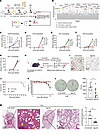 Figure 1
Genome-wide CRISPRi screens identify HGS as a host target for pan-coronavirus therapy. (A) Schematic illustrating genome-wide CRISPRi screens based on surface membrane LAMP1 for the identification of host factors for coronavirus assembly and egress. dCas9-KRAB–expressing 17Cl-1 cells transduced with a genome-wide sgRNA library were infected with MHV for 7 h (MOI = 1). The 15% of cells with low ratio of cell surface LAMP1/total LAMP1 were enriched, and sgRNA abundance was determined by next-generation sequencing. (B) Gene enrichment for CRISPRi screen. Enrichment scores were determined by MaGECK analysis, and genes were colored by biological function. Dotted line indicates log10 (enrichment score) = 1. All genes and enrichment scores can be found in Supplemental Table 1. (C–G) RT-qPCR analysis of extracellular SARS-CoV-2 (C), HCoV-OC43 (D), WIV1 (E), and MHV (F) viral gRNA and HSV-1 (G) viral gDNA levels (hpi = 24 h, 48 h, 96 h, respectively; MOI = 1). N = 3 independent biological replications. (H) Schematic illustrating conditional Hgs-KO K18-hACE2 mice infected with SARS-CoV-2. (I) Immunohistochemical staining of HGS in lung of ctr or Hgs-KO-K18-hACE2 mice. Scale bar = 300 μm. (J, K, and M) Survival curves (J), body weight changes (K), and histopathology of hematoxylin and eosin–stained (HE-stained) lung tissues on day 7 (M). Quantitative analysis of pathological severity scores based on the percentage of affected area in lung tissues. (N = 9 for K18-hACE2 group and N = 8 for Hgs-KO group.) (L) Viral titration by focus-forming assay (FFA) with the supernatant of homogenized lung tissues on day 2 (N = 9 for each group). FFU, focus-forming units. Data are the mean ± SD. Significance testing for C–G was performed with 1-way ANOVA and Tukey’s multiple-comparison test. Significance testing for K–M was performed with a 2-tailed t test. *P ≤ 0.05, **P ≤ 0.005, ***P ≤ 0.0005, ****P ≤ 0.0001.
To investigate the role of HGS in the coronavirus infection, Hgs-knockout (Hgs-KO) Huh7.5.1 and 17Cl-1 cell lines generated using CRISPR/Cas9 were subjected to various coronaviruses, including SARS-CoV-2, HCoV-OC43, bat coronavirus WIV1, and MHV. Quantitative real-time PCR (RT-qPCR) results showed that extracellular viral gRNA levels were dramatically decreased in Hgs-KO cells but restored in Hgs-rescued cells at 72 hpi (Figure 1, C–F). Notably, extracellular viral gDNA levels were unchanged in Hgs-KO and rescued cells following infection with the DNA virus HSV-1 (Figure 1G). These results indicate that HGS functions as a critical host factor for pan-coronavirus infection.
We further investigated the role of HGS in coronavirus infection in vivo. Due to the embryonic lethality of global Hgs-KO mice (13), we employed a conditional gene-targeting approach to generate mice with selective HGS deficiency in human angiotensin-converting enzyme 2–expressing (hACE2-expressing) cells (Figure 1, H and I). Strikingly, HGS deficiency markedly attenuated body weight loss and significantly enhanced the survival rate of SARS-CoV-2 Omicron BA.5–infected mice (Figure 1, J and K). Furthermore, HGS deficiency reduced viral titers in the lungs on day 2 postinfection (Figure 1L). Histopathological analysis further revealed that lung inflammation was alleviated in HGS-deficient mice (Figure 1M). These results indicate that HGS functions as a critical host factor for SARS-CoV-2 infection in vivo.
In addition, we selectively inactivated HGS in the liver by intravenously injecting liver-tropic adeno-associated virus (AAV) containing sgRNA specifically targeting the Hgs gene into spCas9-knockin mice (Supplemental Figure 2A). Immunoblotting (IB) results revealed a significant decrease in Hgs expression in the liver, while no significant change was observed in the lung, as compared with control mice treated with scrambled sgRNA (Supplemental Figure 2, B and C), which confirmed the tissue-specific tropism of the AAV. Subsequently, the mice were intranasally infected with MHV for 5 days. Body weight loss did not show significant differences in the liver-specific Hgs-silencing mice compared with control mice (Supplemental Figure 2D). However, viral gRNA levels and virus titers were significantly decreased in the liver but not the lung of the liver-specific Hgs-silencing mice (Supplemental Figure 2, E–G). Histological analysis further indicated that liver damage was alleviated in the liver-specific Hgs-silencing mice, while acute tissue damage in the lung was not significantly improved (Supplemental Figure 2, H and I). These results collectively demonstrate the important role of HGS in MHV infection in vivo.
HGS controls pan-coronavirus assembly. We further investigated whether HGS plays a role in the virus genome replication or virion assembly and egress. HGS deficiency resulted in a significant decrease in secreted viral gRNA levels, while intracellular viral gRNA levels remained unaffected after various coronaviruses’ infection for 16 hours, including MHV, SARS-CoV-2, HCoV-229E, HCoV-OC43, HCoV-NL63, and bat coronavirus WIV1 (Supplemental Figure 3). Conversely, the rescued expression of HGS in the Hgs-KO cells restored secreted viral gRNA levels without altering intracellular viral gRNA levels (Supplemental Figure 3). Furthermore, the intracellular protein level of viral structural protein N was unchanged in both Hgs-KO and rescued cells (Supplemental Figure 3). These findings strongly indicate that HGS plays a regulatory role in virion assembly and egress, rather than genome replication.
To investigate the role of HGS in regulating coronavirus assembly or release, intracellular and extracellular virus titers were assessed using a virus plaque assay. The results showed a significant reduction in both intracellular and extracellular virus titers in Hgs-KO 17Cl-1 cells infected with MHV and an increase in both intracellular and extracellular virus titers in the Hgs-rescued cells (Figure 2, A and B), suggesting that HGS predominantly influences coronavirus assembly. Consistently, HGS deficiency also decreased other coronaviruses’ assembly, including SARS-CoV-2, HCoV-229E, HCoV-OC43, HCoV-NL63, and WIV1 (Figure 2, C–G). Furthermore, transmission electron microscope (TEM) observations revealed intracellular mature virions were significantly decreased in Hgs-KO cells compared with control cells, while double-membrane vesicles (DMVs), the replication organelles, were not significantly changed (Figure 2, H–K), suggesting that the absence of HGS does not affect replication but impedes virion assembly.
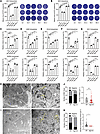 Figure 2
HGS facilitates virion assembly. (A and B) Plaque assay analysis of extracellular (A) and intracellular (B) mature MHV titer levels in the Ctr and 2 Hgs-KO clones and their respective Hgs-rescued 17Cl-1 cells (hpi = 16 h, MOI = 1). N = 3 independent biological replications. (C–G) RT-qPCR analysis of extracellular (upper panel) and intracellular (lower panel) mature virion of SARS-CoV-2 (C), HCoV-OC43 (D), HCoV-229E (E), HCoV-NL63 (F), and WIV1 (G) in the Ctr and 2 Hgs-KO clones and their respective Hgs-rescued Huh7.5.1 cells (hpi = 24 h, MOI = 1). The extracellular and intracellular mature virion from Ctr and 2 Hgs-KO clones and their respective Hgs-rescued Huh7.5.1 cells were subjected to infect WT Huh7.5.1 cells for 6 h. The intracellular viral gRNA levels were examined to indicate the mature virion level. N = 3 independent biological replications. (H–K) TEM analysis of MHV-infected Ctr (H) and Hgs-KO (I) 17Cl-1 cells (hpi = 24 h, MOI = 1). Scale bar, 2 μm (H left), 500 nm (H right), 5 μm (I left), 500 nm (I right). (J) Quantitative analysis of the number of DMV-positive views (left panel) and the number of DMVs per unit cytoplasmic area (right panel). (K) Quantitative analysis of the number of virion-positive views (left panel) and the number of vesicle-contained virions per unit cytoplasmic area (right panel). Data are the mean ± SD. Significance testing for A–G was performed with 1-way ANOVA and Tukey’s multiple-comparison test. Significance testing for J and K was performed with a 2-tailed t test. *P ≤ 0.05, **P ≤ 0.005, ***P ≤ 0.0005, ****P ≤ 0.0001.
In addition, various coronavirus virus-like particles (VLPs) containing M/envelope small membrane (E)/nucleoprotein (N) proteins were utilized to investigate coronavirus assembly, including SARS-CoV-2, MERS, HCoV-OC43, and HCoV-HKU1. Overexpression of HGS significantly increased the ratio of secreted to intracellular N protein (Supplemental Figure 4, A–D). In contrast, HGS deficiency markedly reduced this ratio, while HGS rescue restored it to levels comparable to those observed in control cells (Supplemental Figure 4, E–H). All these results strongly support the role of HGS in regulating pan-coronavirus assembly.
HGS interacts with M protein and facilitates its trafficking to ERGIC for virion assembly. We went on to investigate the mechanism by which HGS regulates virion assembly. Previous studies have established that HGS interacts with multiple cellular proteins and modulates their intracellular trafficking and sorting (14, 15). Given that the coronavirus M protein serves as the central organizer of virion assembly, with its proper subcellular localization being important for this process (16–18), we hypothesized that HGS might regulate M protein trafficking to facilitate viral particle formation. In wild-type (WT) cells, M protein was colocalized with an ERGIC marker, consistent with previous studies demonstrating that coronavirus assembly occurs in the ERGIC (19, 20). However, in Hgs-KO cells, the M protein colocalized with an ER marker but not with an ERGIC marker (Figure 3A). Consistently, similar results were observed in SARS-CoV-2–infected cells (Figure 3B). Moreover, Brefeldin A (BFA), a known inhibitor of ER-to-Golgi trafficking (21, 22), was used to monitor the ER export of M protein (Supplemental Figure 5, A and B). This kinetic process was effectively blocked by BFA treatment, and importantly, the trafficking was restored after a 5-hour BFA washout in WT cells. However, HGS deficiency blocked the M protein in the ER regardless of BFA treatment. Taken together, these results indicate that HGS facilitates M protein trafficking to ERGIC for virion assembly.
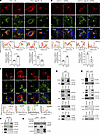 Figure 3
HGS interacts with M protein and facilitates its trafficking to ERGIC. (A and B) Representative IF analysis of the colocalization of SARS-CoV-2 M with SEC61B or ERGIC53 in WT and Hgs-KO 17Cl-1 cells (A) or in SARS-CoV2 Omicron BA.5-infected Huh7.5.1 WT and Hgs-KO cells (MOI = 0.5) (B). Trace outline is used for line-scan analysis of the relative fluorescence intensity of SARS-CoV-2 M with SEC61B and ERGIC53. Scale bar, 10 μm. Quantitative image analysis of M-SEC61B/ERGIC53 colocalization using Manders’ coefficient. N = 3 independent biological replications. (C) Representative IF analysis of the colocalization of HGS with SARS-CoV-2 M, S, E, and N in Vero E6 cells. Trace outline is used for line-scan analysis of the relative fluorescence intensity of HGS with SARS-CoV-2 M, S, E, and N. Scale bar, 10 μm. N = 3 independent biological replications. (D–F) Co-IP analysis of interaction of individually transiently expressed SARS-CoV-2 M, S, E, N with HGS in HEK293T cells (D and E) and HGS with M, S, N in SARS-CoV-2–infected Vero-E6 cells (hpi = 24 h) (F). Immunoprecipitates pulled down by FLAG/HA (D) or HGS (E and F) antibody were analyzed by IB with indicated antibodies. IgG IP was used as negative control. Input represents 5% of the total cell extract. Molecular weights are in kDa. N = 3 independent biological replications. (G) In vitro pull-down analysis of the interaction between HGS and SARS-CoV-2 M. Purified HIS-HGS and FLAG-M proteins subjected to pull-down assay by FLAG antibody were analyzed by IB with indicated antibodies. FLAG-GST protein was used as a negative control. Input represents 5% of the total proteins used for pull-down. Molecular weights are in kDa. N = 3 independent biological replications. Data are the mean ± SD. Significance testing for A and B was performed with a 2-tailed t test. *P ≤ 0.05, ***P ≤ 0.0005.
We further explored how HGS facilitates M protein trafficking to ERGIC. Coexpressing HGS with individual SARS-CoV-2 viral structural protein M, E, N, and spike glycoprotein (S) showed that HGS colocalized with viral structural protein M and S but not with E and N (Figure 3C). Subsequent co-immunoprecipitation (co-IP) results showed that HGS was immunoprecipitated by viral structural proteins M and S, not by E and N (Figure 3D). Conversely, viral structural proteins M and S, but not E and N, were immunoprecipitated by HGS (Figure 3E). These results showed that HGS interacted with viral structural proteins M and S, which were further confirmed by endogenous HGS IP in SARS-CoV-2–infected cells (Figure 3F). Moreover, purified HGS protein and M protein were subjected to pull-down assay. IB results indicated interaction between M protein and HGS, as HGS protein was pulled down by M protein but not by the glutathione-S-transferase (GST) control protein (Figure 3G). Taken together, all these results showed that HGS interacts with viral structural protein M.
Subsequently, we investigated whether HGS could interact with other coronavirus M proteins. Immunofluorescence (IF) analysis revealed that HGS colocalized with all coronavirus M proteins, including those of MHV, HCoV-229E, HCoV-OC43, HCoV-NL63, HCoV-HKU1, MERS, SARS-CoV-1, and WIV1 (Supplemental Figure 5C). Additionally, different HGS species were observed to colocalize with SARS-CoV-2 M protein (Supplemental Figure 5D). These findings collectively suggest that the interaction between HGS and M protein is conserved across diverse coronaviruses.
To identify the specific domain within HGS required for the interaction with M, various truncations of HGS were generated, including HGS 1-166, HGS 1-215, HGS 1-290, HGS 1-390, and HGS 1-509 (Supplemental Figure 6A). IF analysis showed that HGS 1-290, HGS 1-390, and HGS 1-509 were capable of forming vesicular structures and colocalized with M protein, similar to WT HGS (Supplemental Figure 6B). Consistently, co-IP results showed that HGS 1-290, HGS 1-390, and HGS 1-509, but not HGS 1-166 and HGS 1-215, were immunoprecipitated by M protein (Supplemental Figure 6C). These results demonstrated the important role of the HGS 1-290 region in mediating its interaction with M protein.
To identify the specific domain within M required for the interaction with HGS, various truncations of M protein were generated, including a transmembrane domain truncation 1-118 and an intravirion domain truncation Δ19-100 (Supplemental Figure 6D). IF results showed that HGS colocalized with M intravirion domain truncation Δ19-100 but not with M transmembrane domain truncation 1-118 (Supplemental Figure 6E). Furthermore, the purified HGS protein was pulled down by the M intravirion protein but not by the FLAG control protein (Supplemental Figure 6F), indicating an interaction between HGS and the M intravirion domain. Subsequently, we sought to further narrow the specific binding domain within the M intravirion domain with HGS. The M intravirion domain comprises 8 β-sheet domains, and we sequentially generated 4 truncations that deleted these domains: M Δ118-134, M Δ135-161, M Δ162-189, and M Δ190-204 (Supplemental Figure 6D). IF results revealed that only M Δ135-161 did not colocalize with HGS (Supplemental Figure 6E), indicating the important role of the M 135-161 domain in its interaction with HGS. Additionally, both M 135-161-mCherry and M 135-146-mCherry showed complete colocalization with HGS (Supplemental Figure 6E), further confirming an interaction between the M 135-146 domain and HGS. Collectively, these results show HGS interacts with M protein and facilitates its trafficking to ERGIC for virion assembly.
M-derived peptides targeting HGS alleviate the coronavirus infection in vitro, in ALI-cultured HBEs, and in vivo. These pioneering results prompted us to investigate whether the M binding domain could serve as a dominant-negative truncation to disrupt the interaction between HGS and M, thereby preventing coronavirus assembly. To verify this hypothesis, we observed a significant decrease in extracellular virus titer in SARS-CoV-2 M 135-161– and M 135-146–overexpressing 17Cl-1 cells infected with MHV compared with FLAG control cells (Supplemental Figure 7A), indicating that M-derived peptides may impede the HGS-M interaction and hinder coronavirus infection. To expand on the clinical applicability, the M 135-161 and M 135-146 peptides were designed to fuse with HIV-TAT, a cell-penetrating peptide known to facilitate cellular uptake, which we called M161 and M146 here, respectively. Surface plasmon resonance (SPR) results showed that the binding affinity between M146 and M161 with HGS reached to 5.73 nM and 3.84 nM, respectively (Supplemental Figure 7, B and C). The M146 and M161 peptides could significantly block the interaction between HGS and M protein (Supplemental Figure 7D). Cell viability assessments demonstrated that M146 and M161 exhibited no significant cytotoxicity up to 104 nM (Supplemental Figure 7, E–G). Strikingly, M146 and M161 treatment significantly decreased the extracellular viral gRNA levels but not the intracellular viral gRNA levels in a dose-dependent manner after infection with MHV for 24 hours. However, no significant change of extracellular and intracellular viral gRNA level was observed in the control peptide (Supplemental Figure 7, H and I). When coronavirus infection continued for 72 hours, M146 and M161 treatment at 104 nM strikingly decreased the MHV infection but not the HSV-1 virus infection (Supplemental Figure 7, J and K). Furthermore, when M146 and M161 were mutated to decrease their binding affinity to HGS, the inhibition of virus release was consistently reduced (Supplemental Figure 7, L–P). Since HGS is a key host factor for pan-coronavirus assembly, we extended our analysis to various coronaviruses, including SARS-CoV-2, HCoV-NL63, HCoV-229E, HCoV-OC43, and WIV1. Treatment with M146 and M161 at 104 nM for 24 hours markedly decreased extracellular viral gRNA levels across all coronavirus-infected cells, while intracellular viral gRNA levels remained unchanged (Supplemental Figure 7, Q–U), suggesting that targeting HGS could effectively mitigate coronaviruses’ assembly.
The airway ciliated epithelial cells are the main targets for initial coronavirus infections, and spread of progeny to neighboring cells is vital for coronavirus infection (23). Therefore, we differentiated primary HBE cells in ALI cultures to form a bronchial epithelial barrier containing ciliated, goblet, and basal cells (Supplemental Figure 8, A and B). The fully differentiated ALI-cultured HBEs treated with M146 and M161 were inoculated with various coronaviruses, including SARS-CoV-2, HCoV-229E, HCoV-OC43, and HCoV-NL63. IF analysis showed that N proteins were seen most in ciliated cells (Supplemental Figure 8C), consistent with previous results (23). Strikingly, M146 and M161 treatment significantly decreased the N protein levels (Supplemental Figure 8, D–G). Consistently, RT-qPCR analysis of the mucus layer revealed that the viral gRNA was dramatically decreased after treatment with M146 and M161, compared with the FLAG control (Supplemental Figure 8, H–K). Taken together, targeting HGS could effectively mitigate coronavirus infections in ALI-cultured HBEs.
To determine the function of HGS-targeted peptides in vivo, peptide M146 and M161 were modified with d-retroinverso (DRI) isoform to enhance the peptide potency. Several DRI-modified peptides have been reported to be well tolerated and therapeutically effective in clinical trials (24–26). The mice preinjected with M146-DRI and M161-DRI were infected with MHV. Tissue distribution analysis showed that the M146-DRI peptide mainly localized in the lung after intravenous injection (Supplemental Figure 8M). RT-qPCR and virus plaque analysis showed that the viral gRNA and virus titer in the lung were significantly decreased after treatment with M146-DRI and M161-DRI (Supplemental Figure 8, L–P). Consistently, histological analysis indicated that the lung injury was alleviated in the mice treated with M146-DRI and M161-DRI (Supplemental Figure 8Q). Together, these results indicate that targeting HGS could alleviate the coronavirus infection in vivo.
Small-molecule screening reveals RTB disrupts HGS-M interaction. To identify the small molecules that disrupt the interaction between HGS and M protein, the workflow of compound screening based on fluorescence polarization (FP) assay was applied in a preliminary screening of an in-house drug library of over 5,000 compounds with known structure (Figure 4, A and B). By selecting compounds exhibiting more than 60% inhibition, a list of 5 candidates (eltrombopag, RTB, citropten, ethacridine lactate, and 5-amino-2-methoxypyridine) was identified (Figure 4C). We further measured the IC50 values of the hit compounds identified from high-throughput screening, among which RTB exhibited the most potent inhibitory activity (IC50 = 0.58 μM) (Figure 4D). Cell viability assays confirmed that all 5 compounds exhibited minimal cytotoxicity (50% cytotoxic concentration [CC50] > 20 μM). Among these, RTB most effectively rescued coronavirus-induced cytopathic effects, with an EC50 of 3.48 μM. This antiviral potency was benchmarked against remdesivir (RDV; EC50 = 0.69 μM) (Supplemental Figure 9). This pilot screening further illustrated that the FP-based assay can be used as a robust HTS assay for the discovery of HGS protein inhibitors.
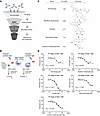 Figure 4
Discovery of a small-molecule inhibitor targeting HGS. (A) The flowchart of FP-based high-throughput screening (HTS) assay. (B) Schematic representation of the FP-based HTS assay. (C) Half of inhibition concentration (IC50) and structure of 5 compounds, which showed the best inhibitory activity among all the compounds. (D) The IC50 values of the top 5 hits were shown in the inhibition curves of HGS 1-390. Data are the mean ± SD and analyzed in GraphPad Prism 9.3.
RTB exhibits anti-coronavirus activity in vitro, in ALI-cultured HBEs, and in vivo. We further explored the role of RTB in the various coronaviruses’ infection. RTB demonstrated broad-spectrum anti-coronaviral infection with the following EC50 values: 14.85 μM for SARS-CoV-2 WT, 4.09 μM for SARS-CoV-2 Omicron BA.5, 8.46 μM for HCoV-NL63, 11.22 μM for MHV, 13.88 μM for HCoV-OC43, 6.11 μM for HCoV-229E, and 3.53 μM for WIV1, respectively (Figure 5, A–G). Notably, all EC50 values for RTB were higher than those of RDV. In fully differentiated ALI cultures of HBEs, RTB produced significant, dose-dependent inhibition of HCoV-OC43, HCoV-229E, HCoV-NL63, and WIV1 infection (Figure 5, H–K).
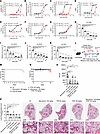 Figure 5
RTB exhibits anti-coronavirus activity in vitro, in ALI-cultured HBEs, and in vivo. (A–G) Dose titration of RTB and RDV for anti-coronavirus activity. Various concentrations of RTB and RDV were used to assess ability to inhibit various coronaviruses’ infection by indirect immunofluorescence assay (IFA). EC50 values of antiviral ability are indicated. (A) SARS-CoV-2 wild-type (MOI = 0.1, hpi = 24 h), (B) SARS-CoV-2 Omicron BA.5 (MOI = 0.1, hpi =24 h), (C) HCoV-NL63 (MOI = 0.1, hpi = 48 h), (D) MHV (MOI = 0.1, hpi = 24 h), (E) HCoV-OC43 (MOI = 0.1, hpi = 48 h), (F) HCoV-229E (MOI = 0.1, hpi = 48 h), (G) WIV1 (MOI = 0.1, hpi = 48 h). (H–K) RTB alleviates coronavirus infection in ALI-cultured HBEs. RT-qPCR analysis of extracellular viral gRNA levels in HCoV-229E (MOI = 1) (H), HCoV-OC43 (MOI = 1) (I), HCoV-NL63 (MOI = 1) (J), WIV1 (MOI = 1) (K) –infected ALI-cultured HBEs with treatment with different doses of RTB or 5 μM RDV for 96 h. (L) Schematic illustrating SARS-CoV-2 Omicron BA.5 infection in K18-hACE2 mice with treatment with or without RTB. SARS-CoV-2 Omicron BA.5-infected mice (2 × 10⁴ FFU) were treated with PBS, molnupiravir (100 mg/kg body weight), RTB (50 or 150 mg/kg body weight), or molnupiravir (100 mg/kg body weight) with RTB (150 mg/kg body weight) every 24 h for 2 or 10 days. (M and N) Survival curves (M) and body weight changes (N) were analyzed after infection with SARS-CoV-2 Omicron BA.5 (N = 9 for each group). (O) Viral titration by FFA with the supernatant of homogenized lung tissues on day 2 (N = 9 for each group). (P) Histopathology of formalin-fixed and HE-stained lung tissues on day 2. Quantitative analysis of pathological severity scores based on the percentage of affected area in lung tissues (N = 5 for each group). Data are the mean ± SD. (H–K, O, and P) One-way ANOVA and Tukey’s multiple-comparison test. *P ≤ 0.05, **P ≤ 0.005, ***P ≤ 0.0005, ****P ≤ 0.0001.
To determine the function of RTB in vivo, K18-hACE2 C57BL/6 mice were infected with the SARS-CoV-2 Omicron BA.5 variant with RTB administered at the onset of infection (Figure 3L). RTB treatment significantly improved survival and markedly reduced body weight loss in infected mice (Figure 5, M and N). Consistently, RTB substantially lowered pulmonary viral titers and alleviated lung inflammation (Figure 5, O and P).
To further explore whether RTB could be an effective antiviral against other coronaviruses in vivo, MHV-infected WT C57BL/6 mice and 229E-infected K18-hACE2 C57BL/6 mice were administered RTB at the onset of infection (Supplemental Figure 10). Remarkably, RTB treatment significantly reduced viral gRNA and lowered pulmonary viral titers in both models. Critically, RTB markedly attenuated virus-induced lung injury (Supplemental Figure 10). Collectively, these results suggest that RTB could alleviate various coronaviruses’ infection in vivo.
RTB directly targets HGS. To investigate the conformational change of HGS induced by RTB, we performed hydrogen-deuterium exchange mass spectrometry (HDX-MS), a widely established technique for probing protein structure, dynamics, folding, and interactions. The different deuterium uptake rates of HGS 1-390 upon RTB binding revealed the specific regions that interact with RTB as well as conformational changes induced by RTB binding. Two regions showed significantly different deuterium incorporation in treated HGS with or without RTB. Interestingly, one region, covering residues 167–175, showed an average 6% increase in deuterium uptake, indicating that the binding of RTB to HGS may have altered the conformational change in this region making it more susceptible to exchange with deuterium water. The other region (residues 209–216) exhibited an approximate 10% decrease in deuterium uptake upon HGS binding to RTB, suggesting that this region may be affected by the binding between RTB and HGS (Figure 6, Α–D).
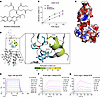 Figure 6
RTB directly targets HGS. (A) The chemical structure of RTB. (B–D) Differential HDX-MS analysis of HGS 1-390 in the presence and absence of RTB is shown as the change in deuterium uptake mapped onto the crystal structure of HGS (PDB: 3ZYQ), highlighting regions affected by RTB binding. The predicted binding pose of RTB with HGS based on the docking result, with RTB represented as indigo sticks (D) and surface representation (C). Deuterium uptake plots for His-tag HGS affected by RTB binding region (green) in the absence (dark green) or presence of RTB (purple), revealing RTB-induced stabilization effects (B). (E–G) SPR analysis of the binding affinity between HGS 1-390 and RTB (E), and binding affinity between HGS 1-390 and peptides M146 (F) or M161 (G) in the presence of RTB. N = 3 independent biological replications. Data are the mean ± SD and analyzed in GraphPad Prism 9.3.
We further explored the direct interaction between HGS and RTB using SPR assay. The results confirmed direct binding between RTB and HGS, with a KD value of 4.82 μM (Figure 6E). Notably, RTB treatment reduced the binding affinity of HGS for M146 and M161, increasing their KD values from 5.73 nM and 3.84 nM to 0.21 μM and 0.83 μM, respectively (Figure 6, F and G).
To investigate whether RTB exerts its anti-coronaviral activity through host factor HGS, the Hgs-KO cells were treated with RTB or RDV. HGS ablation significantly reduced coronavirus infection (Supplemental Figure 11). Strikingly, RTB treatment in Hgs-KO cells failed to inhibit viral infection compared with DMSO-treated Hgs-KO cells (Supplemental Figure 11). In contrast, RDV maintained potent antiviral activity in Hgs-KO cells (Supplemental Figure 11). These results demonstrate that RTB’s anti-coronaviral mechanism is HGS dependent, whereas RDV acts through an HGS-independent pathway.
RTB inhibits virion assembly. To investigate whether RTB acts on the virion assembly, the effect of RTB on the formation of various coronavirus VLPs was studied. RTB treatment resulted in a concentration-dependent inhibition of VLPs’ release (Figure 7, A–D). To confirm these results in cells infected with coronavirus, the effect of RTB was investigated by TEM. TEM observations revealed intracellular mature virions were significantly decreased after treatment of RTB compared with DMSO, while DMVs, the replication organelles, were not significantly changed (Figure 7, E–H), suggesting that the RTB impedes virion assembly, not virus replication. Consistent with the effect of HGS deficiency on the M protein localization, the RTB treatment induced M retention in the ER (Figure 7, I and J). Collectively, these results demonstrate that RTB prevents M protein trafficking to ERGIC, thereby inhibiting virion assembly.
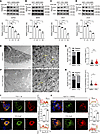 Figure 7
RTB inhibits virion assembly by trapping the M protein in the ER. (A–D) Representative IB analysis of N protein for indicating SARS-CoV-2 (A), MERS (B), HCoV-HKU1 (C), and HCoV-OC43 (D) VLP production in RTB-treated HEK293T cells. HEK293T cells were transfected with VLP system for 48 h. The extracellular secreted protein and intracellular cell lysis were examined by IB with the indicated antibody. Molecular weights are in kDa. N = 3 independent biological replicates. (E–H) TEM analysis of DMSO-treated (E) and RTB-treated (25 μM) (F) MHV-infected 17Cl-1 cells (hpi = 24 h, MOI = 1). (G) Quantitative analysis of the number of DMV-positive views (left panel) and the number of DMVs per unit cytoplasmic area (right panel). (H) Quantitative analysis of the number of virion-positive views (left panel) and number of vesicle-contained virions per unit cytoplasmic area (right panel). (I) Representative IF analysis of the colocalization between SEC61B and SARS-CoV-2 M-mCherry protein in DMSO- and RTB-treated (25 μM) 17Cl-1 cells. Scale bar, 10 μm. Quantitative image analysis of M-SEC61B colocalization using Manders’ coefficient. N = 3 independent biological replicates. (J) Representative IF analysis of the colocalization between SEC61B and M protein in SARS-CoV-2–infected Huh7.5.1 cells treated with or without RTB (25 μM). Scale bar, 10 μm. Quantitative image analysis of M-SEC61B colocalization using Manders’ coefficient. N = 3 independent biological replicates. Data are the mean ± SD. Significance testing for A–D was performed with 1-way ANOVA and Tukey’s multiple-comparison test. Significance testing for G–J was performed with a 2-tailed t test. **P ≤ 0.005, ***P ≤ 0.0005, ****P ≤ 0.0001.
Targeted viral assembly inhibitors offer an advantage over polymerase inhibitors in postinfection antiviral therapy and are ideally suited for combination therapies with current protease and polymerase inhibitors. RTB exhibited similar antiviral activity whether treatment began at infection onset or 6 hpi (Supplemental Figure 12A). In contrast, the antiviral activity of the polymerase inhibitor RDV decreased in a time-dependent manner when treatment was initiated postinfection (Supplemental Figure 12B). Furthermore, RTB demonstrated additive effects in vitro when combined with either molnupiravir or nirmatrelvir (Supplemental Figure 12, C and D). RTB combined with molnupiravir also additively decreased viral titers in the lungs of SARS-CoV-2–infected mice (Figure 5O).


Copyright © 2026 American Society for Clinical Investigation
ISSN: 0021-9738 (print), 1558-8238 (online)