
Advertisement
Commentary
Open Access |  10.1172/JCI199180
Pathogenic expansion: fibroblast proliferation fuels fibrosis
Cody A. Schott1 and Elizabeth F. Redente1,2
1Division of Pulmonary Sciences and Critical Care Medicine, Department of Medicine, University of Colorado, Aurora, Colorado, USA.
2Department of Pediatrics, National Jewish Health, Denver, Colorado, USA.
Address correspondence to: Elizabeth F. Redente, National Jewish Health, 1400 Jackson Street, Smith Bldg. A547, Denver, Colorado 80206, USA. Phone: 303.398.1548; Email: RedenteE@njhealth.org.
Find articles by Schott, C. in: PubMed | Google Scholar
1Division of Pulmonary Sciences and Critical Care Medicine, Department of Medicine, University of Colorado, Aurora, Colorado, USA.
2Department of Pediatrics, National Jewish Health, Denver, Colorado, USA.
Address correspondence to: Elizabeth F. Redente, National Jewish Health, 1400 Jackson Street, Smith Bldg. A547, Denver, Colorado 80206, USA. Phone: 303.398.1548; Email: RedenteE@njhealth.org.
Find articles by
Redente, E.
in:
PubMed
|
Google Scholar
|

Published November 17, 2025 - More info
J Clin Invest. 2025;135(22):e199180. https://doi.org/10.1172/JCI199180.
© 2025 Schott et al. This work is licensed under the Creative Commons Attribution 4.0 International License. To view a copy of this license, visit http://creativecommons.org/licenses/by/4.0/.

Related article:
Abstract
Pulmonary fibrosis (PF) has been called a fibroproliferative disease, yet the functional importance of proliferating fibroblasts to PF has not been systematically examined. In response to alveolar injury, quiescent alveolar fibroblasts differentiate into fibrotic fibroblasts that express high amounts of collagens. However, what role, if any, proliferation plays in the accumulation of fibrotic fibroblasts has remained unclear. Using 5-ethynyl-2′-deoxyuridine (EdU) incorporation, genetic lineage tracing, and single-cell RNA-Seq, we delineated the proliferation dynamics of lung fibroblasts during post-injury fibrogenesis. We found substantial DNA replication in progeny of alveolar fibroblasts in 2 independent models of PF. Lineage labeling revealed clonal expansion of these fibroblast descendants principally in regions of fibrotic remodeling. The transcriptome of proliferating fibroblasts closely resembled that of fibrotic fibroblasts, suggesting that fibroblasts can first differentiate into fibrotic fibroblasts and then proliferate. Genetic ablation of proliferating fibroblasts and selective inhibition of cytokinesis in alveolar fibroblast descendants significantly mitigated PF and rescued lung function. Furthermore, fibroblasts in precision-cut lung slices from human fibrotic lungs exhibited higher proliferation rates than did those in nondiseased lungs. Together, this work establishes fibroblast proliferation as a critical driver of PF and suggests that specifically targeting fibroblast proliferation could be a new therapeutic strategy for fibrotic diseases.
Authors
Christopher Molina, Tatsuya Tsukui, Imran S. Khan, Xin Ren, Wenli Qiu, Michael Matthay, Paul Wolters, Dean Sheppard
-
Preclinical evidence of pathogenic fibroblast proliferation driving fibrosis
Fibroblasts and their extracellular matrix (ECM) products have long been recognized as mediators of pulmonary fibrosis. They are a heterogeneous cell type involved in architectural maintenance, fibrosis, and inflammatory signaling (1, 2). Preclinical studies of pulmonary fibrosis utilize endpoints of fibroblast biology and collagen synthesis as critical in vivo and in vitro surrogates to understand human disease activity. However, important questions about temporal expansion and acquisition of a profibrotic phenotype in fibroblasts have remained unanswered: Which occurs first, and are both processes necessary and/or sufficient for fibrosis development? In this issue of the JCI, Molina et al. implicated alveolar fibroblast proliferation after profibrotic differentiation as an essential step in the development of pulmonary fibrosis (3).
While previous studies have demonstrated that a quantitative increase in fibroblast numbers correlates with fibrosis development (2, 4–6), Molina and colleagues extended these observations, providing evidence that Scube2+ fibroblasts, which this group recently characterized as the naive alveolar fibroblast capable of generating multiple fibroblast subsets (2), gained CD9 expression and a fibrotic transcriptomic profile (Cthrc1+, Col1a1, Tnc+, etc.) prior to proliferation in two distinct murine fibrosis models (single-dose bleomycin and silica) Using Scube2-CreER Brainbow2.1/+ confetti mice and 5-ethynyl-2′-deoxyuridine (EdU) incorporation, clonal expansion of fibroblasts was observed within regions of fibrotic remodeling (3). To determine whether this subpopulation functionally contributes to the development of fibrosis, the proliferative process was disrupted in two ways. First, by deleting Esco2 in proliferating Scube2+ fibroblasts, the chromatin cohesion complex was targeted to induce apoptotic cell death during fibrogenesis, which resulted in a significant reduction in pulmonary fibrosis development (Figure 1) (3). Previous studies in which apoptosis of collagen-expressing fibroblasts was inhibited through the genetic loss of Fas demonstrated a complementary result and sustained fibrosis in the bleomycin model (6). Second, to disrupt proliferation without cell death, Ect2 (which impairs cytokinesis) was deleted in Scube2+ alveolar fibroblasts. This resulted in significantly fewer fibroblast aggregates and an overall reduction in fibrosis development (Figure 1) (3).
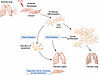 Figure 1
Schematic of fibroblast response to injury during fibrosis development. Molina et al. demonstrated that alveolar fibroblasts, defined by Scube2 expression, first undergo profibrotic differentiation into a CD9+, Cthrc1+ population. Differentiation into this population was followed by clonal proliferative expansion. Genetic deletion of either Esco2, which induces apoptosis in the profibrotic population, or Ect2, which inhibits clonal proliferation of the population, reduced proliferating fibroblasts and fibrosis development (3).
Because not all of the Scube2+ subpopulation differentiated during fibrosis, there remained a nonproliferating fibroblast population in the lungs. Despite this, an improvement in fibrosis occurred, indicating that resident fibroblasts that do not undergo differentiation and that subsequent proliferation may also have a distinct role in directing the repair process (Figure 1) (7, 8). This reparative capacity has been well studied in other organ fibrosis including in the liver, kidneys, and skin (9, 10). These results suggests that a threshold must be exceeded by profibrotic fibroblasts through proliferation (or eventually resistance to apoptosis) to drive aberrant fibrotic repair, and that the presence of a small number of profibrotic fibroblasts themselves is not sufficient to overcome a homeostatic repair process (3, 6).
In usual interstitial pneumonia (UIP) associated with idiopathic pulmonary fibrosis (IPF), there is spatial, temporal, and transcriptomic heterogeneity of fibroblastic foci and profibrotic fibroblasts found within the lungs (1, 11, 12). However, within the fibroblastic foci themselves there is evidence of a paucity of fibroblast proliferation (1, 13). This implies that adjacent fibrotic areas of the lung with ongoing profibrotic activity and fibroproliferation may contribute to the progressive nature of the disease (11). Crosstalk between aberrant epithelial cell populations (alveolar cells, transitional cells, aberrant basaloid cells, airway cells, and those in honeycomb cysts) and resident and recruited immune cells may also contribute to the signaling that drives the proliferation of Cthrc1+ fibroblasts, a profibrotic subpopulation derived from Scube2+ fibroblasts (14–17). As an example, in the bleomycin model, Krt8+ transitional epithelial cell development is tied to macrophage recruitment and fibroblast persistence, and its genetic loss is sufficient to prevent fibrosis development (18). Further investigation into the interdependent signaling loops between the Krt8+ transitional epithelial cells and profibrotic fibroblasts is warranted to determine whether a signaling interaction between these cell populations drives differentiation and proliferation.


Copyright © 2026 American Society for Clinical Investigation
ISSN: 0021-9738 (print), 1558-8238 (online)