
Advertisement
Commentary
Open Access |  10.1172/JCI198981
S-TIR-ring up TLR7 and TLR9: signaling domain substitutions clarify the TLR paradox
Roser Tachó-Piñot and Carola G. Vinuesa
The Francis Crick Institute, London, United Kingdom.
Address correspondence to: Carola G. Vinuesa, 1 Midland Rd., London, NW1 1AT, United Kingdom. Email: carola.vinuesa@crick.ac.uk.
Find articles by Tachó-Piñot, R. in: PubMed | Google Scholar
The Francis Crick Institute, London, United Kingdom.
Address correspondence to: Carola G. Vinuesa, 1 Midland Rd., London, NW1 1AT, United Kingdom. Email: carola.vinuesa@crick.ac.uk.
Find articles by Vinuesa, C. in: PubMed | Google Scholar
Published November 3, 2025 - More info
J Clin Invest. 2025;135(21):e198981. https://doi.org/10.1172/JCI198981.
© 2025 Tachó-Piñot et al. This work is licensed under the Creative Commons Attribution 4.0 International License. To view a copy of this license, visit http://creativecommons.org/licenses/by/4.0/.

Related article:
Abstract
Toll like receptor (TLR) 7 and 9, endosomal sensors for RNA and DNA, are key mediators of autoreactivity. Although generally considered homologous, they paradoxically have opposing effects on lupus: TLR7 exacerbates the disease while TLR9 protects from it How they mediate opposing effects in autoimmunity remains undetermined. We hypothesized that differences in signaling qualities of the Toll-Interleukin 1 Receptor (TIR) domains of TLR7 and TLR9 could be responsible for their opposing effects. To test this, we introduced the TIR domain of TLR9 into the endogenous Tlr7 locus and the TLR7 TIR domain into the endogenous Tlr9 locus of mice, creating chimeric molecules termed TLR779 and TLR997. Lupus-prone MRL/lpr mice carrying Tlr779 had greatly ameliorated disease, while MRL/lpr mice carrying Tlr997 had markedly exacerbated disease compared with respective TlrWT mice. These experiments establish that TLR7 and TLR9 TIR domains have divergent properties and control disease quality, thus explaining the longstanding “TLR paradox”.
Authors
Claire Leibler, Kayla B. Thomas, Coralie Josensi, Russell C. Levack, Shuchi Smita, Shinu John, Daniel J. Wikenheiser, Sheldon Bastacky, Sebastien Gingras, Kevin M. Nickerson, Mark J. Shlomchik
Systemic Lupus Erythematosus (SLE) is an autoimmune disease characterized by loss of immune tolerance to self antigens, often targeting nucleic acids. Antibodies bound to nuclear antigens contribute to SLE pathogenesis by facilitating TLR7-mediated activation of immune cells, such as plasmacytoid dendritic cells (pDCs) and neutrophils, and via immune complex deposition (1). These mechanisms drive inflammation and tissue injury, with renal involvement being a major complication; lupus nephritis represents one of the most severe manifestations of SLE (1).
-
Divergent TIR domain–mediated signaling between TLR7 and TLR9
In this issue of JCI, Leibler et al. extended the Shlomchik lab’s prior findings, establishing that differences in the TIR domains of TLR7 and TLR9 explain their opposing contributions to autoimmunity in a mouse model of lupus (19). To dissect this mechanism, the group genetically engineered mice to incorporate the Tlr9 TIR domain into the Tlr7 endogenous locus (Tlr779 mice), or the Tlr7 TIR domain into the Tlr9 endogenous locus (Tlr997 mice) (Figure 1).
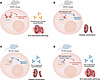 Figure 1
Differences in qualitative signaling downstream of TLR7 and TLR9 TIR domains. (A) In the lupus-prone MRL/lpr background, Tlr7 WT Tlr9–/– mice show SLE-associated pathology, with splenomegaly and nephritis, and high titres of anti-RNA and anti-Smith (anti-Sm) autoantibodies. (B) To evaluate the differential role of the TLR7 and TLR9 TIR domains, the Tlr9 TIR domain was introduced into the Tlr7 locus (termed Tlr779). Tlr779 mice expressed reduced levels of TLR779 protein relative to expression level of TLR7 in A. Due to Tlr7 being X-linked, heterozygous mice were not deemed appropriate dosage controls. However, these experiments showed that TLR779 domain led to reduced spleen and lymph node cellularity, nephritis, and anti-RNA and anti-Sm autoantibodies when compared with Tlr7 WT mice in the MRL/lpr Tlr9–/– background. Moreover, the TLR9 TIR domain induced the expression of genes involved in negative regulation, pointing to potential mechanisms underlying this effect. In the converse experiments, relative to Tlr9 WT mice on the MRL/lpr Tlr7–/– background (C), introduction of the Tlr7 TIR domain into the Tlr9 locus (D) led to increased expression of proinflammatory signalling molecules, which translated into aggravation of disease. Unexpectedly, antinucleosome antibodies were similar between Tlr997 and Tlr9+/– mice. Note that, while TLR997 showed reduced expression relative to TLR9 WT expression levels, this was controlled by comparing to heterozygous Tlr9+/– mice.
Tlr779 mice — in which the Tlr7 TIR domain was replaced with the Tlr9 TIR domain — showed disease amelioration when compared with WT Tlr7 counterparts in the lupus-prone MRL/lpr Tlr9–/– background. TLR779 largely localized to the same endosomes as WT TLR7; however, TLR779 expression in B cells was 50% of that of WT TLR7 (19). Since Tlr7 is an X-linked gene, a substantial fraction of immune B cells and pDCs express a single functional Tlr7 allele (20). As such, Tlr7 heterozygous mice were not deemed appropriate dosage controls. These experiments lacked TLR7 dosage controls, despite TLR7 gene dosage being a well established driver of autoimmunity (21). Nevertheless, in the MRL/lpr Tlr9–/– background, Tlr779 and Tlr7–/– mice were similarly protected from disease, suggesting that signaling through the TLR9 TIR domain does not produce the pathogenic effects that signaling through the TLR7 TIR domain does (19).
In these experiments, Tlr779 did not function as a null allele, as it was able to signal and induce an immune phenotype distinct from both WT and Tlr7-KO mice in the MRL/lpr Tlr9–/– background. This immune phenotype included an increase in the percentage of CD19+ B cells in the spleen, with intermediate levels of age-associated B cells, germinal center B cells, and naive and effector CD4+ T cells and an increase in the frequency of CD4+ memory B cells in Tlr779 mice when compared with WT Tlr7 and Tlr7–/– mice (19).
To understand the potential differences in TIR domain signaling, Leibler et al. compared the response to the TLR7 ligand CL097 in Tlr779 and Tlr7 WT B cells, in an MRL/lpr Tlr9–/– background. B cells expressing TLR779 induced higher expression of some regulatory genes, including Ets1, when compared to B cells expressing WT TLR7 (19). This finding aligns with previous reports from the group proposing that TLR9’s TIR domain could induce protective signaling (16).
Leibler et al. (19) next undertook a reciprocal approach to confirm these conclusions, generating Tlr997 mice, whereby the Tlr9 TIR domain was replaced with the Tlr7 TIR domain, in an MRL/lpr Tlr7–/– background (Figure 1). TLR997 maintained its endosomal localization but was expressed at lower levels than its WT TLR9 counterpart. To correct for the lower TLR997 expression, Tlr9+/– mice were included as TLR9 dose controls.
In B cells from MRL/lpr Tlr7–/– mice, Tlr997 and Tlr9+/– induced broadly similar NF-kB nuclear translocation upon CpG stimulation. However, Tlr997 B cells showed enrichment in the expression of genes related to type 1 IFN signaling when compared with Tlr9+/– B cells. Conversely, stimulated Tlr9+/– B cells showed higher expression of genes related to IL-4 and IL-13 signaling, and to negative regulation of NF-kB, MAPK, and IFN signaling pathways. Together, these findings support the group’s hypothesis that differential signaling downstream of TLR7 and TLR9 is encoded by their TIR domains.
To understand the functional effect of these differences, Leibler et al. (19) stimulated B cells from MRL/lpr Tlr7–/– mice bearing Tlr997 or Tlr9+/–. In Tlr997 mice, CpG stimulation induced higher plasmablast differentiation, suggesting that the signaling downstream of TLR7 TIR domain is a stronger inducer of this process. This is in line with an earlier report by another research group showing that TLR7-BCR costimulation promotes higher B cell survival and differentiation into plasmablasts compared with TLR9-BCR engagement (22).
Differences in B cell responses evoked by the different TIR domains were paralleled by changes in SLE severity. In an MRL/lpr Tlr7–/– background, Tlr997 mice showed increased spleen weight and nephritis scores relative to Tlr9+/– mice. Tlr997 mice also showed SLE-associated immune changes, such as increased age-associated B cells and decreased marginal zone B cells. As expected, and consistent with lack of RNA binding via the extracellular TLR9 domain, Tlr997 mice had reduced anti-Smith antibodies (which are highly specific to SLE) and anti-RNA autoantibodies. Unexpectedly, Tlr997 mice did not show increased anti-nucleosome antibodies compared with Tlr9+/– mice, although the presence of a TLR7 TIR domain linked to the DNA-binding TLR9 extracellular domain should promote such a response.
Article tools
- Download citation information
- Send a comment
- Terms of use
- Standard abbreviations
- Need help? Email the journal
Related comments
-
TLR9 regulates lupus in multiple animal models, not just MRL
Mark Shlomchik
Metrics


Copyright © 2026 American Society for Clinical Investigation
ISSN: 0021-9738 (print), 1558-8238 (online)