
Comments for:
Abstract
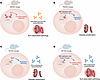
In systemic lupus erythematosus (SLE), autoimmunity often develops toward self nucleic acids. The nucleic acid receptors TLR7 and TLR9, which sense RNA and DNA, respectively, are critical for the generation of pathogenic autoimmune antibodies. Despite similarities in their downstream signaling cascades, these receptors play opposing roles in most mouse lupus models: TLR7 promotes disease, while TLR9 provides protection — an observation often referred to as “the TLR paradox.” To understand the basis of this dichotomy, Leibler et al. created genetically edited lupus-prone mice in which TLR7 receptors express the TLR intracellular signaling domain (TIR) that corresponds to TLR9, or vice versa. Their results revealed that the TIR domains contribute to the receptors’ opposing roles in SLE, shedding light into the TLR paradox in autoimmunity.
Authors
Roser Tachó-Piñot, Carola G. Vinuesa
TLR9 regulates lupus in multiple animal models, not just MRL
Submitter: Mark Shlomchik | mshlomch@pitt.edu
University of Pittsburgh School of Medicine
Published December 8, 2025
The commentary by Drs. Tachó-Piñot and Vinuesa captures well the essence of our paper.
However, it is important to extend the following paragraph by adding references to other mouse models that show regulatory activity of TLR9 and suggest a wider applicability of our findings as otherwise it might seem that the finding only applies to MRL/lpr.
“In mouse models of SLE, B cell–intrinsic TLR9 expression is necessary for the generation of pathogenic autoantibodies against DNA (8), and in BALB/c mice specifically, TLR9 expression is required for lupus-like disease (15). However, lupus-prone MRL/lpr mice lacking TLR9 develop more severe disease than their TLR9-sufficient counterparts, with heightened immune activation, worsened renal pathology, and increased mortality (7). Together, these findings support an overall protective role for TLR9 in the MRL/lpr mouse model of SLE.”
The paragraph omits reference to the numerous and diverse mouse models, which include but is not limited to the MRL/lpr model, in which TLR9 has been shown to play a regulatory role, as reviewed by Green and Marshak-Rothstein (1), in which their Table 1 lists five different genetic models that demonstrated a regulatory role for TLR9. Since that review in 2011, two additional models were published that also demonstrated a regulatory role for TLR9, including one in the BALB/c strain (2, 3). Hence, seven different models show the regulatory role of TLR9, and BALB/c is not an exception.
The main message is that in multiple contexts and animal models—not just MRL/lpr—TLR9 plays a net regulatory role, consistent with its unique combination of proinflammatory and regulatory capacity that differs from that of TLR7.
References Cited:
1. Green NM, and Marshak-Rothstein A. Toll-like receptor driven B cell activation in the induction of systemic autoimmunity. Semin Immunol. 2011;23(2):106-12.
2. Bossaller L, Christ A, Pelka K, Nundel K, Chiang PI, Pang C, et al. TLR9 Deficiency Leads to Accelerated Renal Disease and Myeloid Lineage Abnormalities in Pristane-Induced Murine Lupus. J Immunol. 2016;197(4):1044-53.
3. Jackson SW, Scharping NE, Kolhatkar NS, Khim S, Schwartz MA, Li QZ, et al. Opposing impact of B cell-intrinsic TLR7 and TLR9 signals on autoantibody repertoire and systemic inflammation. J Immunol. 2014;192(10):4525-32.


Copyright © 2026 American Society for Clinical Investigation
ISSN: 0021-9738 (print), 1558-8238 (online)