
Advertisement
Commentary
Open Access |  10.1172/JCI198494
Keratinocyte-neutrophil interactions revealed as targetable drivers of sustained inflammation in Sweet syndrome
Umi Tahara1,2 and Masayuki Amagai1,2
1Department of Dermatology, Keio University School of Medicine, Tokyo, Japan.
2Laboratory for Skin Homeostasis, RIKEN Center for Integrative Medical Sciences, Yokohama, Japan.
Address correspondence to: Masayuki Amagai, Department of Dermatology, Keio University School of Medicine, Tokyo, Japan. Phone: 81.3.5363.3822; Email: amagai@keio.jp.
Find articles by Tahara, U. in: PubMed | Google Scholar
1Department of Dermatology, Keio University School of Medicine, Tokyo, Japan.
2Laboratory for Skin Homeostasis, RIKEN Center for Integrative Medical Sciences, Yokohama, Japan.
Address correspondence to: Masayuki Amagai, Department of Dermatology, Keio University School of Medicine, Tokyo, Japan. Phone: 81.3.5363.3822; Email: amagai@keio.jp.
Find articles by Amagai, M. in: PubMed | Google Scholar
Published October 15, 2025 - More info
J Clin Invest. 2025;135(20):e198494. https://doi.org/10.1172/JCI198494.
© 2025 Tahara, et al. This work is licensed under the Creative Commons Attribution 4.0 International License. To view a copy of this license, visit http://creativecommons.org/licenses/by/4.0/.

Related article:
Abstract
Sweet syndrome (also known as acute febrile neutrophilic dermatosis) is a rare inflammatory skin disorder characterized by erythematous plaques with a dense dermal neutrophilic infiltrate. The first-line therapy remains oral corticosteroids, which suppresses inflammation nonspecifically. Although neutrophils are typically short-lived, how they persist in Sweet syndrome skin and contribute to disease pathogenesis remains unclear. Here, we identify a previously unrecognized population of antigen-presenting cell–like (APC-like) neutrophils expressing MHC class II genes that are uniquely present in Sweet syndrome skin but absent in healthy tissue and the circulation. Keratinocytes extended neutrophil lifespan 10-fold in coculture experiments and drove the emergence of an APC-like phenotype in approximately 30% of neutrophils, mirroring observations in patients’ lesions. Mechanistically, keratinocyte-derived serum amyloid A1 (SAA1) signals through the formyl peptide receptor 2 (FPR2) on neutrophils to promote their survival. These long-lived neutrophils actively orchestrate local immune responses by recruiting T cells and inducing cytokine production. Strikingly, dual blockade of SAA1/FPR2 signaling restores neutrophil turnover to baseline levels, with efficacy comparable to high-dose corticosteroids. These findings uncover a keratinocyte/neutrophil/T cell axis that sustains chronic inflammation in Sweet syndrome and highlight the SAA1/FPR2 pathway as a promising target for precision therapy.
Authors
Jianhe Huang, Satish Sati, Olivia Ahart, Emmanuel Rapp-Reyes, Linda Zhou, Robert G. Micheletti, William D. James, Misha Rosenbach, Thomas H. Leung
-
Unraveling enigmatic roles of neutrophils in Sweet syndrome
Sweet syndrome (SS), first described in 1964 as “acute febrile neutrophilic dermatosis” (1), is a rare inflammatory skin disorder marked by the abrupt onset of fever, leukocytosis, and tender erythematous plaques or nodules with dense dermal neutrophilic infiltrates (Figure 1). Although SS can be triggered by diverse factors — including infections, autoimmune diseases, malignancies, and certain medications — evidence suggests that a shared pathogenic mechanism operates across subtypes (2). A central feature of SS is innate immune dysregulation. Patients often show elevated levels of granulocyte-CSF (G-CSF), IL-1β, and other proinflammatory cytokines in serum and lesional skin (3–8). These mediators drive neutrophil recruitment into the dermis, aided by upregulation of chemoattractants such as CXCL1, CXCL2, and IL-8, as well as adhesion molecules including l-selectin, FAS, and Siglec-5/9 (9). While these findings underscore the pivotal role of neutrophils, exactly how they initiate and sustain inflammation has been unclear.
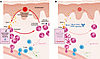 Figure 1
SAA1/FPR2 signaling prolongs neutrophil survival and provides a therapeutic target in SS. (A) The keratinocyte-neutrophil interaction that occurs in SS skin, as reported by Huang, Sati, and colleagues (10). Keratinocytes, the predominant epidermal cell type, upregulate SAA1 in response to neutrophil interaction. Keratinocyte-derived SAA1 binds FPR2 on neutrophils, activating MAPK/ERK and PI3K/AKT signaling to inhibit apoptosis and extend neutrophil lifespan. This interaction maintains a pool of long-lived neutrophils, including a subset with APC-like features such as MHC II expression. Lesional neutrophils also produce CXCL10 and CXCL11, recruiting T cells that generate IL-17, linking neutrophil activity to Th17-type inflammation. (B) The effect of SAA1/FPR2 blockade. Blocking SAA1/FPR2 signaling with neutralizing antibodies promotes neutrophil apoptosis, thereby reducing the neutrophils’ survival. This axis represents a potential point of therapeutic intervention for SS.
A 2023 study from the Leung group described a chronic, treatment-refractory SS patient carrying a neutrophil-specific PIK3R1 mutation that enhanced IL-1β–driven migration and responded dramatically to IL-1 receptor blockade (7). This work provided direct evidence that neutrophils can act as upstream disease initiators rather than mere downstream effectors. However, that work relied on bulk transcriptomics and monoculture assays with neutrophil-like cell lines — approaches that do not recapitulate the cellular diversity or intercellular signaling within SS lesions. To address this gap, in the current JCI issue, Huang, Sati, and colleagues from the same research group combined single-cell RNA-Seq (scRNA-Seq) with in vitro coculture assays to dissect the SS lesional microenvironment (10). Their results support a model in which neutrophils sustain chronic inflammation through reciprocal interactions with keratinocytes, the predominant epidermal cell type. Central to this circuit is the serum amyloid A1/formyl peptide receptor 2 (SAA1/FPR2) signaling axis, which was identified as a potential therapeutic target (Figure 1).
Article tools
- Download citation information
- Send a comment
- Terms of use
- Standard abbreviations
- Need help? Email the journal
Metrics
Go to
- Top
- Abstract
- Unraveling enigmatic roles of neutrophils in Sweet syndrome
- Antigen-presenting cell–like neutrophils: a tissue-adapted inflammatory phenotype
- Keratinocyte-neutrophil crosstalk sustains neutrophil survival and inflammation
- Therapeutic implications and future directions
- Funding support
- Footnotes
- References
- Version history


Copyright © 2026 American Society for Clinical Investigation
ISSN: 0021-9738 (print), 1558-8238 (online)