
Abstract
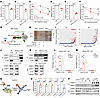
The regulation of the programmed cell death protein 1 (PD-1) gene, PDCD1, has been widely explored at transcription and posttranslational levels in T cell function and tumor immune evasion. However, the mechanism for PDCD1 dysregulation at the posttranscriptional level remains largely unknown. Here, we identify protein arginine methyltransferase 5 (PRMT5) as a RNA binding protein in a methyltransferase activity–independent manner, which promotes PDCD1 decay with WD repeat domain 77 protein (WDR77) and Argonaute2. Furthermore, the type-I IFN/STAT1 pathway transcriptionally activates PRMT5 and WDR77, thus enhancing PRMT5/WDR77 binding on a conserved AU-rich element of PDCD1 3′ UTR. Functionally, conditional knockout of either PRMT5 or WDR77 in T cells disrupts T cell effector function and sensitizes the tumors to anti–PD-1 therapy. Clinically, PRMT5 and WDR77 expression in tumor-infiltrating T cells are negatively correlated with PDCD1 expression and renders tumors resistant to PD-1–targeted immunotherapy. Moreover, fludarabine targeting STAT1 in combination with anti–PD-1 has a synergetic effect on suppressing tumor growth in mice. Overall, this study reveals that the RNA binding–dependent function of PRMT5 regulates PDCD1 and T cell effector function with WDR77 and identifies potential combinatorial therapeutic strategies for enhancing antitumor efficacy.
Authors
Yinmin Gu, Yongbo Pan, Chang Pan, Qiang Pang, Zhantong Tang, Yiwen Chen, Haojing Zang, Xiaodong Wang, Chang Huang, Qingqing Zhang, Facai Yang, Xiaofeng Zhu, Yibi Zhang, Xujie Zhao, Shan Gao
This file is in Adobe Acrobat (PDF) format. If you have not installed and configured the Adobe Acrobat Reader on your system.
Having trouble reading a PDF?
PDFs are designed to be printed out and read, but if you prefer to read them online, you may find it easier if you increase the view size to 125%.
Having trouble saving a PDF?
Many versions of the free Acrobat Reader do not allow Save. You must instead save the PDF from the JCI Online page you downloaded it from. PC users: Right-click on the Download link and choose the option that says something like "Save Link As...". Mac users should hold the mouse button down on the link to get these same options.
Having trouble printing a PDF?
- Try printing one page at a time or to a newer printer.
- Try saving the file to disk before printing rather than opening it "on the fly." This requires that you configure your browser to "Save" rather than "Launch Application" for the file type "application/pdf", and can usually be done in the "Helper Applications" options.
- Make sure you are using the latest version of Adobe's Acrobat Reader.
Unedited blot and gel images - Download (1.89 MB)


Copyright © 2026 American Society for Clinical Investigation
ISSN: 0021-9738 (print), 1558-8238 (online)