
Review Series

Abstract
Recent years have seen Tregs become a popular subject of immunological research. Abundant experimental data have now confirmed that naturally occurring CD25+CD4+ Tregs in particular play a key role in the maintenance of self tolerance, with their dysfunction leading to severe or even fatal immunopathology. The sphere of influence of Tregs is now known to extend well beyond just the maintenance of immunological tolerance and to impinge on a host of clinically important areas from cancer to infectious diseases. The identification of specific molecular markers in both human and murine immune systems has enabled the unprecedented investigation of these cells and should prove key to ultimately unlocking their clinical potential.
Authors
Zoltán Fehérvari, Shimon Sakaguchi

Abstract
There is increasing evidence that the immune response can be inhibited by several T cell subsets, including NK T cells, CD25+CD4+ T cells, and a subpopulation of CD8+ T cells. Animal model studies of multiple sclerosis have suggested an important role for suppressor CD8+ T cells in protection against disease recurrence and exacerbation. The molecular lynchpin of CD8+ suppressive activity is the murine MHC molecule Qa-1, termed HLA-E in humans. Here we summarize findings from work on Qa-1 that have begun to delineate suppressor CD8+ T cells and their mechanisms of action in the context of self tolerance and autoimmune disease.
Authors
Stefanie Sarantopoulos, Linrong Lu, Harvey Cantor

Abstract
Regulation of the immune response is a multifaceted process involving lymphocytes that function to maintain both self tolerance as well as homeostasis following productive immunity against microbes. There are 2 broad categories of Tregs that function in different immunological settings depending upon the context of antigen exposure and the nature of the inflammatory response. During massive inflammatory conditions such as microbial exposure in the gut or tissue transplantation, regulatory CD4+CD25+ Tregs broadly suppress priming and/or expansion of polyclonal autoreactive responses nonspecifically. In other immune settings where initially a limited repertoire of antigen-reactive T cells is activated and expanded, TCR-specific negative feedback mechanisms are able to achieve a fine homeostatic balance. Here I will describe experimental evidence for the existence of a Treg population specific for determinants that are derived from the TCR and are expressed by expanding myelin basic protein–reactive T cells mediating experimental autoimmune encephalomyelitis, an animal prototype for multiple sclerosis. These mechanisms ensure induction of effective but appropriately limited responses against foreign antigens while preventing autoreactivity from inflicting escalating damage. In contrast to CD25+ Tregs, which are most efficient at suppressing priming or activation, these specific Tregs are most efficient in controlling T cells following their activation.
Authors
Vipin Kumar

Abstract
T cell vaccination (TCV) activates Tregs of 2 kinds: anti-idiotypic (anti-id) and anti-ergotypic (anti-erg). These regulators furnish a useful view of the physiology of T cell regulation of the immune response. Anti-id Tregs recognize specific effector clones by their unique TCR CDR3 peptides; anti-id networks of CD4+ and CD8+ Tregs have been described in detail. Here we shall focus on anti-erg T regulators. Anti-erg T cells, unlike anti-id T cells, do not recognize the clonal identity of effector T cells; rather, anti-erg T cells recognize the state of activation of target effector T cells, irrespective of their TCR specificity. We consider several features of anti-erg T cells: their ontogeny, subset markers, and target ergotope molecules; mechanisms by which they regulate other T cells; mechanisms by which they get regulated; and therapeutic prospects for anti-erg upregulation and downregulation.
Authors
Irun R. Cohen, Francisco J. Quintana, Avishai Mimran

Abstract
Malaria, the most prevalent and most pernicious parasitic disease of humans, is estimated to kill between one and two million people, mainly children, each year. Resistance has emerged to all classes of antimalarial drugs except the artemisinins and is responsible for a recent increase in malaria-related mortality, particularly in Africa. The de novo emergence of resistance can be prevented by the use of antimalarial drug combinations. Artemisinin-derivative combinations are particularly effective, since they act rapidly and are well tolerated and highly effective. Widespread use of these drugs could roll back malaria.
Authors
Nicholas J. White

Abstract
Since its identification nearly 30 years ago, Lyme disease has continued to spread, and there have been increasing numbers of cases in the northeastern and north central US. The Lyme disease agent, Borrelia burgdorferi, causes infection by migration through tissues, adhesion to host cells, and evasion of immune clearance. Both innate and adaptive immune responses, especially macrophage- and antibody-mediated killing, are required for optimal control of the infection and spirochetal eradication. Ecological conditions favorable to the disease, and the challenge of prevention, predict that Lyme disease will be a continuing public health concern.
Authors
Allen C. Steere, Jenifer Coburn, Lisa Glickstein

Abstract
West Nile virus was first detected in North America in 1999 and has subsequently spread throughout the United States and Canada and into Mexico and the Caribbean. This review describes the epidemiology and ecology of West Nile virus in North America and the prospects for effective treatments and vaccines.
Authors
L. Hannah Gould, Erol Fikrig

Abstract
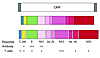
Inability to recognize incident infection has traditionally limited both scientific and public health approaches to HIV disease. Recently, some laboratories have begun adding HIV nucleic acid amplification testing to HIV diagnostic testing algorithms so that acute (antibody-negative) HIV infections can be routinely detected within the first 1–3 weeks of exposure. In this review article, we will highlight critical opportunities for HIV treatment and prevention that are presented by these diagnostic strategies.
Authors
Christopher D. Pilcher, Joseph J. Eron Jr., Shannon Galvin, Cynthia Gay, Myron S. Cohen
Abstract
Dengue is an expanding public health problem, and an effective vaccine remains elusive. This review discusses how the significant influence of sequential infection with different dengue virus serotypes on the severity of disease can be viewed in terms of beneficial and detrimental effects of heterologous immunity. A more complete understanding of these effects is likely to be critical for predicting optimal vaccine-induced immune responses.
Authors
Alan L. Rothman

Abstract
Human population growth, technological advances, and changing social behaviors lead to the selection of new microbial pathogens. Antimicrobial drugs, vaccines, diagnostics, and treatments for emerging infectious diseases must be developed. The selective forces that drive the emergence of new infectious diseases, and the implications for our survival, are just beginning to be understood.
Authors
Vincent R. Racaniello
No posts were found with this tag.


Copyright © 2025 American Society for Clinical Investigation
ISSN: 0021-9738 (print), 1558-8238 (online)