
Go to JCI Insight
  • About
  • Editors
  • Consulting Editors
  • For authors
  • Journal stats
  • Publication ethics
  • Publication alerts by email
  • Advertising
  • Job board
  • Contact
  • Clinical Research and Public Health
  • Current issue
  • Past issues
  • By specialty
    • COVID-19
    • Cardiology
    • Gastroenterology
    • Immunology
    • Metabolism
    • Nephrology
    • Neuroscience
    • Oncology
    • Pulmonology
    • Vascular biology
    • All ...
  • Videos
    • ASCI Milestone Awards
    • Video Abstracts
    • Conversations with Giants in Medicine
  • Reviews
    • View all reviews ...
    • The cGAS-STING pathway: DNA sensing in health and disease (Jun 2026)
    • Neurodegeneration (Mar 2026)
    • Clinical innovation and scientific progress in GLP-1 medicine (Nov 2025)
    • Pancreatic Cancer (Jul 2025)
    • Complement Biology and Therapeutics (May 2025)
    • Evolving insights into MASLD and MASH pathogenesis and treatment (Apr 2025)
    • Microbiome in Health and Disease (Feb 2025)
    • View all review series ...
  • Viewpoint
  • Collections
    • In-Press Preview
    • Clinical Research and Public Health
    • Research Letters
    • Letters to the Editor
    • Editorials
    • Commentaries
    • Editor's notes
    • Reviews
    • Viewpoints
    • 100th anniversary
    • Top read articles

  • Current issue
  • Past issues
  • Specialties
  • Reviews
  • Review series
  • ASCI Milestone Awards
  • Video Abstracts
  • Conversations with Giants in Medicine
  • In-Press Preview
  • Clinical Research and Public Health
  • Research Letters
  • Letters to the Editor
  • Editorials
  • Commentaries
  • Editor's notes
  • Reviews
  • Viewpoints
  • 100th anniversary
  • Top read articles
  • About
  • Editors
  • Consulting Editors
  • For authors
  • Journal stats
  • Publication ethics
  • Publication alerts by email
  • Advertising
  • Job board
  • Contact

Dodging the checkpoint
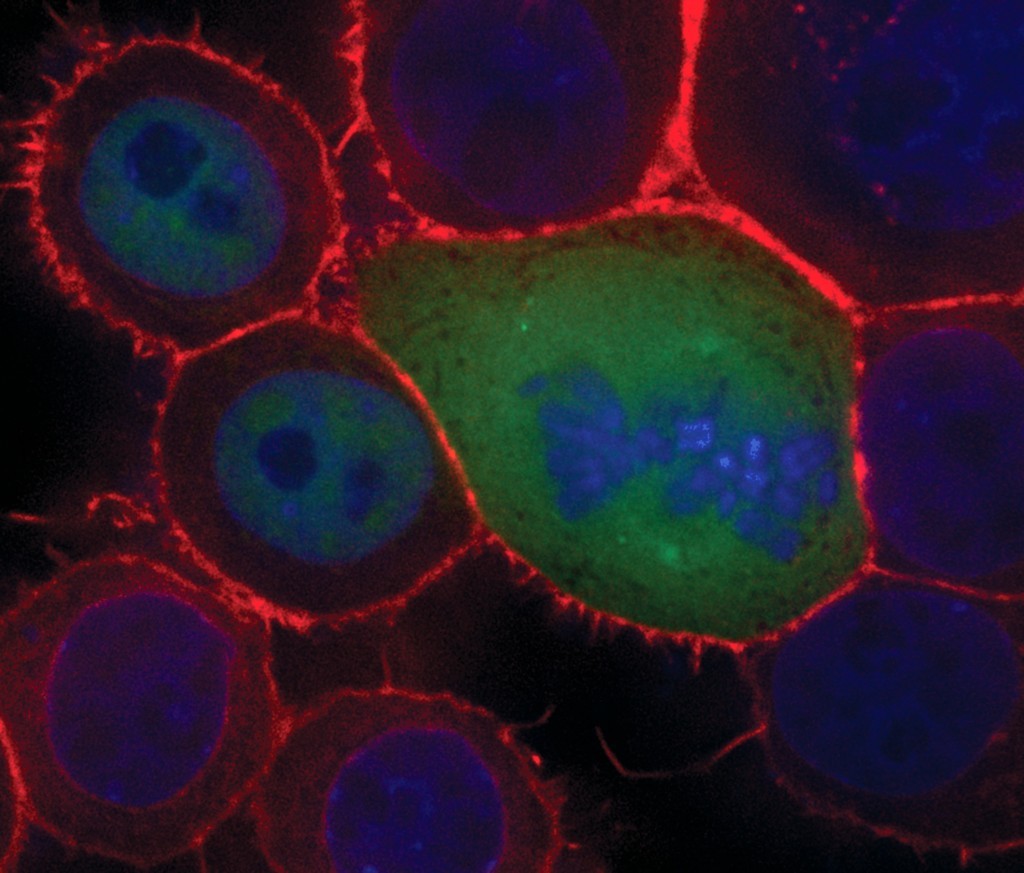

Patients with the genetic disorder Fanconi anemia (FA) are prone to cancer due to genomic instability. Mutations in any one of fifteen FA associated genes can lead to abnormal chromosome numbers, though the role of FA proteins in chromosomal segregation is unclear. Grzegorz Nalepa and colleagues at Indiana University found that FA proteins are required for the spindle assemble checkpoint, which prevents duplicate chromosome separation until each chromosome is attached to the spindle apparatus. Individual FA proteins localized to different components of the mitotic apparatus and are required for high-fidelity chromosome segregation during cell division. This study provides insight into how FA pathway disruption leads to an inappropriate number of chromosomes in dividing cells and subsequent cancer development. The accompanying micrograph shows that FA protein C (green) localizes to the centromeres in a mitotic cell (outlined by actin staining (red)) during prometaphase (chromosomes stained blue with DAPI).

Published August 15, 2013, by Corinne Williams

Scientific Show Stopper

Related articles

Fanconi anemia signaling network regulates the spindle assembly checkpoint
Grzegorz Nalepa, Rikki Enzor, Zejin Sun, Christophe Marchal, Su-Jung Park, Yanzhu Yang, Laura Tedeschi, Stephanie Kelich, Helmut Hanenberg, D. Wade Clapp
View: Text | PDF
Research Article Hematology

Fanconi anemia signaling network regulates the spindle assembly checkpoint

  • Text
  • PDF
Abstract

Fanconi anemia (FA) is a heterogenous genetic disease with a high risk of cancer. The FA proteins are essential for interphase DNA damage repair; however, it is incompletely understood why FA-deficient cells also develop gross aneuploidy, leading to cancer. Here, we systematically evaluated the role of the FA proteins in chromosome segregation through functional RNAi screens and analysis of primary cells from patients with FA. We found that FA signaling is essential for the spindle assembly checkpoint and is therefore required for high-fidelity chromosome segregation and prevention of aneuploidy. Furthermore, we discovered that FA proteins differentially localize to key structures of the mitotic apparatus in a cell cycle–dependent manner. The essential role of the FA pathway in mitosis offers a mechanistic explanation for the aneuploidy and malignant transformation known to occur after disruption of FA signaling. Collectively, our findings provide insight into the genetically unstable cancers resulting from inactivation of the FA/BRCA pathway.

Authors

Grzegorz Nalepa, Rikki Enzor, Zejin Sun, Christophe Marchal, Su-Jung Park, Yanzhu Yang, Laura Tedeschi, Stephanie Kelich, Helmut Hanenberg, D. Wade Clapp

×
Advertisement

Copyright © 2026 American Society for Clinical Investigation
ISSN: 0021-9738 (print), 1558-8238 (online)

Sign up for email alerts