
Reparative response in the liver
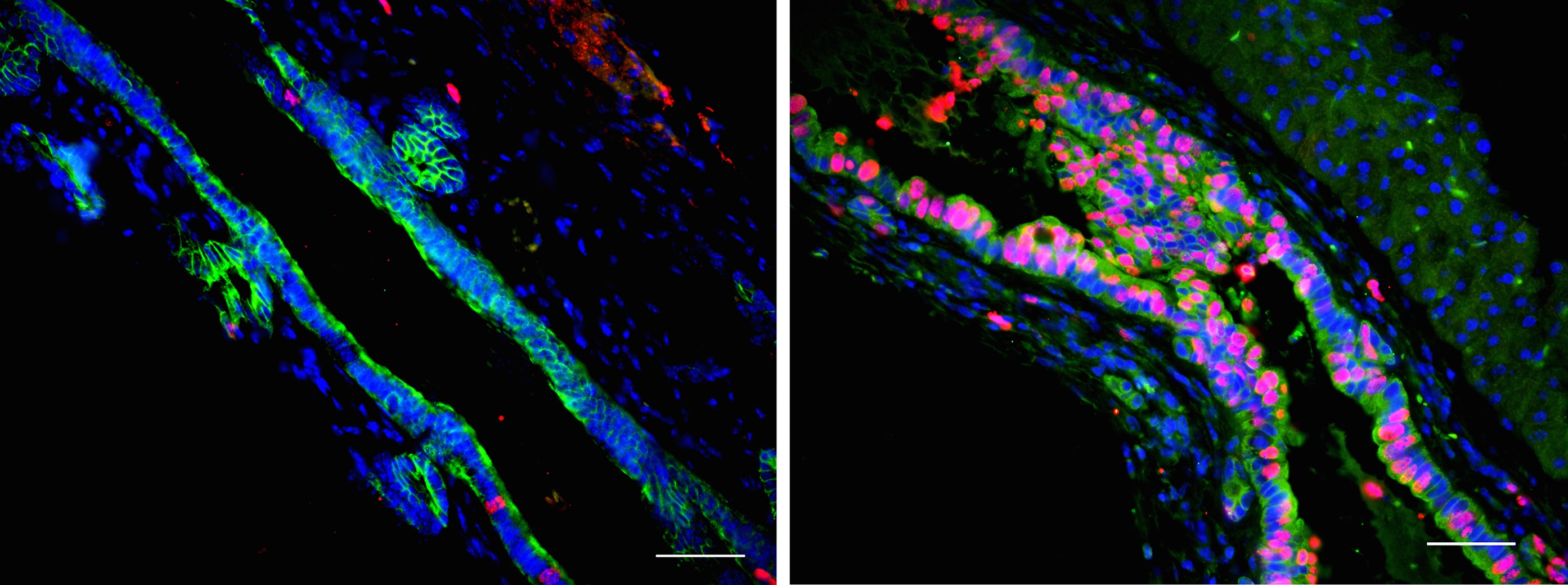
Damage to the biliary epithelium induces inflammation and fibrosis, which can lead to severe liver disease and malignancy. Many biliary injury-associated diseases are associated with induction of a Th1 response; however, some patients with biliary atresia present with increased levels of Th2-associated cytokines, and it is not clear if a particular inflammatory response following biliary injury promotes epithelial repair or carcinogenesis. Jun Li and colleagues at the University of Cincinnati College of Medicine revealed that the cytokine IL-33, a Th2-promoting cytokine, is upregulated in biliary atresia patient serum as well as the bile ducts and serum of mice with experimental biliary atresia. In WT mice, administration of IL-33 promoted biliary epithelial cell proliferation and a dramatic enlargement of the bile ducts. The authors demonstrated that type 2 innate lymphoid cells (ILC2s) increase in resposne to IL-33 and release high levels of IL-13, which subsequently promotes cholangiocyte hyperplasia. Interestingly, in a biliary injury model, induction of this IL-33/ILC2/IL-13 circuit promoted epithelial repair but induced metastatic cholangiocarcinoma in animals with constitutive activation of oncogenic mediators in bile ducts. The resullts from this study suggest that activating the IL-33/ILC2/IL-13 pathway may improve biliary repair. The accompanying image demostrates induction of biliary epithelium (green) proliferation (BrdU incorporation, red) in response to IL-33 (left panel). Nuclei stained blue with DAPI.
Related articles

Abstract
Injury to the biliary epithelium triggers inflammation and fibrosis, which can result in severe liver diseases and may progress to malignancy. Development of a type 1 immune response has been linked to biliary injury pathogenesis; however, a subset of patients with biliary atresia, the most common childhood cholangiopathy, exhibit increased levels of Th2-promoting cytokines. The relationship among different inflammatory drivers, epithelial repair, and carcinogenesis remains unclear. Here, we determined that the Th2-activating cytokine IL-33 is elevated in biliary atresia patient serum and in the livers and bile ducts of mice with experimental biliary atresia. Administration of IL-33 to WT mice markedly increased cholangiocyte proliferation and promoted sustained cell growth, resulting in dramatic and rapid enlargement of extrahepatic bile ducts. The IL-33–dependent proliferative response was mediated by an increase in the number of type 2 innate lymphoid cells (ILC2s), which released high levels of IL-13 that in turn promoted cholangiocyte hyperplasia. Induction of the IL-33/ILC2/IL-13 circuit in a murine biliary injury model promoted epithelial repair; however, induction of this circuit in mice with constitutive activation of AKT and YAP in bile ducts induced cholangiocarcinoma with liver metastases. These findings reveal that IL-33 mediates epithelial proliferation and suggest that activation of IL-33/ILC2/IL-13 may improve biliary repair and disruption of the circuit may block progression of carcinogenesis.
Authors
Jun Li, Nataliya Razumilava, Gregory J. Gores, Stephanie Walters, Tatsuki Mizuochi, Reena Mourya, Kazuhiko Bessho, Yui-Hsi Wang, Shannon S. Glaser, Pranavkumar Shivakumar, Jorge A. Bezerra


Copyright © 2026 American Society for Clinical Investigation
ISSN: 0021-9738 (print), 1558-8238 (online)