
Submit a comment
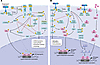
Abstract
Somatic alterations in the phosphoinositide 3-kinase (PI3K) pathway are frequent oncogenic drivers in cancer and are particularly relevant in estrogen receptor–positive breast cancer, where PI3K signaling integrates hormonal, growth factor, and metabolic inputs. Therapeutic targeting of PI3K has been limited by toxicity, pathway crosstalk, and adaptive resistance. Recent advances in structural and functional characterization of PIK3CA mutations have enabled the development of more selective inhibitors, including PI3K isoform–selective and emerging allosteric PI3Ka mutant–targeted compounds. These approaches aim to improve the therapeutic index while maintaining pathway inhibition. In parallel, combination strategies with endocrine therapy and CDK4/6 inhibitors have demonstrated clinical benefit in selected patient populations. However, responses are often transient owing to compensatory signaling and pathway reactivation. Additional metabolic and transcriptional adaptations further contribute to sustaining tumor cell survival. Overall, PI3K-targeted therapy is evolving along two complementary paths: increased mutant-selective inhibition to improve therapeutic index and broader pathway-level strategies designed to overcome adaptive resistance and achieve more durable responses. Ongoing efforts focus on optimizing combination strategies, enhancing development of predictive biomarkers, and improving therapeutic sequencing to achieve durable responses while minimizing toxicity.
Authors
Fabiana Napolitano, Nisha Unni, Carlos L. Arteaga
Guidelines
The Editorial Board will only consider comments that are deemed relevant and of interest to readers. The Journal will not post data that have not been subjected to peer review; or a comment that is essentially a reiteration of another comment.
- Comments appear on the Journal’s website and are linked from the original article’s web page.
- Authors are notified by email if their comments are posted.
- The Journal reserves the right to edit comments for length and clarity.
- No appeals will be considered.
- Comments are not indexed in PubMed.
Specific requirements
- Maximum length, 400 words
- Entered as plain text or HTML
- Author’s name and email address, to be posted with the comment
- Declaration of all potential conflicts of interest (even if these are not ultimately posted); see the Journal’s conflict-of-interest policy
- Comments may not include figures


Copyright © 2026 American Society for Clinical Investigation
ISSN: 0021-9738 (print), 1558-8238 (online)