
Go to JCI Insight
  • About
  • Editors
  • Consulting Editors
  • For authors
  • Journal stats
  • Publication ethics
  • Publication alerts by email
  • Advertising
  • Job board
  • Contact
  • Clinical Research and Public Health
  • Current issue
  • Past issues
  • By specialty
    • COVID-19
    • Cardiology
    • Gastroenterology
    • Immunology
    • Metabolism
    • Nephrology
    • Neuroscience
    • Oncology
    • Pulmonology
    • Vascular biology
    • All ...
  • Videos
    • ASCI Milestone Awards
    • Video Abstracts
    • Conversations with Giants in Medicine
  • Reviews
    • View all reviews ...
    • The cGAS-STING pathway: DNA sensing in health and disease (Jun 2026)
    • Neurodegeneration (Mar 2026)
    • Clinical innovation and scientific progress in GLP-1 medicine (Nov 2025)
    • Pancreatic Cancer (Jul 2025)
    • Complement Biology and Therapeutics (May 2025)
    • Evolving insights into MASLD and MASH pathogenesis and treatment (Apr 2025)
    • Microbiome in Health and Disease (Feb 2025)
    • View all review series ...
  • Viewpoint
  • Collections
    • In-Press Preview
    • Clinical Research and Public Health
    • Research Letters
    • Letters to the Editor
    • Editorials
    • Commentaries
    • Editor's notes
    • Reviews
    • Viewpoints
    • 100th anniversary
    • Top read articles

  • Current issue
  • Past issues
  • Specialties
  • Reviews
  • Review series
  • ASCI Milestone Awards
  • Video Abstracts
  • Conversations with Giants in Medicine
  • In-Press Preview
  • Clinical Research and Public Health
  • Research Letters
  • Letters to the Editor
  • Editorials
  • Commentaries
  • Editor's notes
  • Reviews
  • Viewpoints
  • 100th anniversary
  • Top read articles
  • About
  • Editors
  • Consulting Editors
  • For authors
  • Journal stats
  • Publication ethics
  • Publication alerts by email
  • Advertising
  • Job board
  • Contact

Submit a comment

FGFR3-driven gene regulatory network analysis reveals a protumoral role for p63 in luminal bladder tumors
Aura Moreno-Vega, Macarena Zambrano, Lilia Estrada-Virrueta, Xiangyu Meng, Julia Puig, Helene Neyret-Kahn, Mingjun Shi, Florent Dufour, Guerric Gilbert, Ke Li, Clarice Groeneveld, Jacqueline Fontugne, Mercedes Pérez-Escavy, Wajdi Dhifli, Clément Hua, Luc Cabel, Clémentine Krucker, Laura Tanguy, Sia Viborg Lindskrog, Claire Beraud, Yanina V. Langle, Tao Ye, Fariza Tahi, Irwin Davidson, Jesus M. Paramio, Lars Dyrskjøt, Yves Allory, Philippe Lluel, Ana Maria Eiján, Mohamed Elati, François Radvanyi, Catalina Lodillinsky, Isabelle Bernard-Pierrot
View: Text | PDF
Research Article Genetics Oncology

FGFR3-driven gene regulatory network analysis reveals a protumoral role for p63 in luminal bladder tumors

  • Text
  • PDF
Abstract

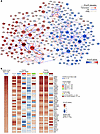
Fibroblast growth factor receptor 3 (FGFR3) is one of the most frequently altered genes in bladder cancer, primarily through activating mutations that drive oncogenesis and are enriched in luminal tumors. However, the underlying gene regulatory network (GRN) remains poorly characterized. Here, we constructed an FGFR3-mutated GRN using a bottom-up bioinformatics approach, integrating transcriptomic data from bladder cancer cell lines, FGFR3-mutated tumors, and FGFR3 perturbation experiments in human and mouse models. Using publicly available CRISPR/Cas9 screening data, we identified transcription factors from this GRN that regulate the viability of FGFR3-mutated cells, with a focus on p63 (TP63). We showed that FGFR3 activation upregulates p63 in patient-derived xenografts and cell lines, while single-cell RNA sequencing revealed heterogeneous p63 activation associated with basal differentiation. Functional studies, including TP63 knockdown in FGFR3-dependent in vitro and in vivo models and RNA-seq along with p63 ChIP-seq, demonstrated that p63 directly promotes cell proliferation and migration and uncovered a positive feedback loop between FGFR3 and p63. Together, these findings support p63 as a protumorigenic regulator in FGFR3-mutated tumors despite their luminal differentiation and provide a detailed FGFR3-driven GRN, offering insights into FGFR3-induced oncogenic dependency and potential strategies to circumvent resistance to FGFR inhibitors.

Authors

Aura Moreno-Vega, Macarena Zambrano, Lilia Estrada-Virrueta, Xiangyu Meng, Julia Puig, Helene Neyret-Kahn, Mingjun Shi, Florent Dufour, Guerric Gilbert, Ke Li, Clarice Groeneveld, Jacqueline Fontugne, Mercedes Pérez-Escavy, Wajdi Dhifli, Clément Hua, Luc Cabel, Clémentine Krucker, Laura Tanguy, Sia Viborg Lindskrog, Claire Beraud, Yanina V. Langle, Tao Ye, Fariza Tahi, Irwin Davidson, Jesus M. Paramio, Lars Dyrskjøt, Yves Allory, Philippe Lluel, Ana Maria Eiján, Mohamed Elati, François Radvanyi, Catalina Lodillinsky, Isabelle Bernard-Pierrot

×

Guidelines

The Editorial Board will only consider comments that are deemed relevant and of interest to readers. The Journal will not post data that have not been subjected to peer review; or a comment that is essentially a reiteration of another comment.

  • Comments appear on the Journal’s website and are linked from the original article’s web page.
  • Authors are notified by email if their comments are posted.
  • The Journal reserves the right to edit comments for length and clarity.
  • No appeals will be considered.
  • Comments are not indexed in PubMed.

Specific requirements

  • Maximum length, 400 words
  • Entered as plain text or HTML
  • Author’s name and email address, to be posted with the comment
  • Declaration of all potential conflicts of interest (even if these are not ultimately posted); see the Journal’s conflict-of-interest policy
  • Comments may not include figures
This field is required

Copyright © 2026 American Society for Clinical Investigation
ISSN: 0021-9738 (print), 1558-8238 (online)

Sign up for email alerts