
Go to JCI Insight
  • About
  • Editors
  • Consulting Editors
  • For authors
  • Publication ethics
  • Publication alerts by email
  • Advertising
  • Job board
  • Contact
  • Clinical Research and Public Health
  • Current issue
  • Past issues
  • By specialty
    • COVID-19
    • Cardiology
    • Gastroenterology
    • Immunology
    • Metabolism
    • Nephrology
    • Neuroscience
    • Oncology
    • Pulmonology
    • Vascular biology
    • All ...
  • Videos
    • Conversations with Giants in Medicine
    • Video Abstracts
  • Reviews
    • View all reviews ...
    • Clinical innovation and scientific progress in GLP-1 medicine (Nov 2025)
    • Pancreatic Cancer (Jul 2025)
    • Complement Biology and Therapeutics (May 2025)
    • Evolving insights into MASLD and MASH pathogenesis and treatment (Apr 2025)
    • Microbiome in Health and Disease (Feb 2025)
    • Substance Use Disorders (Oct 2024)
    • Clonal Hematopoiesis (Oct 2024)
    • View all review series ...
  • Viewpoint
  • Collections
    • In-Press Preview
    • Clinical Research and Public Health
    • Research Letters
    • Letters to the Editor
    • Editorials
    • Commentaries
    • Editor's notes
    • Reviews
    • Viewpoints
    • 100th anniversary
    • Top read articles

  • Current issue
  • Past issues
  • Specialties
  • Reviews
  • Review series
  • Conversations with Giants in Medicine
  • Video Abstracts
  • In-Press Preview
  • Clinical Research and Public Health
  • Research Letters
  • Letters to the Editor
  • Editorials
  • Commentaries
  • Editor's notes
  • Reviews
  • Viewpoints
  • 100th anniversary
  • Top read articles
  • About
  • Editors
  • Consulting Editors
  • For authors
  • Publication ethics
  • Publication alerts by email
  • Advertising
  • Job board
  • Contact
Sialic acid is a critical fetal defense against maternal complement attack
Markus Abeln, Iris Albers, Ulrike Peters-Bernard, Kerstin Flächsig-Schulz, Elina Kats, Andreas Kispert, Stephen Tomlinson, Rita Gerardy-Schahn, Anja Münster-Kühnel, Birgit Weinhold
View: Text | PDF
Research Article Immunology Reproductive biology

Sialic acid is a critical fetal defense against maternal complement attack

  • Text
  • PDF
Abstract

The negatively charged sugar sialic acid (Sia) occupies the outermost position in the bulk of cell surface glycans. Lack of sialylated glycans due to genetic ablation of the Sia-activating enzyme CMP–sialic acid synthase (CMAS) resulted in embryonic lethality around day 9.5 post coitum (E9.5) in mice. Developmental failure was caused by complement activation on trophoblasts in Cmas–/– implants and was accompanied by infiltration of maternal neutrophils at the fetal-maternal interface, intrauterine growth restriction, impaired placental development, and a thickened Reichert’s membrane. This phenotype, which shared features with complement receptor 1-related protein Y (Crry) depletion, was rescued in E8.5 Cmas–/– mice upon injection of cobra venom factor, resulting in exhaustion of the maternal complement component C3. Here we show that Sia is dispensable for early development of the embryo proper but pivotal for fetal-maternal immune homeostasis during pregnancy, i.e., for protecting the allograft implant against attack by the maternal innate immune system. Finally, embryos devoid of cell surface sialylation suffered from malnutrition due to inadequate placentation as a secondary effect.

Authors

Markus Abeln, Iris Albers, Ulrike Peters-Bernard, Kerstin Flächsig-Schulz, Elina Kats, Andreas Kispert, Stephen Tomlinson, Rita Gerardy-Schahn, Anja Münster-Kühnel, Birgit Weinhold

×

Figure 6

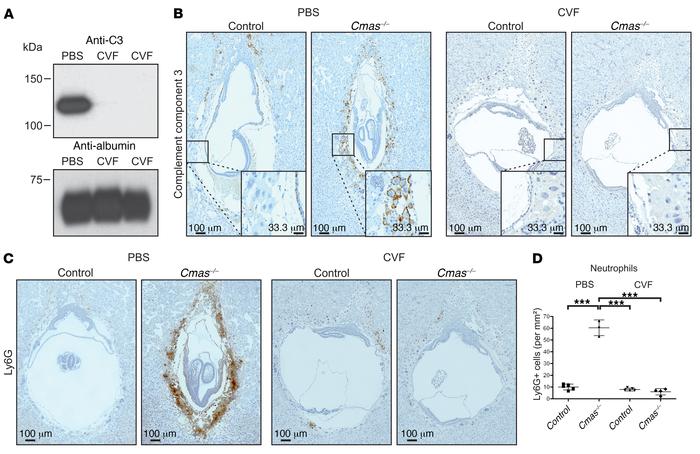
CVF decomplements the maternal serum and rescues the inflammatory phenotype of Cmas–/– implants.
Options: View larger image (or click on image) Download as PowerPoint
CVF decomplements the maternal serum and rescues the inflammatory phenot...
(A) C3 Western blot analysis. Serum of PBS- or CVF-treated pregnant mice at E8.5 was separated by SDS-PAGE and immunostained with anti-C3 antibody. C3 protein was only detectable in PBS-treated mice, but was depleted in CVF-treated pregnant mice. Anti-albumin staining was used as loading control. (B) C3 immunohistochemical staining of sagittal paraffin sections of E8.5 embryos within the uterus of PBS- or CVF-treated mice. In PBS-treated mothers, C3 reactivity was restricted to the EPC in control implants, but was expanded to the entire fetal-maternal interface in Cmas–/– embryos, with strong staining at the surface of TGCs. In implants of CVF-treated mothers, the C3 reactivity was abolished irrespective of the genotype. Insets show fetal TGCs. (C) Ly6G immunohistochemical staining for neutrophils on sagittal paraffin sections of E8.5 uteri from PBS- or CVF-treated mice. Ly6G-positive cells are sparsely distributed in proximity of control embryos of PBS-treated mothers. In contrast, the entire fetal-maternal boundary of Cmas–/– implants is infiltrated with Ly6G-positive cells in PBS-treated mice. CVF treatment does not change the phenotype of controls but reverts Ly6G staining of Cmas–/– implants to that of controls. (D) Quantification of Ly6G-positive cells (neutrophils) on sagittal paraffin sections of E8.5 uteri of PBS- or CVF-treated pregnant mice. Error bars indicate SD. Statistical analyses were performed by ANOVA with Newman-Keuls post test (***P < 0.001). Images are representative of experiments of 3 PBS-treated pregnant mice with n = 5 control and n = 3 Cmas–/– embryos, and of 3 CVF-treated pregnant mice with n = 5 control and n = 4 Cmas–/– embryos (B–D).

Copyright © 2026 American Society for Clinical Investigation
ISSN: 0021-9738 (print), 1558-8238 (online)

Sign up for email alerts