
Advertisement
Commentary
Open Access |  10.1172/JCI206031
Liver-derived ceramides link metabolism to tissue wasting in cancer cachexia
Kerui Huang,1 Norbert Perrimon,1,2 and Marcus D. Goncalves3
1Department of Genetics, Blavatnik Institute, Harvard Medical School, Harvard University, Boston, Massachusetts, USA.
2Howard Hughes Medical Institute, Boston, Massachusetts, USA.
3NYU Grossman School of Medicine, New York, New York, USA.
Address correspondence to: Marcus D. Goncalves, Holman Division of Endocrinology, Diabetes and Metabolism, NYU Grossman School of Medicine, 435 E. 30th Street, SB Rm. 617, New York, New York, 10016, USA. Email: Marcus.goncalves@nyulangone.org.
Find articles by Huang, K. in: PubMed | Google Scholar
1Department of Genetics, Blavatnik Institute, Harvard Medical School, Harvard University, Boston, Massachusetts, USA.
2Howard Hughes Medical Institute, Boston, Massachusetts, USA.
3NYU Grossman School of Medicine, New York, New York, USA.
Address correspondence to: Marcus D. Goncalves, Holman Division of Endocrinology, Diabetes and Metabolism, NYU Grossman School of Medicine, 435 E. 30th Street, SB Rm. 617, New York, New York, 10016, USA. Email: Marcus.goncalves@nyulangone.org.
Find articles by Perrimon, N. in: PubMed | Google Scholar
1Department of Genetics, Blavatnik Institute, Harvard Medical School, Harvard University, Boston, Massachusetts, USA.
2Howard Hughes Medical Institute, Boston, Massachusetts, USA.
3NYU Grossman School of Medicine, New York, New York, USA.
Address correspondence to: Marcus D. Goncalves, Holman Division of Endocrinology, Diabetes and Metabolism, NYU Grossman School of Medicine, 435 E. 30th Street, SB Rm. 617, New York, New York, 10016, USA. Email: Marcus.goncalves@nyulangone.org.
Find articles by
Goncalves, M.
in:
PubMed
|
Google Scholar
|

Published May 15, 2026 - More info
J Clin Invest. 2026;136(10):e206031. https://doi.org/10.1172/JCI206031.
© 2026 Huang et al. This work is licensed under the Creative Commons Attribution 4.0 International License. To view a copy of this license, visit http://creativecommons.org/licenses/by/4.0/.

Related article:
Abstract
Cachexia is a metabolic wasting syndrome affecting many patients with cancer, with poor survival outcomes. Disturbed lipid metabolism is a hallmark of cachexia, and our previous work has identified increased levels of circulating ceramides, which are bioactive lipids with adverse effects in metabolic diseases, as biomarkers for cachexia in mouse models and patients. Here, we investigated the role of ceramides on cachexia development using the well-established C26 colon carcinoma model. We demonstrated that elevated ceramides in cachexia arose from increased liver synthesis. We showed that ceramides directly contributed to impaired mitochondrial function and energy homeostasis in cachexia target tissues. Targeting ceramide synthesis using miRNA interference, or myriocin, an approved compound targeting the key synthesis enzyme serine palmitoyltransferase (SPT), improved markers of muscle atrophy in cachectic male mice. Importantly, we demonstrated that key enzymes involved in ceramide production were also elevated in livers, but not in other organs, of patients with cancer cachexia, correlating with disease severity. Our data place ceramides as contributors to metabolic dysfunction in cachexia and highlight the suitability of the ceramide synthesis pathway for therapeutic targeting.
Authors
Pauline Morigny, Honglei Ji, Laura Cussonneau, Sabrina Zorzato, Yun Kwon, Fabien Riols, Doris Kaltenecker, Alisa Maier, Vignesh Karthikaisamy, Samantha Corrà, Tanja Krauss, Claudine Seeliger, Syed Qaaifah Gillani, Joël J. Tissink, Sandra Lacas-Gervais, Tuna Felix Samanci, Adriano Maida, Raul Terron-Exposito, Angela Trinca, Christine von Toerne, Leonardo Nogara, Melina Claussnitzer, Olga Prokopchuk, Jeannine Bachmann, Mauricio Berriel Diaz, Laure B. Bindels, Ondrej Kuda, Hans Hauner, Mark Haid, Stephan Herzig, Carlo Fiore Viscomi, Jerome Gilleron, Anja Zeigerer, Bert Blaauw, Maria Rohm
-
Targeting hepatic ceramide synthesis preserves muscle mass
In this issue of the JCI, Morigny et al. addressed this question using the C26 colon carcinoma model of cachexia (8), which exhibits elevated levels of circulating ceramides. The authors first established the liver as the dominant source of these circulating ceramides in cachectic mice: hepatocyte-specific knockdown of the SPT subunit SPTLC2 via adeno-associated virus–delivered (AAV-delivered) miRNA (miR) nearly completely normalized hepatic and plasma ceramide levels. Having identified the tissue of origin, they then tested the therapeutic relevance of this pathway. Pharmacologic inhibition of SPT with myriocin significantly reduced body weight loss and preserved cardiac and skeletal muscle mass and grip strength, all without affecting tumor growth in the cachectic mice. Adipose tissue loss, by contrast, was unaffected. Hepatocyte-specific genetic knockdown of SPTLC2 recapitulated these effects, confirming that the benefits were attributable to ceramide synthesis rather than off-target activity of myriocin. The concordance between pharmacologic and genetic approaches, tested across early and advanced cachexia time points, substantially strengthens the causal inference.
A critical advance in this study is the dissociation of hepatic ceramide synthesis from lipolysis-driven fatty acid flux. Animals subjected to 24-hour fasting, which recapitulates the body composition changes and elevated circulating fatty acids seen in cachexia, showed no increase in hepatic ceramide synthesis enzyme expression. Instead, IL-6 neutralization in C26 tumor–bearing mice almost completely reversed the upregulation of these enzymes, and LPS challenge reproduced the induction. These experiments place inflammatory signaling, not substrate availability, as the upstream trigger. An emerging body of work places the liver at the center of cachexia pathogenesis, whereby inflammation, neural inputs, and intrinsic transcriptional programs converge to drive the production of circulating factors that promote systemic wasting (9, 10). The current study extends this framework by demonstrating that the liver converts tumor-driven inflammation into a circulating lipotoxic signal (Figure 1).
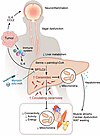 Figure 1
Elevated hepatic production of ceramides drive energetic failure in cachexia. Schematic illustration depicts the liver as a central hub that integrates tumor-, immune-, and CNS-derived signals to orchestrate cachexia-associated metabolic rewiring, producing lipotoxic mediators and hepatokines that drive muscle atrophy, cardiac dysfunction, and white adipose tissue (WAT) wasting. The findings of Morigny, Rohm, and colleagues (8) implicate increased circulating ceramides in cachexia’s complex pathobiology and position sphingolipid metabolism as a potential target for cachexia interventions.
Article tools
- Download citation information
- Send a comment
- Terms of use
- Standard abbreviations
- Need help? Email the journal
Metrics
Go to
- Top
- Abstract
- Circulating metabolite signals in cachexia
- Targeting hepatic ceramide synthesis preserves muscle mass
- Elevated ceramides drive energetic failure by impairing mitochondria
- Outstanding questions and translational implications
- Conflict of interest
- Funding support
- Footnotes
- References
- Version history


Copyright © 2026 American Society for Clinical Investigation
ISSN: 0021-9738 (print), 1558-8238 (online)