
Advertisement
Research ArticleMetabolismOncology
Open Access |  10.1172/JCI194687
Inhibition of ceramide synthesis ameliorates body wasting in a cancer cachexia model
Pauline Morigny,1,2,3 Honglei Ji,1,2,3 Laura Cussonneau,4,5 Sabrina Zorzato,4,5 Yun Kwon,6 Fabien Riols,7 Doris Kaltenecker,1,2,3 Alisa Maier,1,2,3 Vignesh Karthikaisamy,1,2,3 Samantha Corrà,4 Tanja Krauss,8 Claudine Seeliger,8,9 Syed Qaaifah Gillani,1,2,3,6 Joël J. Tissink,1,2,3,6 Sandra Lacas-Gervais,10 Tuna Felix Samanci,1,2,3 Adriano Maida,1,2,3 Raul Terron-Exposito,1,2,3 Angela Trinca,1,2,3 Christine von Toerne,7 Leonardo Nogara,4,5,11 Melina Claussnitzer,12,13,14 Olga Prokopchuk,15 Jeannine Bachmann,15 Mauricio Berriel Diaz,1,2,3 Laure B. Bindels,16,17 Ondrej Kuda,18 Hans Hauner,3,8,9,19 Mark Haid,7 Stephan Herzig,1,2,3,20 Carlo Fiore Viscomi,4,21 Jerome Gilleron,22 Anja Zeigerer,1,2,3,6 Bert Blaauw,4,5 and Maria Rohm1,2,3,23
1Institute for Diabetes and Cancer (IDC), Helmholtz Munich, Neuherberg, Germany.
2Joint Heidelberg-IDC Translational Diabetes Program, University Hospital, Heidelberg, Germany.
3German Center for Diabetes Research (DZD), Munich, Germany.
4Veneto Institute of Molecular Medicine, Padua, Italy.
5Department of Biomedical Sciences, University of Padua, Padua, Italy.
6European Center for Angioscience, Medical Faculty Mannheim, Heidelberg University, Mannheim, Germany.
7Metabolomics and Proteomics Core Facility, Helmholtz Munich, Neuherberg, Germany.
8Else Kröner Fresenius Center for Nutritional Medicine, School of Life Sciences, and
9ZIEL Institute for Food and Health, Technical University of Munich, Freising-Weihenstephan, Germany.
10Université Côte d’Azur, Centre Commun de Microscopie Appliqué, Nice, France.
11Department of Pharmaceutical Sciences, University of Padua, Padua, Italy.
12Novo Nordisk Foundation Center for Genomic Mechanisms of Disease, Broad Institute of MIT and Harvard, Cambridge, Massachusetts, USA.
13Diabetes Unit and Center for Genomic Medicine, Massachusetts General Hospital, Boston, Massachusetts, USA.
14Department of Medicine, Harvard Medical School, Boston, Massachusetts, USA.
15Department of Surgery, Klinikum rechts der Isar, School of Medicine, Technical University of Munich, Munich, Germany.
16Metabolism and Nutrition Research Group, Louvain Drug Research Institute, Université Catholique de Louvain, Brussels, Belgium.
17Welbio Department, WEL Research Institute, Wavre, Belgium.
18Laboratory of Metabolism of Bioactive Lipids, Institute of Physiology of the Czech Academy of Sciences, Prague, Czechia.
19Institute of Nutritional Medicine, School of Medicine and Health, and
20Chair Molecular Metabolic Control, Technical University Munich, Munich, Germany.
21Department of Biosciences, University of Milano, Milano, Italy
22Université Côte d’Azur, INSERM, Adipo-Cible Research Study Group, Mediterranean Center of Molecular Medicine (C3M), Team “Insulin Resistance in Obesity and Type 2 Diabetes”, Nice, France.
23German Center for Cardiovascular Research (DZHK), partner site Munich Heart Alliance, Munich, Germany.
Address correspondence to: Maria Rohm, Institute for Diabetes and Cancer, Helmholtz Munich, Ingolstädter Landstraße 1, 85764, Neuherberg, Germany. Phone: 49.89.3187.1861; Email: maria.rohm@helmholtz-munich.de. Or to: Pauline Morigny, Institute for Metabolic and Cardiovascular Diseases (I2MC), Inserm/ University of Toulouse, 1 avenue Jean Poulhès, 31432, Toulouse, France. Phone: 33.5.31224077; Email: pauline.morigny@inserm.fr.
Find articles by Morigny, P. in: PubMed | Google Scholar
1Institute for Diabetes and Cancer (IDC), Helmholtz Munich, Neuherberg, Germany.
2Joint Heidelberg-IDC Translational Diabetes Program, University Hospital, Heidelberg, Germany.
3German Center for Diabetes Research (DZD), Munich, Germany.
4Veneto Institute of Molecular Medicine, Padua, Italy.
5Department of Biomedical Sciences, University of Padua, Padua, Italy.
6European Center for Angioscience, Medical Faculty Mannheim, Heidelberg University, Mannheim, Germany.
7Metabolomics and Proteomics Core Facility, Helmholtz Munich, Neuherberg, Germany.
8Else Kröner Fresenius Center for Nutritional Medicine, School of Life Sciences, and
9ZIEL Institute for Food and Health, Technical University of Munich, Freising-Weihenstephan, Germany.
10Université Côte d’Azur, Centre Commun de Microscopie Appliqué, Nice, France.
11Department of Pharmaceutical Sciences, University of Padua, Padua, Italy.
12Novo Nordisk Foundation Center for Genomic Mechanisms of Disease, Broad Institute of MIT and Harvard, Cambridge, Massachusetts, USA.
13Diabetes Unit and Center for Genomic Medicine, Massachusetts General Hospital, Boston, Massachusetts, USA.
14Department of Medicine, Harvard Medical School, Boston, Massachusetts, USA.
15Department of Surgery, Klinikum rechts der Isar, School of Medicine, Technical University of Munich, Munich, Germany.
16Metabolism and Nutrition Research Group, Louvain Drug Research Institute, Université Catholique de Louvain, Brussels, Belgium.
17Welbio Department, WEL Research Institute, Wavre, Belgium.
18Laboratory of Metabolism of Bioactive Lipids, Institute of Physiology of the Czech Academy of Sciences, Prague, Czechia.
19Institute of Nutritional Medicine, School of Medicine and Health, and
20Chair Molecular Metabolic Control, Technical University Munich, Munich, Germany.
21Department of Biosciences, University of Milano, Milano, Italy
22Université Côte d’Azur, INSERM, Adipo-Cible Research Study Group, Mediterranean Center of Molecular Medicine (C3M), Team “Insulin Resistance in Obesity and Type 2 Diabetes”, Nice, France.
23German Center for Cardiovascular Research (DZHK), partner site Munich Heart Alliance, Munich, Germany.
Address correspondence to: Maria Rohm, Institute for Diabetes and Cancer, Helmholtz Munich, Ingolstädter Landstraße 1, 85764, Neuherberg, Germany. Phone: 49.89.3187.1861; Email: maria.rohm@helmholtz-munich.de. Or to: Pauline Morigny, Institute for Metabolic and Cardiovascular Diseases (I2MC), Inserm/ University of Toulouse, 1 avenue Jean Poulhès, 31432, Toulouse, France. Phone: 33.5.31224077; Email: pauline.morigny@inserm.fr.
Find articles by Ji, H. in: PubMed | Google Scholar
1Institute for Diabetes and Cancer (IDC), Helmholtz Munich, Neuherberg, Germany.
2Joint Heidelberg-IDC Translational Diabetes Program, University Hospital, Heidelberg, Germany.
3German Center for Diabetes Research (DZD), Munich, Germany.
4Veneto Institute of Molecular Medicine, Padua, Italy.
5Department of Biomedical Sciences, University of Padua, Padua, Italy.
6European Center for Angioscience, Medical Faculty Mannheim, Heidelberg University, Mannheim, Germany.
7Metabolomics and Proteomics Core Facility, Helmholtz Munich, Neuherberg, Germany.
8Else Kröner Fresenius Center for Nutritional Medicine, School of Life Sciences, and
9ZIEL Institute for Food and Health, Technical University of Munich, Freising-Weihenstephan, Germany.
10Université Côte d’Azur, Centre Commun de Microscopie Appliqué, Nice, France.
11Department of Pharmaceutical Sciences, University of Padua, Padua, Italy.
12Novo Nordisk Foundation Center for Genomic Mechanisms of Disease, Broad Institute of MIT and Harvard, Cambridge, Massachusetts, USA.
13Diabetes Unit and Center for Genomic Medicine, Massachusetts General Hospital, Boston, Massachusetts, USA.
14Department of Medicine, Harvard Medical School, Boston, Massachusetts, USA.
15Department of Surgery, Klinikum rechts der Isar, School of Medicine, Technical University of Munich, Munich, Germany.
16Metabolism and Nutrition Research Group, Louvain Drug Research Institute, Université Catholique de Louvain, Brussels, Belgium.
17Welbio Department, WEL Research Institute, Wavre, Belgium.
18Laboratory of Metabolism of Bioactive Lipids, Institute of Physiology of the Czech Academy of Sciences, Prague, Czechia.
19Institute of Nutritional Medicine, School of Medicine and Health, and
20Chair Molecular Metabolic Control, Technical University Munich, Munich, Germany.
21Department of Biosciences, University of Milano, Milano, Italy
22Université Côte d’Azur, INSERM, Adipo-Cible Research Study Group, Mediterranean Center of Molecular Medicine (C3M), Team “Insulin Resistance in Obesity and Type 2 Diabetes”, Nice, France.
23German Center for Cardiovascular Research (DZHK), partner site Munich Heart Alliance, Munich, Germany.
Address correspondence to: Maria Rohm, Institute for Diabetes and Cancer, Helmholtz Munich, Ingolstädter Landstraße 1, 85764, Neuherberg, Germany. Phone: 49.89.3187.1861; Email: maria.rohm@helmholtz-munich.de. Or to: Pauline Morigny, Institute for Metabolic and Cardiovascular Diseases (I2MC), Inserm/ University of Toulouse, 1 avenue Jean Poulhès, 31432, Toulouse, France. Phone: 33.5.31224077; Email: pauline.morigny@inserm.fr.
Find articles by Cussonneau, L. in: PubMed | Google Scholar
1Institute for Diabetes and Cancer (IDC), Helmholtz Munich, Neuherberg, Germany.
2Joint Heidelberg-IDC Translational Diabetes Program, University Hospital, Heidelberg, Germany.
3German Center for Diabetes Research (DZD), Munich, Germany.
4Veneto Institute of Molecular Medicine, Padua, Italy.
5Department of Biomedical Sciences, University of Padua, Padua, Italy.
6European Center for Angioscience, Medical Faculty Mannheim, Heidelberg University, Mannheim, Germany.
7Metabolomics and Proteomics Core Facility, Helmholtz Munich, Neuherberg, Germany.
8Else Kröner Fresenius Center for Nutritional Medicine, School of Life Sciences, and
9ZIEL Institute for Food and Health, Technical University of Munich, Freising-Weihenstephan, Germany.
10Université Côte d’Azur, Centre Commun de Microscopie Appliqué, Nice, France.
11Department of Pharmaceutical Sciences, University of Padua, Padua, Italy.
12Novo Nordisk Foundation Center for Genomic Mechanisms of Disease, Broad Institute of MIT and Harvard, Cambridge, Massachusetts, USA.
13Diabetes Unit and Center for Genomic Medicine, Massachusetts General Hospital, Boston, Massachusetts, USA.
14Department of Medicine, Harvard Medical School, Boston, Massachusetts, USA.
15Department of Surgery, Klinikum rechts der Isar, School of Medicine, Technical University of Munich, Munich, Germany.
16Metabolism and Nutrition Research Group, Louvain Drug Research Institute, Université Catholique de Louvain, Brussels, Belgium.
17Welbio Department, WEL Research Institute, Wavre, Belgium.
18Laboratory of Metabolism of Bioactive Lipids, Institute of Physiology of the Czech Academy of Sciences, Prague, Czechia.
19Institute of Nutritional Medicine, School of Medicine and Health, and
20Chair Molecular Metabolic Control, Technical University Munich, Munich, Germany.
21Department of Biosciences, University of Milano, Milano, Italy
22Université Côte d’Azur, INSERM, Adipo-Cible Research Study Group, Mediterranean Center of Molecular Medicine (C3M), Team “Insulin Resistance in Obesity and Type 2 Diabetes”, Nice, France.
23German Center for Cardiovascular Research (DZHK), partner site Munich Heart Alliance, Munich, Germany.
Address correspondence to: Maria Rohm, Institute for Diabetes and Cancer, Helmholtz Munich, Ingolstädter Landstraße 1, 85764, Neuherberg, Germany. Phone: 49.89.3187.1861; Email: maria.rohm@helmholtz-munich.de. Or to: Pauline Morigny, Institute for Metabolic and Cardiovascular Diseases (I2MC), Inserm/ University of Toulouse, 1 avenue Jean Poulhès, 31432, Toulouse, France. Phone: 33.5.31224077; Email: pauline.morigny@inserm.fr.
Find articles by Zorzato, S. in: PubMed | Google Scholar
1Institute for Diabetes and Cancer (IDC), Helmholtz Munich, Neuherberg, Germany.
2Joint Heidelberg-IDC Translational Diabetes Program, University Hospital, Heidelberg, Germany.
3German Center for Diabetes Research (DZD), Munich, Germany.
4Veneto Institute of Molecular Medicine, Padua, Italy.
5Department of Biomedical Sciences, University of Padua, Padua, Italy.
6European Center for Angioscience, Medical Faculty Mannheim, Heidelberg University, Mannheim, Germany.
7Metabolomics and Proteomics Core Facility, Helmholtz Munich, Neuherberg, Germany.
8Else Kröner Fresenius Center for Nutritional Medicine, School of Life Sciences, and
9ZIEL Institute for Food and Health, Technical University of Munich, Freising-Weihenstephan, Germany.
10Université Côte d’Azur, Centre Commun de Microscopie Appliqué, Nice, France.
11Department of Pharmaceutical Sciences, University of Padua, Padua, Italy.
12Novo Nordisk Foundation Center for Genomic Mechanisms of Disease, Broad Institute of MIT and Harvard, Cambridge, Massachusetts, USA.
13Diabetes Unit and Center for Genomic Medicine, Massachusetts General Hospital, Boston, Massachusetts, USA.
14Department of Medicine, Harvard Medical School, Boston, Massachusetts, USA.
15Department of Surgery, Klinikum rechts der Isar, School of Medicine, Technical University of Munich, Munich, Germany.
16Metabolism and Nutrition Research Group, Louvain Drug Research Institute, Université Catholique de Louvain, Brussels, Belgium.
17Welbio Department, WEL Research Institute, Wavre, Belgium.
18Laboratory of Metabolism of Bioactive Lipids, Institute of Physiology of the Czech Academy of Sciences, Prague, Czechia.
19Institute of Nutritional Medicine, School of Medicine and Health, and
20Chair Molecular Metabolic Control, Technical University Munich, Munich, Germany.
21Department of Biosciences, University of Milano, Milano, Italy
22Université Côte d’Azur, INSERM, Adipo-Cible Research Study Group, Mediterranean Center of Molecular Medicine (C3M), Team “Insulin Resistance in Obesity and Type 2 Diabetes”, Nice, France.
23German Center for Cardiovascular Research (DZHK), partner site Munich Heart Alliance, Munich, Germany.
Address correspondence to: Maria Rohm, Institute for Diabetes and Cancer, Helmholtz Munich, Ingolstädter Landstraße 1, 85764, Neuherberg, Germany. Phone: 49.89.3187.1861; Email: maria.rohm@helmholtz-munich.de. Or to: Pauline Morigny, Institute for Metabolic and Cardiovascular Diseases (I2MC), Inserm/ University of Toulouse, 1 avenue Jean Poulhès, 31432, Toulouse, France. Phone: 33.5.31224077; Email: pauline.morigny@inserm.fr.
Find articles by Kwon, Y. in: PubMed | Google Scholar
1Institute for Diabetes and Cancer (IDC), Helmholtz Munich, Neuherberg, Germany.
2Joint Heidelberg-IDC Translational Diabetes Program, University Hospital, Heidelberg, Germany.
3German Center for Diabetes Research (DZD), Munich, Germany.
4Veneto Institute of Molecular Medicine, Padua, Italy.
5Department of Biomedical Sciences, University of Padua, Padua, Italy.
6European Center for Angioscience, Medical Faculty Mannheim, Heidelberg University, Mannheim, Germany.
7Metabolomics and Proteomics Core Facility, Helmholtz Munich, Neuherberg, Germany.
8Else Kröner Fresenius Center for Nutritional Medicine, School of Life Sciences, and
9ZIEL Institute for Food and Health, Technical University of Munich, Freising-Weihenstephan, Germany.
10Université Côte d’Azur, Centre Commun de Microscopie Appliqué, Nice, France.
11Department of Pharmaceutical Sciences, University of Padua, Padua, Italy.
12Novo Nordisk Foundation Center for Genomic Mechanisms of Disease, Broad Institute of MIT and Harvard, Cambridge, Massachusetts, USA.
13Diabetes Unit and Center for Genomic Medicine, Massachusetts General Hospital, Boston, Massachusetts, USA.
14Department of Medicine, Harvard Medical School, Boston, Massachusetts, USA.
15Department of Surgery, Klinikum rechts der Isar, School of Medicine, Technical University of Munich, Munich, Germany.
16Metabolism and Nutrition Research Group, Louvain Drug Research Institute, Université Catholique de Louvain, Brussels, Belgium.
17Welbio Department, WEL Research Institute, Wavre, Belgium.
18Laboratory of Metabolism of Bioactive Lipids, Institute of Physiology of the Czech Academy of Sciences, Prague, Czechia.
19Institute of Nutritional Medicine, School of Medicine and Health, and
20Chair Molecular Metabolic Control, Technical University Munich, Munich, Germany.
21Department of Biosciences, University of Milano, Milano, Italy
22Université Côte d’Azur, INSERM, Adipo-Cible Research Study Group, Mediterranean Center of Molecular Medicine (C3M), Team “Insulin Resistance in Obesity and Type 2 Diabetes”, Nice, France.
23German Center for Cardiovascular Research (DZHK), partner site Munich Heart Alliance, Munich, Germany.
Address correspondence to: Maria Rohm, Institute for Diabetes and Cancer, Helmholtz Munich, Ingolstädter Landstraße 1, 85764, Neuherberg, Germany. Phone: 49.89.3187.1861; Email: maria.rohm@helmholtz-munich.de. Or to: Pauline Morigny, Institute for Metabolic and Cardiovascular Diseases (I2MC), Inserm/ University of Toulouse, 1 avenue Jean Poulhès, 31432, Toulouse, France. Phone: 33.5.31224077; Email: pauline.morigny@inserm.fr.
Find articles by Riols, F. in: PubMed | Google Scholar
1Institute for Diabetes and Cancer (IDC), Helmholtz Munich, Neuherberg, Germany.
2Joint Heidelberg-IDC Translational Diabetes Program, University Hospital, Heidelberg, Germany.
3German Center for Diabetes Research (DZD), Munich, Germany.
4Veneto Institute of Molecular Medicine, Padua, Italy.
5Department of Biomedical Sciences, University of Padua, Padua, Italy.
6European Center for Angioscience, Medical Faculty Mannheim, Heidelberg University, Mannheim, Germany.
7Metabolomics and Proteomics Core Facility, Helmholtz Munich, Neuherberg, Germany.
8Else Kröner Fresenius Center for Nutritional Medicine, School of Life Sciences, and
9ZIEL Institute for Food and Health, Technical University of Munich, Freising-Weihenstephan, Germany.
10Université Côte d’Azur, Centre Commun de Microscopie Appliqué, Nice, France.
11Department of Pharmaceutical Sciences, University of Padua, Padua, Italy.
12Novo Nordisk Foundation Center for Genomic Mechanisms of Disease, Broad Institute of MIT and Harvard, Cambridge, Massachusetts, USA.
13Diabetes Unit and Center for Genomic Medicine, Massachusetts General Hospital, Boston, Massachusetts, USA.
14Department of Medicine, Harvard Medical School, Boston, Massachusetts, USA.
15Department of Surgery, Klinikum rechts der Isar, School of Medicine, Technical University of Munich, Munich, Germany.
16Metabolism and Nutrition Research Group, Louvain Drug Research Institute, Université Catholique de Louvain, Brussels, Belgium.
17Welbio Department, WEL Research Institute, Wavre, Belgium.
18Laboratory of Metabolism of Bioactive Lipids, Institute of Physiology of the Czech Academy of Sciences, Prague, Czechia.
19Institute of Nutritional Medicine, School of Medicine and Health, and
20Chair Molecular Metabolic Control, Technical University Munich, Munich, Germany.
21Department of Biosciences, University of Milano, Milano, Italy
22Université Côte d’Azur, INSERM, Adipo-Cible Research Study Group, Mediterranean Center of Molecular Medicine (C3M), Team “Insulin Resistance in Obesity and Type 2 Diabetes”, Nice, France.
23German Center for Cardiovascular Research (DZHK), partner site Munich Heart Alliance, Munich, Germany.
Address correspondence to: Maria Rohm, Institute for Diabetes and Cancer, Helmholtz Munich, Ingolstädter Landstraße 1, 85764, Neuherberg, Germany. Phone: 49.89.3187.1861; Email: maria.rohm@helmholtz-munich.de. Or to: Pauline Morigny, Institute for Metabolic and Cardiovascular Diseases (I2MC), Inserm/ University of Toulouse, 1 avenue Jean Poulhès, 31432, Toulouse, France. Phone: 33.5.31224077; Email: pauline.morigny@inserm.fr.
Find articles by Kaltenecker, D. in: PubMed | Google Scholar
1Institute for Diabetes and Cancer (IDC), Helmholtz Munich, Neuherberg, Germany.
2Joint Heidelberg-IDC Translational Diabetes Program, University Hospital, Heidelberg, Germany.
3German Center for Diabetes Research (DZD), Munich, Germany.
4Veneto Institute of Molecular Medicine, Padua, Italy.
5Department of Biomedical Sciences, University of Padua, Padua, Italy.
6European Center for Angioscience, Medical Faculty Mannheim, Heidelberg University, Mannheim, Germany.
7Metabolomics and Proteomics Core Facility, Helmholtz Munich, Neuherberg, Germany.
8Else Kröner Fresenius Center for Nutritional Medicine, School of Life Sciences, and
9ZIEL Institute for Food and Health, Technical University of Munich, Freising-Weihenstephan, Germany.
10Université Côte d’Azur, Centre Commun de Microscopie Appliqué, Nice, France.
11Department of Pharmaceutical Sciences, University of Padua, Padua, Italy.
12Novo Nordisk Foundation Center for Genomic Mechanisms of Disease, Broad Institute of MIT and Harvard, Cambridge, Massachusetts, USA.
13Diabetes Unit and Center for Genomic Medicine, Massachusetts General Hospital, Boston, Massachusetts, USA.
14Department of Medicine, Harvard Medical School, Boston, Massachusetts, USA.
15Department of Surgery, Klinikum rechts der Isar, School of Medicine, Technical University of Munich, Munich, Germany.
16Metabolism and Nutrition Research Group, Louvain Drug Research Institute, Université Catholique de Louvain, Brussels, Belgium.
17Welbio Department, WEL Research Institute, Wavre, Belgium.
18Laboratory of Metabolism of Bioactive Lipids, Institute of Physiology of the Czech Academy of Sciences, Prague, Czechia.
19Institute of Nutritional Medicine, School of Medicine and Health, and
20Chair Molecular Metabolic Control, Technical University Munich, Munich, Germany.
21Department of Biosciences, University of Milano, Milano, Italy
22Université Côte d’Azur, INSERM, Adipo-Cible Research Study Group, Mediterranean Center of Molecular Medicine (C3M), Team “Insulin Resistance in Obesity and Type 2 Diabetes”, Nice, France.
23German Center for Cardiovascular Research (DZHK), partner site Munich Heart Alliance, Munich, Germany.
Address correspondence to: Maria Rohm, Institute for Diabetes and Cancer, Helmholtz Munich, Ingolstädter Landstraße 1, 85764, Neuherberg, Germany. Phone: 49.89.3187.1861; Email: maria.rohm@helmholtz-munich.de. Or to: Pauline Morigny, Institute for Metabolic and Cardiovascular Diseases (I2MC), Inserm/ University of Toulouse, 1 avenue Jean Poulhès, 31432, Toulouse, France. Phone: 33.5.31224077; Email: pauline.morigny@inserm.fr.
Find articles by Maier, A. in: PubMed | Google Scholar
1Institute for Diabetes and Cancer (IDC), Helmholtz Munich, Neuherberg, Germany.
2Joint Heidelberg-IDC Translational Diabetes Program, University Hospital, Heidelberg, Germany.
3German Center for Diabetes Research (DZD), Munich, Germany.
4Veneto Institute of Molecular Medicine, Padua, Italy.
5Department of Biomedical Sciences, University of Padua, Padua, Italy.
6European Center for Angioscience, Medical Faculty Mannheim, Heidelberg University, Mannheim, Germany.
7Metabolomics and Proteomics Core Facility, Helmholtz Munich, Neuherberg, Germany.
8Else Kröner Fresenius Center for Nutritional Medicine, School of Life Sciences, and
9ZIEL Institute for Food and Health, Technical University of Munich, Freising-Weihenstephan, Germany.
10Université Côte d’Azur, Centre Commun de Microscopie Appliqué, Nice, France.
11Department of Pharmaceutical Sciences, University of Padua, Padua, Italy.
12Novo Nordisk Foundation Center for Genomic Mechanisms of Disease, Broad Institute of MIT and Harvard, Cambridge, Massachusetts, USA.
13Diabetes Unit and Center for Genomic Medicine, Massachusetts General Hospital, Boston, Massachusetts, USA.
14Department of Medicine, Harvard Medical School, Boston, Massachusetts, USA.
15Department of Surgery, Klinikum rechts der Isar, School of Medicine, Technical University of Munich, Munich, Germany.
16Metabolism and Nutrition Research Group, Louvain Drug Research Institute, Université Catholique de Louvain, Brussels, Belgium.
17Welbio Department, WEL Research Institute, Wavre, Belgium.
18Laboratory of Metabolism of Bioactive Lipids, Institute of Physiology of the Czech Academy of Sciences, Prague, Czechia.
19Institute of Nutritional Medicine, School of Medicine and Health, and
20Chair Molecular Metabolic Control, Technical University Munich, Munich, Germany.
21Department of Biosciences, University of Milano, Milano, Italy
22Université Côte d’Azur, INSERM, Adipo-Cible Research Study Group, Mediterranean Center of Molecular Medicine (C3M), Team “Insulin Resistance in Obesity and Type 2 Diabetes”, Nice, France.
23German Center for Cardiovascular Research (DZHK), partner site Munich Heart Alliance, Munich, Germany.
Address correspondence to: Maria Rohm, Institute for Diabetes and Cancer, Helmholtz Munich, Ingolstädter Landstraße 1, 85764, Neuherberg, Germany. Phone: 49.89.3187.1861; Email: maria.rohm@helmholtz-munich.de. Or to: Pauline Morigny, Institute for Metabolic and Cardiovascular Diseases (I2MC), Inserm/ University of Toulouse, 1 avenue Jean Poulhès, 31432, Toulouse, France. Phone: 33.5.31224077; Email: pauline.morigny@inserm.fr.
Find articles by Karthikaisamy, V. in: PubMed | Google Scholar
1Institute for Diabetes and Cancer (IDC), Helmholtz Munich, Neuherberg, Germany.
2Joint Heidelberg-IDC Translational Diabetes Program, University Hospital, Heidelberg, Germany.
3German Center for Diabetes Research (DZD), Munich, Germany.
4Veneto Institute of Molecular Medicine, Padua, Italy.
5Department of Biomedical Sciences, University of Padua, Padua, Italy.
6European Center for Angioscience, Medical Faculty Mannheim, Heidelberg University, Mannheim, Germany.
7Metabolomics and Proteomics Core Facility, Helmholtz Munich, Neuherberg, Germany.
8Else Kröner Fresenius Center for Nutritional Medicine, School of Life Sciences, and
9ZIEL Institute for Food and Health, Technical University of Munich, Freising-Weihenstephan, Germany.
10Université Côte d’Azur, Centre Commun de Microscopie Appliqué, Nice, France.
11Department of Pharmaceutical Sciences, University of Padua, Padua, Italy.
12Novo Nordisk Foundation Center for Genomic Mechanisms of Disease, Broad Institute of MIT and Harvard, Cambridge, Massachusetts, USA.
13Diabetes Unit and Center for Genomic Medicine, Massachusetts General Hospital, Boston, Massachusetts, USA.
14Department of Medicine, Harvard Medical School, Boston, Massachusetts, USA.
15Department of Surgery, Klinikum rechts der Isar, School of Medicine, Technical University of Munich, Munich, Germany.
16Metabolism and Nutrition Research Group, Louvain Drug Research Institute, Université Catholique de Louvain, Brussels, Belgium.
17Welbio Department, WEL Research Institute, Wavre, Belgium.
18Laboratory of Metabolism of Bioactive Lipids, Institute of Physiology of the Czech Academy of Sciences, Prague, Czechia.
19Institute of Nutritional Medicine, School of Medicine and Health, and
20Chair Molecular Metabolic Control, Technical University Munich, Munich, Germany.
21Department of Biosciences, University of Milano, Milano, Italy
22Université Côte d’Azur, INSERM, Adipo-Cible Research Study Group, Mediterranean Center of Molecular Medicine (C3M), Team “Insulin Resistance in Obesity and Type 2 Diabetes”, Nice, France.
23German Center for Cardiovascular Research (DZHK), partner site Munich Heart Alliance, Munich, Germany.
Address correspondence to: Maria Rohm, Institute for Diabetes and Cancer, Helmholtz Munich, Ingolstädter Landstraße 1, 85764, Neuherberg, Germany. Phone: 49.89.3187.1861; Email: maria.rohm@helmholtz-munich.de. Or to: Pauline Morigny, Institute for Metabolic and Cardiovascular Diseases (I2MC), Inserm/ University of Toulouse, 1 avenue Jean Poulhès, 31432, Toulouse, France. Phone: 33.5.31224077; Email: pauline.morigny@inserm.fr.
Find articles by Corrà, S. in: PubMed | Google Scholar
1Institute for Diabetes and Cancer (IDC), Helmholtz Munich, Neuherberg, Germany.
2Joint Heidelberg-IDC Translational Diabetes Program, University Hospital, Heidelberg, Germany.
3German Center for Diabetes Research (DZD), Munich, Germany.
4Veneto Institute of Molecular Medicine, Padua, Italy.
5Department of Biomedical Sciences, University of Padua, Padua, Italy.
6European Center for Angioscience, Medical Faculty Mannheim, Heidelberg University, Mannheim, Germany.
7Metabolomics and Proteomics Core Facility, Helmholtz Munich, Neuherberg, Germany.
8Else Kröner Fresenius Center for Nutritional Medicine, School of Life Sciences, and
9ZIEL Institute for Food and Health, Technical University of Munich, Freising-Weihenstephan, Germany.
10Université Côte d’Azur, Centre Commun de Microscopie Appliqué, Nice, France.
11Department of Pharmaceutical Sciences, University of Padua, Padua, Italy.
12Novo Nordisk Foundation Center for Genomic Mechanisms of Disease, Broad Institute of MIT and Harvard, Cambridge, Massachusetts, USA.
13Diabetes Unit and Center for Genomic Medicine, Massachusetts General Hospital, Boston, Massachusetts, USA.
14Department of Medicine, Harvard Medical School, Boston, Massachusetts, USA.
15Department of Surgery, Klinikum rechts der Isar, School of Medicine, Technical University of Munich, Munich, Germany.
16Metabolism and Nutrition Research Group, Louvain Drug Research Institute, Université Catholique de Louvain, Brussels, Belgium.
17Welbio Department, WEL Research Institute, Wavre, Belgium.
18Laboratory of Metabolism of Bioactive Lipids, Institute of Physiology of the Czech Academy of Sciences, Prague, Czechia.
19Institute of Nutritional Medicine, School of Medicine and Health, and
20Chair Molecular Metabolic Control, Technical University Munich, Munich, Germany.
21Department of Biosciences, University of Milano, Milano, Italy
22Université Côte d’Azur, INSERM, Adipo-Cible Research Study Group, Mediterranean Center of Molecular Medicine (C3M), Team “Insulin Resistance in Obesity and Type 2 Diabetes”, Nice, France.
23German Center for Cardiovascular Research (DZHK), partner site Munich Heart Alliance, Munich, Germany.
Address correspondence to: Maria Rohm, Institute for Diabetes and Cancer, Helmholtz Munich, Ingolstädter Landstraße 1, 85764, Neuherberg, Germany. Phone: 49.89.3187.1861; Email: maria.rohm@helmholtz-munich.de. Or to: Pauline Morigny, Institute for Metabolic and Cardiovascular Diseases (I2MC), Inserm/ University of Toulouse, 1 avenue Jean Poulhès, 31432, Toulouse, France. Phone: 33.5.31224077; Email: pauline.morigny@inserm.fr.
Find articles by Krauss, T. in: PubMed | Google Scholar
1Institute for Diabetes and Cancer (IDC), Helmholtz Munich, Neuherberg, Germany.
2Joint Heidelberg-IDC Translational Diabetes Program, University Hospital, Heidelberg, Germany.
3German Center for Diabetes Research (DZD), Munich, Germany.
4Veneto Institute of Molecular Medicine, Padua, Italy.
5Department of Biomedical Sciences, University of Padua, Padua, Italy.
6European Center for Angioscience, Medical Faculty Mannheim, Heidelberg University, Mannheim, Germany.
7Metabolomics and Proteomics Core Facility, Helmholtz Munich, Neuherberg, Germany.
8Else Kröner Fresenius Center for Nutritional Medicine, School of Life Sciences, and
9ZIEL Institute for Food and Health, Technical University of Munich, Freising-Weihenstephan, Germany.
10Université Côte d’Azur, Centre Commun de Microscopie Appliqué, Nice, France.
11Department of Pharmaceutical Sciences, University of Padua, Padua, Italy.
12Novo Nordisk Foundation Center for Genomic Mechanisms of Disease, Broad Institute of MIT and Harvard, Cambridge, Massachusetts, USA.
13Diabetes Unit and Center for Genomic Medicine, Massachusetts General Hospital, Boston, Massachusetts, USA.
14Department of Medicine, Harvard Medical School, Boston, Massachusetts, USA.
15Department of Surgery, Klinikum rechts der Isar, School of Medicine, Technical University of Munich, Munich, Germany.
16Metabolism and Nutrition Research Group, Louvain Drug Research Institute, Université Catholique de Louvain, Brussels, Belgium.
17Welbio Department, WEL Research Institute, Wavre, Belgium.
18Laboratory of Metabolism of Bioactive Lipids, Institute of Physiology of the Czech Academy of Sciences, Prague, Czechia.
19Institute of Nutritional Medicine, School of Medicine and Health, and
20Chair Molecular Metabolic Control, Technical University Munich, Munich, Germany.
21Department of Biosciences, University of Milano, Milano, Italy
22Université Côte d’Azur, INSERM, Adipo-Cible Research Study Group, Mediterranean Center of Molecular Medicine (C3M), Team “Insulin Resistance in Obesity and Type 2 Diabetes”, Nice, France.
23German Center for Cardiovascular Research (DZHK), partner site Munich Heart Alliance, Munich, Germany.
Address correspondence to: Maria Rohm, Institute for Diabetes and Cancer, Helmholtz Munich, Ingolstädter Landstraße 1, 85764, Neuherberg, Germany. Phone: 49.89.3187.1861; Email: maria.rohm@helmholtz-munich.de. Or to: Pauline Morigny, Institute for Metabolic and Cardiovascular Diseases (I2MC), Inserm/ University of Toulouse, 1 avenue Jean Poulhès, 31432, Toulouse, France. Phone: 33.5.31224077; Email: pauline.morigny@inserm.fr.
Find articles by
Seeliger, C.
in:
PubMed
|
Google Scholar
|

1Institute for Diabetes and Cancer (IDC), Helmholtz Munich, Neuherberg, Germany.
2Joint Heidelberg-IDC Translational Diabetes Program, University Hospital, Heidelberg, Germany.
3German Center for Diabetes Research (DZD), Munich, Germany.
4Veneto Institute of Molecular Medicine, Padua, Italy.
5Department of Biomedical Sciences, University of Padua, Padua, Italy.
6European Center for Angioscience, Medical Faculty Mannheim, Heidelberg University, Mannheim, Germany.
7Metabolomics and Proteomics Core Facility, Helmholtz Munich, Neuherberg, Germany.
8Else Kröner Fresenius Center for Nutritional Medicine, School of Life Sciences, and
9ZIEL Institute for Food and Health, Technical University of Munich, Freising-Weihenstephan, Germany.
10Université Côte d’Azur, Centre Commun de Microscopie Appliqué, Nice, France.
11Department of Pharmaceutical Sciences, University of Padua, Padua, Italy.
12Novo Nordisk Foundation Center for Genomic Mechanisms of Disease, Broad Institute of MIT and Harvard, Cambridge, Massachusetts, USA.
13Diabetes Unit and Center for Genomic Medicine, Massachusetts General Hospital, Boston, Massachusetts, USA.
14Department of Medicine, Harvard Medical School, Boston, Massachusetts, USA.
15Department of Surgery, Klinikum rechts der Isar, School of Medicine, Technical University of Munich, Munich, Germany.
16Metabolism and Nutrition Research Group, Louvain Drug Research Institute, Université Catholique de Louvain, Brussels, Belgium.
17Welbio Department, WEL Research Institute, Wavre, Belgium.
18Laboratory of Metabolism of Bioactive Lipids, Institute of Physiology of the Czech Academy of Sciences, Prague, Czechia.
19Institute of Nutritional Medicine, School of Medicine and Health, and
20Chair Molecular Metabolic Control, Technical University Munich, Munich, Germany.
21Department of Biosciences, University of Milano, Milano, Italy
22Université Côte d’Azur, INSERM, Adipo-Cible Research Study Group, Mediterranean Center of Molecular Medicine (C3M), Team “Insulin Resistance in Obesity and Type 2 Diabetes”, Nice, France.
23German Center for Cardiovascular Research (DZHK), partner site Munich Heart Alliance, Munich, Germany.
Address correspondence to: Maria Rohm, Institute for Diabetes and Cancer, Helmholtz Munich, Ingolstädter Landstraße 1, 85764, Neuherberg, Germany. Phone: 49.89.3187.1861; Email: maria.rohm@helmholtz-munich.de. Or to: Pauline Morigny, Institute for Metabolic and Cardiovascular Diseases (I2MC), Inserm/ University of Toulouse, 1 avenue Jean Poulhès, 31432, Toulouse, France. Phone: 33.5.31224077; Email: pauline.morigny@inserm.fr.
Find articles by Gillani, S. in: PubMed | Google Scholar
1Institute for Diabetes and Cancer (IDC), Helmholtz Munich, Neuherberg, Germany.
2Joint Heidelberg-IDC Translational Diabetes Program, University Hospital, Heidelberg, Germany.
3German Center for Diabetes Research (DZD), Munich, Germany.
4Veneto Institute of Molecular Medicine, Padua, Italy.
5Department of Biomedical Sciences, University of Padua, Padua, Italy.
6European Center for Angioscience, Medical Faculty Mannheim, Heidelberg University, Mannheim, Germany.
7Metabolomics and Proteomics Core Facility, Helmholtz Munich, Neuherberg, Germany.
8Else Kröner Fresenius Center for Nutritional Medicine, School of Life Sciences, and
9ZIEL Institute for Food and Health, Technical University of Munich, Freising-Weihenstephan, Germany.
10Université Côte d’Azur, Centre Commun de Microscopie Appliqué, Nice, France.
11Department of Pharmaceutical Sciences, University of Padua, Padua, Italy.
12Novo Nordisk Foundation Center for Genomic Mechanisms of Disease, Broad Institute of MIT and Harvard, Cambridge, Massachusetts, USA.
13Diabetes Unit and Center for Genomic Medicine, Massachusetts General Hospital, Boston, Massachusetts, USA.
14Department of Medicine, Harvard Medical School, Boston, Massachusetts, USA.
15Department of Surgery, Klinikum rechts der Isar, School of Medicine, Technical University of Munich, Munich, Germany.
16Metabolism and Nutrition Research Group, Louvain Drug Research Institute, Université Catholique de Louvain, Brussels, Belgium.
17Welbio Department, WEL Research Institute, Wavre, Belgium.
18Laboratory of Metabolism of Bioactive Lipids, Institute of Physiology of the Czech Academy of Sciences, Prague, Czechia.
19Institute of Nutritional Medicine, School of Medicine and Health, and
20Chair Molecular Metabolic Control, Technical University Munich, Munich, Germany.
21Department of Biosciences, University of Milano, Milano, Italy
22Université Côte d’Azur, INSERM, Adipo-Cible Research Study Group, Mediterranean Center of Molecular Medicine (C3M), Team “Insulin Resistance in Obesity and Type 2 Diabetes”, Nice, France.
23German Center for Cardiovascular Research (DZHK), partner site Munich Heart Alliance, Munich, Germany.
Address correspondence to: Maria Rohm, Institute for Diabetes and Cancer, Helmholtz Munich, Ingolstädter Landstraße 1, 85764, Neuherberg, Germany. Phone: 49.89.3187.1861; Email: maria.rohm@helmholtz-munich.de. Or to: Pauline Morigny, Institute for Metabolic and Cardiovascular Diseases (I2MC), Inserm/ University of Toulouse, 1 avenue Jean Poulhès, 31432, Toulouse, France. Phone: 33.5.31224077; Email: pauline.morigny@inserm.fr.
Find articles by Tissink, J. in: PubMed | Google Scholar
1Institute for Diabetes and Cancer (IDC), Helmholtz Munich, Neuherberg, Germany.
2Joint Heidelberg-IDC Translational Diabetes Program, University Hospital, Heidelberg, Germany.
3German Center for Diabetes Research (DZD), Munich, Germany.
4Veneto Institute of Molecular Medicine, Padua, Italy.
5Department of Biomedical Sciences, University of Padua, Padua, Italy.
6European Center for Angioscience, Medical Faculty Mannheim, Heidelberg University, Mannheim, Germany.
7Metabolomics and Proteomics Core Facility, Helmholtz Munich, Neuherberg, Germany.
8Else Kröner Fresenius Center for Nutritional Medicine, School of Life Sciences, and
9ZIEL Institute for Food and Health, Technical University of Munich, Freising-Weihenstephan, Germany.
10Université Côte d’Azur, Centre Commun de Microscopie Appliqué, Nice, France.
11Department of Pharmaceutical Sciences, University of Padua, Padua, Italy.
12Novo Nordisk Foundation Center for Genomic Mechanisms of Disease, Broad Institute of MIT and Harvard, Cambridge, Massachusetts, USA.
13Diabetes Unit and Center for Genomic Medicine, Massachusetts General Hospital, Boston, Massachusetts, USA.
14Department of Medicine, Harvard Medical School, Boston, Massachusetts, USA.
15Department of Surgery, Klinikum rechts der Isar, School of Medicine, Technical University of Munich, Munich, Germany.
16Metabolism and Nutrition Research Group, Louvain Drug Research Institute, Université Catholique de Louvain, Brussels, Belgium.
17Welbio Department, WEL Research Institute, Wavre, Belgium.
18Laboratory of Metabolism of Bioactive Lipids, Institute of Physiology of the Czech Academy of Sciences, Prague, Czechia.
19Institute of Nutritional Medicine, School of Medicine and Health, and
20Chair Molecular Metabolic Control, Technical University Munich, Munich, Germany.
21Department of Biosciences, University of Milano, Milano, Italy
22Université Côte d’Azur, INSERM, Adipo-Cible Research Study Group, Mediterranean Center of Molecular Medicine (C3M), Team “Insulin Resistance in Obesity and Type 2 Diabetes”, Nice, France.
23German Center for Cardiovascular Research (DZHK), partner site Munich Heart Alliance, Munich, Germany.
Address correspondence to: Maria Rohm, Institute for Diabetes and Cancer, Helmholtz Munich, Ingolstädter Landstraße 1, 85764, Neuherberg, Germany. Phone: 49.89.3187.1861; Email: maria.rohm@helmholtz-munich.de. Or to: Pauline Morigny, Institute for Metabolic and Cardiovascular Diseases (I2MC), Inserm/ University of Toulouse, 1 avenue Jean Poulhès, 31432, Toulouse, France. Phone: 33.5.31224077; Email: pauline.morigny@inserm.fr.
Find articles by Lacas-Gervais, S. in: PubMed | Google Scholar
1Institute for Diabetes and Cancer (IDC), Helmholtz Munich, Neuherberg, Germany.
2Joint Heidelberg-IDC Translational Diabetes Program, University Hospital, Heidelberg, Germany.
3German Center for Diabetes Research (DZD), Munich, Germany.
4Veneto Institute of Molecular Medicine, Padua, Italy.
5Department of Biomedical Sciences, University of Padua, Padua, Italy.
6European Center for Angioscience, Medical Faculty Mannheim, Heidelberg University, Mannheim, Germany.
7Metabolomics and Proteomics Core Facility, Helmholtz Munich, Neuherberg, Germany.
8Else Kröner Fresenius Center for Nutritional Medicine, School of Life Sciences, and
9ZIEL Institute for Food and Health, Technical University of Munich, Freising-Weihenstephan, Germany.
10Université Côte d’Azur, Centre Commun de Microscopie Appliqué, Nice, France.
11Department of Pharmaceutical Sciences, University of Padua, Padua, Italy.
12Novo Nordisk Foundation Center for Genomic Mechanisms of Disease, Broad Institute of MIT and Harvard, Cambridge, Massachusetts, USA.
13Diabetes Unit and Center for Genomic Medicine, Massachusetts General Hospital, Boston, Massachusetts, USA.
14Department of Medicine, Harvard Medical School, Boston, Massachusetts, USA.
15Department of Surgery, Klinikum rechts der Isar, School of Medicine, Technical University of Munich, Munich, Germany.
16Metabolism and Nutrition Research Group, Louvain Drug Research Institute, Université Catholique de Louvain, Brussels, Belgium.
17Welbio Department, WEL Research Institute, Wavre, Belgium.
18Laboratory of Metabolism of Bioactive Lipids, Institute of Physiology of the Czech Academy of Sciences, Prague, Czechia.
19Institute of Nutritional Medicine, School of Medicine and Health, and
20Chair Molecular Metabolic Control, Technical University Munich, Munich, Germany.
21Department of Biosciences, University of Milano, Milano, Italy
22Université Côte d’Azur, INSERM, Adipo-Cible Research Study Group, Mediterranean Center of Molecular Medicine (C3M), Team “Insulin Resistance in Obesity and Type 2 Diabetes”, Nice, France.
23German Center for Cardiovascular Research (DZHK), partner site Munich Heart Alliance, Munich, Germany.
Address correspondence to: Maria Rohm, Institute for Diabetes and Cancer, Helmholtz Munich, Ingolstädter Landstraße 1, 85764, Neuherberg, Germany. Phone: 49.89.3187.1861; Email: maria.rohm@helmholtz-munich.de. Or to: Pauline Morigny, Institute for Metabolic and Cardiovascular Diseases (I2MC), Inserm/ University of Toulouse, 1 avenue Jean Poulhès, 31432, Toulouse, France. Phone: 33.5.31224077; Email: pauline.morigny@inserm.fr.
Find articles by Samanci, T. in: PubMed | Google Scholar
1Institute for Diabetes and Cancer (IDC), Helmholtz Munich, Neuherberg, Germany.
2Joint Heidelberg-IDC Translational Diabetes Program, University Hospital, Heidelberg, Germany.
3German Center for Diabetes Research (DZD), Munich, Germany.
4Veneto Institute of Molecular Medicine, Padua, Italy.
5Department of Biomedical Sciences, University of Padua, Padua, Italy.
6European Center for Angioscience, Medical Faculty Mannheim, Heidelberg University, Mannheim, Germany.
7Metabolomics and Proteomics Core Facility, Helmholtz Munich, Neuherberg, Germany.
8Else Kröner Fresenius Center for Nutritional Medicine, School of Life Sciences, and
9ZIEL Institute for Food and Health, Technical University of Munich, Freising-Weihenstephan, Germany.
10Université Côte d’Azur, Centre Commun de Microscopie Appliqué, Nice, France.
11Department of Pharmaceutical Sciences, University of Padua, Padua, Italy.
12Novo Nordisk Foundation Center for Genomic Mechanisms of Disease, Broad Institute of MIT and Harvard, Cambridge, Massachusetts, USA.
13Diabetes Unit and Center for Genomic Medicine, Massachusetts General Hospital, Boston, Massachusetts, USA.
14Department of Medicine, Harvard Medical School, Boston, Massachusetts, USA.
15Department of Surgery, Klinikum rechts der Isar, School of Medicine, Technical University of Munich, Munich, Germany.
16Metabolism and Nutrition Research Group, Louvain Drug Research Institute, Université Catholique de Louvain, Brussels, Belgium.
17Welbio Department, WEL Research Institute, Wavre, Belgium.
18Laboratory of Metabolism of Bioactive Lipids, Institute of Physiology of the Czech Academy of Sciences, Prague, Czechia.
19Institute of Nutritional Medicine, School of Medicine and Health, and
20Chair Molecular Metabolic Control, Technical University Munich, Munich, Germany.
21Department of Biosciences, University of Milano, Milano, Italy
22Université Côte d’Azur, INSERM, Adipo-Cible Research Study Group, Mediterranean Center of Molecular Medicine (C3M), Team “Insulin Resistance in Obesity and Type 2 Diabetes”, Nice, France.
23German Center for Cardiovascular Research (DZHK), partner site Munich Heart Alliance, Munich, Germany.
Address correspondence to: Maria Rohm, Institute for Diabetes and Cancer, Helmholtz Munich, Ingolstädter Landstraße 1, 85764, Neuherberg, Germany. Phone: 49.89.3187.1861; Email: maria.rohm@helmholtz-munich.de. Or to: Pauline Morigny, Institute for Metabolic and Cardiovascular Diseases (I2MC), Inserm/ University of Toulouse, 1 avenue Jean Poulhès, 31432, Toulouse, France. Phone: 33.5.31224077; Email: pauline.morigny@inserm.fr.
Find articles by Maida, A. in: PubMed | Google Scholar
1Institute for Diabetes and Cancer (IDC), Helmholtz Munich, Neuherberg, Germany.
2Joint Heidelberg-IDC Translational Diabetes Program, University Hospital, Heidelberg, Germany.
3German Center for Diabetes Research (DZD), Munich, Germany.
4Veneto Institute of Molecular Medicine, Padua, Italy.
5Department of Biomedical Sciences, University of Padua, Padua, Italy.
6European Center for Angioscience, Medical Faculty Mannheim, Heidelberg University, Mannheim, Germany.
7Metabolomics and Proteomics Core Facility, Helmholtz Munich, Neuherberg, Germany.
8Else Kröner Fresenius Center for Nutritional Medicine, School of Life Sciences, and
9ZIEL Institute for Food and Health, Technical University of Munich, Freising-Weihenstephan, Germany.
10Université Côte d’Azur, Centre Commun de Microscopie Appliqué, Nice, France.
11Department of Pharmaceutical Sciences, University of Padua, Padua, Italy.
12Novo Nordisk Foundation Center for Genomic Mechanisms of Disease, Broad Institute of MIT and Harvard, Cambridge, Massachusetts, USA.
13Diabetes Unit and Center for Genomic Medicine, Massachusetts General Hospital, Boston, Massachusetts, USA.
14Department of Medicine, Harvard Medical School, Boston, Massachusetts, USA.
15Department of Surgery, Klinikum rechts der Isar, School of Medicine, Technical University of Munich, Munich, Germany.
16Metabolism and Nutrition Research Group, Louvain Drug Research Institute, Université Catholique de Louvain, Brussels, Belgium.
17Welbio Department, WEL Research Institute, Wavre, Belgium.
18Laboratory of Metabolism of Bioactive Lipids, Institute of Physiology of the Czech Academy of Sciences, Prague, Czechia.
19Institute of Nutritional Medicine, School of Medicine and Health, and
20Chair Molecular Metabolic Control, Technical University Munich, Munich, Germany.
21Department of Biosciences, University of Milano, Milano, Italy
22Université Côte d’Azur, INSERM, Adipo-Cible Research Study Group, Mediterranean Center of Molecular Medicine (C3M), Team “Insulin Resistance in Obesity and Type 2 Diabetes”, Nice, France.
23German Center for Cardiovascular Research (DZHK), partner site Munich Heart Alliance, Munich, Germany.
Address correspondence to: Maria Rohm, Institute for Diabetes and Cancer, Helmholtz Munich, Ingolstädter Landstraße 1, 85764, Neuherberg, Germany. Phone: 49.89.3187.1861; Email: maria.rohm@helmholtz-munich.de. Or to: Pauline Morigny, Institute for Metabolic and Cardiovascular Diseases (I2MC), Inserm/ University of Toulouse, 1 avenue Jean Poulhès, 31432, Toulouse, France. Phone: 33.5.31224077; Email: pauline.morigny@inserm.fr.
Find articles by Terron-Exposito, R. in: PubMed | Google Scholar
1Institute for Diabetes and Cancer (IDC), Helmholtz Munich, Neuherberg, Germany.
2Joint Heidelberg-IDC Translational Diabetes Program, University Hospital, Heidelberg, Germany.
3German Center for Diabetes Research (DZD), Munich, Germany.
4Veneto Institute of Molecular Medicine, Padua, Italy.
5Department of Biomedical Sciences, University of Padua, Padua, Italy.
6European Center for Angioscience, Medical Faculty Mannheim, Heidelberg University, Mannheim, Germany.
7Metabolomics and Proteomics Core Facility, Helmholtz Munich, Neuherberg, Germany.
8Else Kröner Fresenius Center for Nutritional Medicine, School of Life Sciences, and
9ZIEL Institute for Food and Health, Technical University of Munich, Freising-Weihenstephan, Germany.
10Université Côte d’Azur, Centre Commun de Microscopie Appliqué, Nice, France.
11Department of Pharmaceutical Sciences, University of Padua, Padua, Italy.
12Novo Nordisk Foundation Center for Genomic Mechanisms of Disease, Broad Institute of MIT and Harvard, Cambridge, Massachusetts, USA.
13Diabetes Unit and Center for Genomic Medicine, Massachusetts General Hospital, Boston, Massachusetts, USA.
14Department of Medicine, Harvard Medical School, Boston, Massachusetts, USA.
15Department of Surgery, Klinikum rechts der Isar, School of Medicine, Technical University of Munich, Munich, Germany.
16Metabolism and Nutrition Research Group, Louvain Drug Research Institute, Université Catholique de Louvain, Brussels, Belgium.
17Welbio Department, WEL Research Institute, Wavre, Belgium.
18Laboratory of Metabolism of Bioactive Lipids, Institute of Physiology of the Czech Academy of Sciences, Prague, Czechia.
19Institute of Nutritional Medicine, School of Medicine and Health, and
20Chair Molecular Metabolic Control, Technical University Munich, Munich, Germany.
21Department of Biosciences, University of Milano, Milano, Italy
22Université Côte d’Azur, INSERM, Adipo-Cible Research Study Group, Mediterranean Center of Molecular Medicine (C3M), Team “Insulin Resistance in Obesity and Type 2 Diabetes”, Nice, France.
23German Center for Cardiovascular Research (DZHK), partner site Munich Heart Alliance, Munich, Germany.
Address correspondence to: Maria Rohm, Institute for Diabetes and Cancer, Helmholtz Munich, Ingolstädter Landstraße 1, 85764, Neuherberg, Germany. Phone: 49.89.3187.1861; Email: maria.rohm@helmholtz-munich.de. Or to: Pauline Morigny, Institute for Metabolic and Cardiovascular Diseases (I2MC), Inserm/ University of Toulouse, 1 avenue Jean Poulhès, 31432, Toulouse, France. Phone: 33.5.31224077; Email: pauline.morigny@inserm.fr.
Find articles by Trinca, A. in: PubMed | Google Scholar
1Institute for Diabetes and Cancer (IDC), Helmholtz Munich, Neuherberg, Germany.
2Joint Heidelberg-IDC Translational Diabetes Program, University Hospital, Heidelberg, Germany.
3German Center for Diabetes Research (DZD), Munich, Germany.
4Veneto Institute of Molecular Medicine, Padua, Italy.
5Department of Biomedical Sciences, University of Padua, Padua, Italy.
6European Center for Angioscience, Medical Faculty Mannheim, Heidelberg University, Mannheim, Germany.
7Metabolomics and Proteomics Core Facility, Helmholtz Munich, Neuherberg, Germany.
8Else Kröner Fresenius Center for Nutritional Medicine, School of Life Sciences, and
9ZIEL Institute for Food and Health, Technical University of Munich, Freising-Weihenstephan, Germany.
10Université Côte d’Azur, Centre Commun de Microscopie Appliqué, Nice, France.
11Department of Pharmaceutical Sciences, University of Padua, Padua, Italy.
12Novo Nordisk Foundation Center for Genomic Mechanisms of Disease, Broad Institute of MIT and Harvard, Cambridge, Massachusetts, USA.
13Diabetes Unit and Center for Genomic Medicine, Massachusetts General Hospital, Boston, Massachusetts, USA.
14Department of Medicine, Harvard Medical School, Boston, Massachusetts, USA.
15Department of Surgery, Klinikum rechts der Isar, School of Medicine, Technical University of Munich, Munich, Germany.
16Metabolism and Nutrition Research Group, Louvain Drug Research Institute, Université Catholique de Louvain, Brussels, Belgium.
17Welbio Department, WEL Research Institute, Wavre, Belgium.
18Laboratory of Metabolism of Bioactive Lipids, Institute of Physiology of the Czech Academy of Sciences, Prague, Czechia.
19Institute of Nutritional Medicine, School of Medicine and Health, and
20Chair Molecular Metabolic Control, Technical University Munich, Munich, Germany.
21Department of Biosciences, University of Milano, Milano, Italy
22Université Côte d’Azur, INSERM, Adipo-Cible Research Study Group, Mediterranean Center of Molecular Medicine (C3M), Team “Insulin Resistance in Obesity and Type 2 Diabetes”, Nice, France.
23German Center for Cardiovascular Research (DZHK), partner site Munich Heart Alliance, Munich, Germany.
Address correspondence to: Maria Rohm, Institute for Diabetes and Cancer, Helmholtz Munich, Ingolstädter Landstraße 1, 85764, Neuherberg, Germany. Phone: 49.89.3187.1861; Email: maria.rohm@helmholtz-munich.de. Or to: Pauline Morigny, Institute for Metabolic and Cardiovascular Diseases (I2MC), Inserm/ University of Toulouse, 1 avenue Jean Poulhès, 31432, Toulouse, France. Phone: 33.5.31224077; Email: pauline.morigny@inserm.fr.
Find articles by von Toerne, C. in: PubMed | Google Scholar
1Institute for Diabetes and Cancer (IDC), Helmholtz Munich, Neuherberg, Germany.
2Joint Heidelberg-IDC Translational Diabetes Program, University Hospital, Heidelberg, Germany.
3German Center for Diabetes Research (DZD), Munich, Germany.
4Veneto Institute of Molecular Medicine, Padua, Italy.
5Department of Biomedical Sciences, University of Padua, Padua, Italy.
6European Center for Angioscience, Medical Faculty Mannheim, Heidelberg University, Mannheim, Germany.
7Metabolomics and Proteomics Core Facility, Helmholtz Munich, Neuherberg, Germany.
8Else Kröner Fresenius Center for Nutritional Medicine, School of Life Sciences, and
9ZIEL Institute for Food and Health, Technical University of Munich, Freising-Weihenstephan, Germany.
10Université Côte d’Azur, Centre Commun de Microscopie Appliqué, Nice, France.
11Department of Pharmaceutical Sciences, University of Padua, Padua, Italy.
12Novo Nordisk Foundation Center for Genomic Mechanisms of Disease, Broad Institute of MIT and Harvard, Cambridge, Massachusetts, USA.
13Diabetes Unit and Center for Genomic Medicine, Massachusetts General Hospital, Boston, Massachusetts, USA.
14Department of Medicine, Harvard Medical School, Boston, Massachusetts, USA.
15Department of Surgery, Klinikum rechts der Isar, School of Medicine, Technical University of Munich, Munich, Germany.
16Metabolism and Nutrition Research Group, Louvain Drug Research Institute, Université Catholique de Louvain, Brussels, Belgium.
17Welbio Department, WEL Research Institute, Wavre, Belgium.
18Laboratory of Metabolism of Bioactive Lipids, Institute of Physiology of the Czech Academy of Sciences, Prague, Czechia.
19Institute of Nutritional Medicine, School of Medicine and Health, and
20Chair Molecular Metabolic Control, Technical University Munich, Munich, Germany.
21Department of Biosciences, University of Milano, Milano, Italy
22Université Côte d’Azur, INSERM, Adipo-Cible Research Study Group, Mediterranean Center of Molecular Medicine (C3M), Team “Insulin Resistance in Obesity and Type 2 Diabetes”, Nice, France.
23German Center for Cardiovascular Research (DZHK), partner site Munich Heart Alliance, Munich, Germany.
Address correspondence to: Maria Rohm, Institute for Diabetes and Cancer, Helmholtz Munich, Ingolstädter Landstraße 1, 85764, Neuherberg, Germany. Phone: 49.89.3187.1861; Email: maria.rohm@helmholtz-munich.de. Or to: Pauline Morigny, Institute for Metabolic and Cardiovascular Diseases (I2MC), Inserm/ University of Toulouse, 1 avenue Jean Poulhès, 31432, Toulouse, France. Phone: 33.5.31224077; Email: pauline.morigny@inserm.fr.
Find articles by
Nogara, L.
in:
PubMed
|
Google Scholar
|
1Institute for Diabetes and Cancer (IDC), Helmholtz Munich, Neuherberg, Germany.
2Joint Heidelberg-IDC Translational Diabetes Program, University Hospital, Heidelberg, Germany.
3German Center for Diabetes Research (DZD), Munich, Germany.
4Veneto Institute of Molecular Medicine, Padua, Italy.
5Department of Biomedical Sciences, University of Padua, Padua, Italy.
6European Center for Angioscience, Medical Faculty Mannheim, Heidelberg University, Mannheim, Germany.
7Metabolomics and Proteomics Core Facility, Helmholtz Munich, Neuherberg, Germany.
8Else Kröner Fresenius Center for Nutritional Medicine, School of Life Sciences, and
9ZIEL Institute for Food and Health, Technical University of Munich, Freising-Weihenstephan, Germany.
10Université Côte d’Azur, Centre Commun de Microscopie Appliqué, Nice, France.
11Department of Pharmaceutical Sciences, University of Padua, Padua, Italy.
12Novo Nordisk Foundation Center for Genomic Mechanisms of Disease, Broad Institute of MIT and Harvard, Cambridge, Massachusetts, USA.
13Diabetes Unit and Center for Genomic Medicine, Massachusetts General Hospital, Boston, Massachusetts, USA.
14Department of Medicine, Harvard Medical School, Boston, Massachusetts, USA.
15Department of Surgery, Klinikum rechts der Isar, School of Medicine, Technical University of Munich, Munich, Germany.
16Metabolism and Nutrition Research Group, Louvain Drug Research Institute, Université Catholique de Louvain, Brussels, Belgium.
17Welbio Department, WEL Research Institute, Wavre, Belgium.
18Laboratory of Metabolism of Bioactive Lipids, Institute of Physiology of the Czech Academy of Sciences, Prague, Czechia.
19Institute of Nutritional Medicine, School of Medicine and Health, and
20Chair Molecular Metabolic Control, Technical University Munich, Munich, Germany.
21Department of Biosciences, University of Milano, Milano, Italy
22Université Côte d’Azur, INSERM, Adipo-Cible Research Study Group, Mediterranean Center of Molecular Medicine (C3M), Team “Insulin Resistance in Obesity and Type 2 Diabetes”, Nice, France.
23German Center for Cardiovascular Research (DZHK), partner site Munich Heart Alliance, Munich, Germany.
Address correspondence to: Maria Rohm, Institute for Diabetes and Cancer, Helmholtz Munich, Ingolstädter Landstraße 1, 85764, Neuherberg, Germany. Phone: 49.89.3187.1861; Email: maria.rohm@helmholtz-munich.de. Or to: Pauline Morigny, Institute for Metabolic and Cardiovascular Diseases (I2MC), Inserm/ University of Toulouse, 1 avenue Jean Poulhès, 31432, Toulouse, France. Phone: 33.5.31224077; Email: pauline.morigny@inserm.fr.
Find articles by Claussnitzer, M. in: PubMed | Google Scholar
1Institute for Diabetes and Cancer (IDC), Helmholtz Munich, Neuherberg, Germany.
2Joint Heidelberg-IDC Translational Diabetes Program, University Hospital, Heidelberg, Germany.
3German Center for Diabetes Research (DZD), Munich, Germany.
4Veneto Institute of Molecular Medicine, Padua, Italy.
5Department of Biomedical Sciences, University of Padua, Padua, Italy.
6European Center for Angioscience, Medical Faculty Mannheim, Heidelberg University, Mannheim, Germany.
7Metabolomics and Proteomics Core Facility, Helmholtz Munich, Neuherberg, Germany.
8Else Kröner Fresenius Center for Nutritional Medicine, School of Life Sciences, and
9ZIEL Institute for Food and Health, Technical University of Munich, Freising-Weihenstephan, Germany.
10Université Côte d’Azur, Centre Commun de Microscopie Appliqué, Nice, France.
11Department of Pharmaceutical Sciences, University of Padua, Padua, Italy.
12Novo Nordisk Foundation Center for Genomic Mechanisms of Disease, Broad Institute of MIT and Harvard, Cambridge, Massachusetts, USA.
13Diabetes Unit and Center for Genomic Medicine, Massachusetts General Hospital, Boston, Massachusetts, USA.
14Department of Medicine, Harvard Medical School, Boston, Massachusetts, USA.
15Department of Surgery, Klinikum rechts der Isar, School of Medicine, Technical University of Munich, Munich, Germany.
16Metabolism and Nutrition Research Group, Louvain Drug Research Institute, Université Catholique de Louvain, Brussels, Belgium.
17Welbio Department, WEL Research Institute, Wavre, Belgium.
18Laboratory of Metabolism of Bioactive Lipids, Institute of Physiology of the Czech Academy of Sciences, Prague, Czechia.
19Institute of Nutritional Medicine, School of Medicine and Health, and
20Chair Molecular Metabolic Control, Technical University Munich, Munich, Germany.
21Department of Biosciences, University of Milano, Milano, Italy
22Université Côte d’Azur, INSERM, Adipo-Cible Research Study Group, Mediterranean Center of Molecular Medicine (C3M), Team “Insulin Resistance in Obesity and Type 2 Diabetes”, Nice, France.
23German Center for Cardiovascular Research (DZHK), partner site Munich Heart Alliance, Munich, Germany.
Address correspondence to: Maria Rohm, Institute for Diabetes and Cancer, Helmholtz Munich, Ingolstädter Landstraße 1, 85764, Neuherberg, Germany. Phone: 49.89.3187.1861; Email: maria.rohm@helmholtz-munich.de. Or to: Pauline Morigny, Institute for Metabolic and Cardiovascular Diseases (I2MC), Inserm/ University of Toulouse, 1 avenue Jean Poulhès, 31432, Toulouse, France. Phone: 33.5.31224077; Email: pauline.morigny@inserm.fr.
Find articles by
Prokopchuk, O.
in:
PubMed
|
Google Scholar
|
1Institute for Diabetes and Cancer (IDC), Helmholtz Munich, Neuherberg, Germany.
2Joint Heidelberg-IDC Translational Diabetes Program, University Hospital, Heidelberg, Germany.
3German Center for Diabetes Research (DZD), Munich, Germany.
4Veneto Institute of Molecular Medicine, Padua, Italy.
5Department of Biomedical Sciences, University of Padua, Padua, Italy.
6European Center for Angioscience, Medical Faculty Mannheim, Heidelberg University, Mannheim, Germany.
7Metabolomics and Proteomics Core Facility, Helmholtz Munich, Neuherberg, Germany.
8Else Kröner Fresenius Center for Nutritional Medicine, School of Life Sciences, and
9ZIEL Institute for Food and Health, Technical University of Munich, Freising-Weihenstephan, Germany.
10Université Côte d’Azur, Centre Commun de Microscopie Appliqué, Nice, France.
11Department of Pharmaceutical Sciences, University of Padua, Padua, Italy.
12Novo Nordisk Foundation Center for Genomic Mechanisms of Disease, Broad Institute of MIT and Harvard, Cambridge, Massachusetts, USA.
13Diabetes Unit and Center for Genomic Medicine, Massachusetts General Hospital, Boston, Massachusetts, USA.
14Department of Medicine, Harvard Medical School, Boston, Massachusetts, USA.
15Department of Surgery, Klinikum rechts der Isar, School of Medicine, Technical University of Munich, Munich, Germany.
16Metabolism and Nutrition Research Group, Louvain Drug Research Institute, Université Catholique de Louvain, Brussels, Belgium.
17Welbio Department, WEL Research Institute, Wavre, Belgium.
18Laboratory of Metabolism of Bioactive Lipids, Institute of Physiology of the Czech Academy of Sciences, Prague, Czechia.
19Institute of Nutritional Medicine, School of Medicine and Health, and
20Chair Molecular Metabolic Control, Technical University Munich, Munich, Germany.
21Department of Biosciences, University of Milano, Milano, Italy
22Université Côte d’Azur, INSERM, Adipo-Cible Research Study Group, Mediterranean Center of Molecular Medicine (C3M), Team “Insulin Resistance in Obesity and Type 2 Diabetes”, Nice, France.
23German Center for Cardiovascular Research (DZHK), partner site Munich Heart Alliance, Munich, Germany.
Address correspondence to: Maria Rohm, Institute for Diabetes and Cancer, Helmholtz Munich, Ingolstädter Landstraße 1, 85764, Neuherberg, Germany. Phone: 49.89.3187.1861; Email: maria.rohm@helmholtz-munich.de. Or to: Pauline Morigny, Institute for Metabolic and Cardiovascular Diseases (I2MC), Inserm/ University of Toulouse, 1 avenue Jean Poulhès, 31432, Toulouse, France. Phone: 33.5.31224077; Email: pauline.morigny@inserm.fr.
Find articles by Bachmann, J. in: PubMed | Google Scholar
1Institute for Diabetes and Cancer (IDC), Helmholtz Munich, Neuherberg, Germany.
2Joint Heidelberg-IDC Translational Diabetes Program, University Hospital, Heidelberg, Germany.
3German Center for Diabetes Research (DZD), Munich, Germany.
4Veneto Institute of Molecular Medicine, Padua, Italy.
5Department of Biomedical Sciences, University of Padua, Padua, Italy.
6European Center for Angioscience, Medical Faculty Mannheim, Heidelberg University, Mannheim, Germany.
7Metabolomics and Proteomics Core Facility, Helmholtz Munich, Neuherberg, Germany.
8Else Kröner Fresenius Center for Nutritional Medicine, School of Life Sciences, and
9ZIEL Institute for Food and Health, Technical University of Munich, Freising-Weihenstephan, Germany.
10Université Côte d’Azur, Centre Commun de Microscopie Appliqué, Nice, France.
11Department of Pharmaceutical Sciences, University of Padua, Padua, Italy.
12Novo Nordisk Foundation Center for Genomic Mechanisms of Disease, Broad Institute of MIT and Harvard, Cambridge, Massachusetts, USA.
13Diabetes Unit and Center for Genomic Medicine, Massachusetts General Hospital, Boston, Massachusetts, USA.
14Department of Medicine, Harvard Medical School, Boston, Massachusetts, USA.
15Department of Surgery, Klinikum rechts der Isar, School of Medicine, Technical University of Munich, Munich, Germany.
16Metabolism and Nutrition Research Group, Louvain Drug Research Institute, Université Catholique de Louvain, Brussels, Belgium.
17Welbio Department, WEL Research Institute, Wavre, Belgium.
18Laboratory of Metabolism of Bioactive Lipids, Institute of Physiology of the Czech Academy of Sciences, Prague, Czechia.
19Institute of Nutritional Medicine, School of Medicine and Health, and
20Chair Molecular Metabolic Control, Technical University Munich, Munich, Germany.
21Department of Biosciences, University of Milano, Milano, Italy
22Université Côte d’Azur, INSERM, Adipo-Cible Research Study Group, Mediterranean Center of Molecular Medicine (C3M), Team “Insulin Resistance in Obesity and Type 2 Diabetes”, Nice, France.
23German Center for Cardiovascular Research (DZHK), partner site Munich Heart Alliance, Munich, Germany.
Address correspondence to: Maria Rohm, Institute for Diabetes and Cancer, Helmholtz Munich, Ingolstädter Landstraße 1, 85764, Neuherberg, Germany. Phone: 49.89.3187.1861; Email: maria.rohm@helmholtz-munich.de. Or to: Pauline Morigny, Institute for Metabolic and Cardiovascular Diseases (I2MC), Inserm/ University of Toulouse, 1 avenue Jean Poulhès, 31432, Toulouse, France. Phone: 33.5.31224077; Email: pauline.morigny@inserm.fr.
Find articles by Berriel Diaz, M. in: PubMed | Google Scholar
1Institute for Diabetes and Cancer (IDC), Helmholtz Munich, Neuherberg, Germany.
2Joint Heidelberg-IDC Translational Diabetes Program, University Hospital, Heidelberg, Germany.
3German Center for Diabetes Research (DZD), Munich, Germany.
4Veneto Institute of Molecular Medicine, Padua, Italy.
5Department of Biomedical Sciences, University of Padua, Padua, Italy.
6European Center for Angioscience, Medical Faculty Mannheim, Heidelberg University, Mannheim, Germany.
7Metabolomics and Proteomics Core Facility, Helmholtz Munich, Neuherberg, Germany.
8Else Kröner Fresenius Center for Nutritional Medicine, School of Life Sciences, and
9ZIEL Institute for Food and Health, Technical University of Munich, Freising-Weihenstephan, Germany.
10Université Côte d’Azur, Centre Commun de Microscopie Appliqué, Nice, France.
11Department of Pharmaceutical Sciences, University of Padua, Padua, Italy.
12Novo Nordisk Foundation Center for Genomic Mechanisms of Disease, Broad Institute of MIT and Harvard, Cambridge, Massachusetts, USA.
13Diabetes Unit and Center for Genomic Medicine, Massachusetts General Hospital, Boston, Massachusetts, USA.
14Department of Medicine, Harvard Medical School, Boston, Massachusetts, USA.
15Department of Surgery, Klinikum rechts der Isar, School of Medicine, Technical University of Munich, Munich, Germany.
16Metabolism and Nutrition Research Group, Louvain Drug Research Institute, Université Catholique de Louvain, Brussels, Belgium.
17Welbio Department, WEL Research Institute, Wavre, Belgium.
18Laboratory of Metabolism of Bioactive Lipids, Institute of Physiology of the Czech Academy of Sciences, Prague, Czechia.
19Institute of Nutritional Medicine, School of Medicine and Health, and
20Chair Molecular Metabolic Control, Technical University Munich, Munich, Germany.
21Department of Biosciences, University of Milano, Milano, Italy
22Université Côte d’Azur, INSERM, Adipo-Cible Research Study Group, Mediterranean Center of Molecular Medicine (C3M), Team “Insulin Resistance in Obesity and Type 2 Diabetes”, Nice, France.
23German Center for Cardiovascular Research (DZHK), partner site Munich Heart Alliance, Munich, Germany.
Address correspondence to: Maria Rohm, Institute for Diabetes and Cancer, Helmholtz Munich, Ingolstädter Landstraße 1, 85764, Neuherberg, Germany. Phone: 49.89.3187.1861; Email: maria.rohm@helmholtz-munich.de. Or to: Pauline Morigny, Institute for Metabolic and Cardiovascular Diseases (I2MC), Inserm/ University of Toulouse, 1 avenue Jean Poulhès, 31432, Toulouse, France. Phone: 33.5.31224077; Email: pauline.morigny@inserm.fr.
Find articles by Bindels, L. in: PubMed | Google Scholar
1Institute for Diabetes and Cancer (IDC), Helmholtz Munich, Neuherberg, Germany.
2Joint Heidelberg-IDC Translational Diabetes Program, University Hospital, Heidelberg, Germany.
3German Center for Diabetes Research (DZD), Munich, Germany.
4Veneto Institute of Molecular Medicine, Padua, Italy.
5Department of Biomedical Sciences, University of Padua, Padua, Italy.
6European Center for Angioscience, Medical Faculty Mannheim, Heidelberg University, Mannheim, Germany.
7Metabolomics and Proteomics Core Facility, Helmholtz Munich, Neuherberg, Germany.
8Else Kröner Fresenius Center for Nutritional Medicine, School of Life Sciences, and
9ZIEL Institute for Food and Health, Technical University of Munich, Freising-Weihenstephan, Germany.
10Université Côte d’Azur, Centre Commun de Microscopie Appliqué, Nice, France.
11Department of Pharmaceutical Sciences, University of Padua, Padua, Italy.
12Novo Nordisk Foundation Center for Genomic Mechanisms of Disease, Broad Institute of MIT and Harvard, Cambridge, Massachusetts, USA.
13Diabetes Unit and Center for Genomic Medicine, Massachusetts General Hospital, Boston, Massachusetts, USA.
14Department of Medicine, Harvard Medical School, Boston, Massachusetts, USA.
15Department of Surgery, Klinikum rechts der Isar, School of Medicine, Technical University of Munich, Munich, Germany.
16Metabolism and Nutrition Research Group, Louvain Drug Research Institute, Université Catholique de Louvain, Brussels, Belgium.
17Welbio Department, WEL Research Institute, Wavre, Belgium.
18Laboratory of Metabolism of Bioactive Lipids, Institute of Physiology of the Czech Academy of Sciences, Prague, Czechia.
19Institute of Nutritional Medicine, School of Medicine and Health, and
20Chair Molecular Metabolic Control, Technical University Munich, Munich, Germany.
21Department of Biosciences, University of Milano, Milano, Italy
22Université Côte d’Azur, INSERM, Adipo-Cible Research Study Group, Mediterranean Center of Molecular Medicine (C3M), Team “Insulin Resistance in Obesity and Type 2 Diabetes”, Nice, France.
23German Center for Cardiovascular Research (DZHK), partner site Munich Heart Alliance, Munich, Germany.
Address correspondence to: Maria Rohm, Institute for Diabetes and Cancer, Helmholtz Munich, Ingolstädter Landstraße 1, 85764, Neuherberg, Germany. Phone: 49.89.3187.1861; Email: maria.rohm@helmholtz-munich.de. Or to: Pauline Morigny, Institute for Metabolic and Cardiovascular Diseases (I2MC), Inserm/ University of Toulouse, 1 avenue Jean Poulhès, 31432, Toulouse, France. Phone: 33.5.31224077; Email: pauline.morigny@inserm.fr.
Find articles by
Kuda, O.
in:
PubMed
|
Google Scholar
|
1Institute for Diabetes and Cancer (IDC), Helmholtz Munich, Neuherberg, Germany.
2Joint Heidelberg-IDC Translational Diabetes Program, University Hospital, Heidelberg, Germany.
3German Center for Diabetes Research (DZD), Munich, Germany.
4Veneto Institute of Molecular Medicine, Padua, Italy.
5Department of Biomedical Sciences, University of Padua, Padua, Italy.
6European Center for Angioscience, Medical Faculty Mannheim, Heidelberg University, Mannheim, Germany.
7Metabolomics and Proteomics Core Facility, Helmholtz Munich, Neuherberg, Germany.
8Else Kröner Fresenius Center for Nutritional Medicine, School of Life Sciences, and
9ZIEL Institute for Food and Health, Technical University of Munich, Freising-Weihenstephan, Germany.
10Université Côte d’Azur, Centre Commun de Microscopie Appliqué, Nice, France.
11Department of Pharmaceutical Sciences, University of Padua, Padua, Italy.
12Novo Nordisk Foundation Center for Genomic Mechanisms of Disease, Broad Institute of MIT and Harvard, Cambridge, Massachusetts, USA.
13Diabetes Unit and Center for Genomic Medicine, Massachusetts General Hospital, Boston, Massachusetts, USA.
14Department of Medicine, Harvard Medical School, Boston, Massachusetts, USA.
15Department of Surgery, Klinikum rechts der Isar, School of Medicine, Technical University of Munich, Munich, Germany.
16Metabolism and Nutrition Research Group, Louvain Drug Research Institute, Université Catholique de Louvain, Brussels, Belgium.
17Welbio Department, WEL Research Institute, Wavre, Belgium.
18Laboratory of Metabolism of Bioactive Lipids, Institute of Physiology of the Czech Academy of Sciences, Prague, Czechia.
19Institute of Nutritional Medicine, School of Medicine and Health, and
20Chair Molecular Metabolic Control, Technical University Munich, Munich, Germany.
21Department of Biosciences, University of Milano, Milano, Italy
22Université Côte d’Azur, INSERM, Adipo-Cible Research Study Group, Mediterranean Center of Molecular Medicine (C3M), Team “Insulin Resistance in Obesity and Type 2 Diabetes”, Nice, France.
23German Center for Cardiovascular Research (DZHK), partner site Munich Heart Alliance, Munich, Germany.
Address correspondence to: Maria Rohm, Institute for Diabetes and Cancer, Helmholtz Munich, Ingolstädter Landstraße 1, 85764, Neuherberg, Germany. Phone: 49.89.3187.1861; Email: maria.rohm@helmholtz-munich.de. Or to: Pauline Morigny, Institute for Metabolic and Cardiovascular Diseases (I2MC), Inserm/ University of Toulouse, 1 avenue Jean Poulhès, 31432, Toulouse, France. Phone: 33.5.31224077; Email: pauline.morigny@inserm.fr.
Find articles by Hauner, H. in: PubMed | Google Scholar
1Institute for Diabetes and Cancer (IDC), Helmholtz Munich, Neuherberg, Germany.
2Joint Heidelberg-IDC Translational Diabetes Program, University Hospital, Heidelberg, Germany.
3German Center for Diabetes Research (DZD), Munich, Germany.
4Veneto Institute of Molecular Medicine, Padua, Italy.
5Department of Biomedical Sciences, University of Padua, Padua, Italy.
6European Center for Angioscience, Medical Faculty Mannheim, Heidelberg University, Mannheim, Germany.
7Metabolomics and Proteomics Core Facility, Helmholtz Munich, Neuherberg, Germany.
8Else Kröner Fresenius Center for Nutritional Medicine, School of Life Sciences, and
9ZIEL Institute for Food and Health, Technical University of Munich, Freising-Weihenstephan, Germany.
10Université Côte d’Azur, Centre Commun de Microscopie Appliqué, Nice, France.
11Department of Pharmaceutical Sciences, University of Padua, Padua, Italy.
12Novo Nordisk Foundation Center for Genomic Mechanisms of Disease, Broad Institute of MIT and Harvard, Cambridge, Massachusetts, USA.
13Diabetes Unit and Center for Genomic Medicine, Massachusetts General Hospital, Boston, Massachusetts, USA.
14Department of Medicine, Harvard Medical School, Boston, Massachusetts, USA.
15Department of Surgery, Klinikum rechts der Isar, School of Medicine, Technical University of Munich, Munich, Germany.
16Metabolism and Nutrition Research Group, Louvain Drug Research Institute, Université Catholique de Louvain, Brussels, Belgium.
17Welbio Department, WEL Research Institute, Wavre, Belgium.
18Laboratory of Metabolism of Bioactive Lipids, Institute of Physiology of the Czech Academy of Sciences, Prague, Czechia.
19Institute of Nutritional Medicine, School of Medicine and Health, and
20Chair Molecular Metabolic Control, Technical University Munich, Munich, Germany.
21Department of Biosciences, University of Milano, Milano, Italy
22Université Côte d’Azur, INSERM, Adipo-Cible Research Study Group, Mediterranean Center of Molecular Medicine (C3M), Team “Insulin Resistance in Obesity and Type 2 Diabetes”, Nice, France.
23German Center for Cardiovascular Research (DZHK), partner site Munich Heart Alliance, Munich, Germany.
Address correspondence to: Maria Rohm, Institute for Diabetes and Cancer, Helmholtz Munich, Ingolstädter Landstraße 1, 85764, Neuherberg, Germany. Phone: 49.89.3187.1861; Email: maria.rohm@helmholtz-munich.de. Or to: Pauline Morigny, Institute for Metabolic and Cardiovascular Diseases (I2MC), Inserm/ University of Toulouse, 1 avenue Jean Poulhès, 31432, Toulouse, France. Phone: 33.5.31224077; Email: pauline.morigny@inserm.fr.
Find articles by Haid, M. in: PubMed | Google Scholar
1Institute for Diabetes and Cancer (IDC), Helmholtz Munich, Neuherberg, Germany.
2Joint Heidelberg-IDC Translational Diabetes Program, University Hospital, Heidelberg, Germany.
3German Center for Diabetes Research (DZD), Munich, Germany.
4Veneto Institute of Molecular Medicine, Padua, Italy.
5Department of Biomedical Sciences, University of Padua, Padua, Italy.
6European Center for Angioscience, Medical Faculty Mannheim, Heidelberg University, Mannheim, Germany.
7Metabolomics and Proteomics Core Facility, Helmholtz Munich, Neuherberg, Germany.
8Else Kröner Fresenius Center for Nutritional Medicine, School of Life Sciences, and
9ZIEL Institute for Food and Health, Technical University of Munich, Freising-Weihenstephan, Germany.
10Université Côte d’Azur, Centre Commun de Microscopie Appliqué, Nice, France.
11Department of Pharmaceutical Sciences, University of Padua, Padua, Italy.
12Novo Nordisk Foundation Center for Genomic Mechanisms of Disease, Broad Institute of MIT and Harvard, Cambridge, Massachusetts, USA.
13Diabetes Unit and Center for Genomic Medicine, Massachusetts General Hospital, Boston, Massachusetts, USA.
14Department of Medicine, Harvard Medical School, Boston, Massachusetts, USA.
15Department of Surgery, Klinikum rechts der Isar, School of Medicine, Technical University of Munich, Munich, Germany.
16Metabolism and Nutrition Research Group, Louvain Drug Research Institute, Université Catholique de Louvain, Brussels, Belgium.
17Welbio Department, WEL Research Institute, Wavre, Belgium.
18Laboratory of Metabolism of Bioactive Lipids, Institute of Physiology of the Czech Academy of Sciences, Prague, Czechia.
19Institute of Nutritional Medicine, School of Medicine and Health, and
20Chair Molecular Metabolic Control, Technical University Munich, Munich, Germany.
21Department of Biosciences, University of Milano, Milano, Italy
22Université Côte d’Azur, INSERM, Adipo-Cible Research Study Group, Mediterranean Center of Molecular Medicine (C3M), Team “Insulin Resistance in Obesity and Type 2 Diabetes”, Nice, France.
23German Center for Cardiovascular Research (DZHK), partner site Munich Heart Alliance, Munich, Germany.
Address correspondence to: Maria Rohm, Institute for Diabetes and Cancer, Helmholtz Munich, Ingolstädter Landstraße 1, 85764, Neuherberg, Germany. Phone: 49.89.3187.1861; Email: maria.rohm@helmholtz-munich.de. Or to: Pauline Morigny, Institute for Metabolic and Cardiovascular Diseases (I2MC), Inserm/ University of Toulouse, 1 avenue Jean Poulhès, 31432, Toulouse, France. Phone: 33.5.31224077; Email: pauline.morigny@inserm.fr.
Find articles by Herzig, S. in: PubMed | Google Scholar
1Institute for Diabetes and Cancer (IDC), Helmholtz Munich, Neuherberg, Germany.
2Joint Heidelberg-IDC Translational Diabetes Program, University Hospital, Heidelberg, Germany.
3German Center for Diabetes Research (DZD), Munich, Germany.
4Veneto Institute of Molecular Medicine, Padua, Italy.
5Department of Biomedical Sciences, University of Padua, Padua, Italy.
6European Center for Angioscience, Medical Faculty Mannheim, Heidelberg University, Mannheim, Germany.
7Metabolomics and Proteomics Core Facility, Helmholtz Munich, Neuherberg, Germany.
8Else Kröner Fresenius Center for Nutritional Medicine, School of Life Sciences, and
9ZIEL Institute for Food and Health, Technical University of Munich, Freising-Weihenstephan, Germany.
10Université Côte d’Azur, Centre Commun de Microscopie Appliqué, Nice, France.
11Department of Pharmaceutical Sciences, University of Padua, Padua, Italy.
12Novo Nordisk Foundation Center for Genomic Mechanisms of Disease, Broad Institute of MIT and Harvard, Cambridge, Massachusetts, USA.
13Diabetes Unit and Center for Genomic Medicine, Massachusetts General Hospital, Boston, Massachusetts, USA.
14Department of Medicine, Harvard Medical School, Boston, Massachusetts, USA.
15Department of Surgery, Klinikum rechts der Isar, School of Medicine, Technical University of Munich, Munich, Germany.
16Metabolism and Nutrition Research Group, Louvain Drug Research Institute, Université Catholique de Louvain, Brussels, Belgium.
17Welbio Department, WEL Research Institute, Wavre, Belgium.
18Laboratory of Metabolism of Bioactive Lipids, Institute of Physiology of the Czech Academy of Sciences, Prague, Czechia.
19Institute of Nutritional Medicine, School of Medicine and Health, and
20Chair Molecular Metabolic Control, Technical University Munich, Munich, Germany.
21Department of Biosciences, University of Milano, Milano, Italy
22Université Côte d’Azur, INSERM, Adipo-Cible Research Study Group, Mediterranean Center of Molecular Medicine (C3M), Team “Insulin Resistance in Obesity and Type 2 Diabetes”, Nice, France.
23German Center for Cardiovascular Research (DZHK), partner site Munich Heart Alliance, Munich, Germany.
Address correspondence to: Maria Rohm, Institute for Diabetes and Cancer, Helmholtz Munich, Ingolstädter Landstraße 1, 85764, Neuherberg, Germany. Phone: 49.89.3187.1861; Email: maria.rohm@helmholtz-munich.de. Or to: Pauline Morigny, Institute for Metabolic and Cardiovascular Diseases (I2MC), Inserm/ University of Toulouse, 1 avenue Jean Poulhès, 31432, Toulouse, France. Phone: 33.5.31224077; Email: pauline.morigny@inserm.fr.
Find articles by Viscomi, C. in: PubMed | Google Scholar
1Institute for Diabetes and Cancer (IDC), Helmholtz Munich, Neuherberg, Germany.
2Joint Heidelberg-IDC Translational Diabetes Program, University Hospital, Heidelberg, Germany.
3German Center for Diabetes Research (DZD), Munich, Germany.
4Veneto Institute of Molecular Medicine, Padua, Italy.
5Department of Biomedical Sciences, University of Padua, Padua, Italy.
6European Center for Angioscience, Medical Faculty Mannheim, Heidelberg University, Mannheim, Germany.
7Metabolomics and Proteomics Core Facility, Helmholtz Munich, Neuherberg, Germany.
8Else Kröner Fresenius Center for Nutritional Medicine, School of Life Sciences, and
9ZIEL Institute for Food and Health, Technical University of Munich, Freising-Weihenstephan, Germany.
10Université Côte d’Azur, Centre Commun de Microscopie Appliqué, Nice, France.
11Department of Pharmaceutical Sciences, University of Padua, Padua, Italy.
12Novo Nordisk Foundation Center for Genomic Mechanisms of Disease, Broad Institute of MIT and Harvard, Cambridge, Massachusetts, USA.
13Diabetes Unit and Center for Genomic Medicine, Massachusetts General Hospital, Boston, Massachusetts, USA.
14Department of Medicine, Harvard Medical School, Boston, Massachusetts, USA.
15Department of Surgery, Klinikum rechts der Isar, School of Medicine, Technical University of Munich, Munich, Germany.
16Metabolism and Nutrition Research Group, Louvain Drug Research Institute, Université Catholique de Louvain, Brussels, Belgium.
17Welbio Department, WEL Research Institute, Wavre, Belgium.
18Laboratory of Metabolism of Bioactive Lipids, Institute of Physiology of the Czech Academy of Sciences, Prague, Czechia.
19Institute of Nutritional Medicine, School of Medicine and Health, and
20Chair Molecular Metabolic Control, Technical University Munich, Munich, Germany.
21Department of Biosciences, University of Milano, Milano, Italy
22Université Côte d’Azur, INSERM, Adipo-Cible Research Study Group, Mediterranean Center of Molecular Medicine (C3M), Team “Insulin Resistance in Obesity and Type 2 Diabetes”, Nice, France.
23German Center for Cardiovascular Research (DZHK), partner site Munich Heart Alliance, Munich, Germany.
Address correspondence to: Maria Rohm, Institute for Diabetes and Cancer, Helmholtz Munich, Ingolstädter Landstraße 1, 85764, Neuherberg, Germany. Phone: 49.89.3187.1861; Email: maria.rohm@helmholtz-munich.de. Or to: Pauline Morigny, Institute for Metabolic and Cardiovascular Diseases (I2MC), Inserm/ University of Toulouse, 1 avenue Jean Poulhès, 31432, Toulouse, France. Phone: 33.5.31224077; Email: pauline.morigny@inserm.fr.
Find articles by Gilleron, J. in: PubMed | Google Scholar
1Institute for Diabetes and Cancer (IDC), Helmholtz Munich, Neuherberg, Germany.
2Joint Heidelberg-IDC Translational Diabetes Program, University Hospital, Heidelberg, Germany.
3German Center for Diabetes Research (DZD), Munich, Germany.
4Veneto Institute of Molecular Medicine, Padua, Italy.
5Department of Biomedical Sciences, University of Padua, Padua, Italy.
6European Center for Angioscience, Medical Faculty Mannheim, Heidelberg University, Mannheim, Germany.
7Metabolomics and Proteomics Core Facility, Helmholtz Munich, Neuherberg, Germany.
8Else Kröner Fresenius Center for Nutritional Medicine, School of Life Sciences, and
9ZIEL Institute for Food and Health, Technical University of Munich, Freising-Weihenstephan, Germany.
10Université Côte d’Azur, Centre Commun de Microscopie Appliqué, Nice, France.
11Department of Pharmaceutical Sciences, University of Padua, Padua, Italy.
12Novo Nordisk Foundation Center for Genomic Mechanisms of Disease, Broad Institute of MIT and Harvard, Cambridge, Massachusetts, USA.
13Diabetes Unit and Center for Genomic Medicine, Massachusetts General Hospital, Boston, Massachusetts, USA.
14Department of Medicine, Harvard Medical School, Boston, Massachusetts, USA.
15Department of Surgery, Klinikum rechts der Isar, School of Medicine, Technical University of Munich, Munich, Germany.
16Metabolism and Nutrition Research Group, Louvain Drug Research Institute, Université Catholique de Louvain, Brussels, Belgium.
17Welbio Department, WEL Research Institute, Wavre, Belgium.
18Laboratory of Metabolism of Bioactive Lipids, Institute of Physiology of the Czech Academy of Sciences, Prague, Czechia.
19Institute of Nutritional Medicine, School of Medicine and Health, and
20Chair Molecular Metabolic Control, Technical University Munich, Munich, Germany.
21Department of Biosciences, University of Milano, Milano, Italy
22Université Côte d’Azur, INSERM, Adipo-Cible Research Study Group, Mediterranean Center of Molecular Medicine (C3M), Team “Insulin Resistance in Obesity and Type 2 Diabetes”, Nice, France.
23German Center for Cardiovascular Research (DZHK), partner site Munich Heart Alliance, Munich, Germany.
Address correspondence to: Maria Rohm, Institute for Diabetes and Cancer, Helmholtz Munich, Ingolstädter Landstraße 1, 85764, Neuherberg, Germany. Phone: 49.89.3187.1861; Email: maria.rohm@helmholtz-munich.de. Or to: Pauline Morigny, Institute for Metabolic and Cardiovascular Diseases (I2MC), Inserm/ University of Toulouse, 1 avenue Jean Poulhès, 31432, Toulouse, France. Phone: 33.5.31224077; Email: pauline.morigny@inserm.fr.
Find articles by Zeigerer, A. in: PubMed | Google Scholar
1Institute for Diabetes and Cancer (IDC), Helmholtz Munich, Neuherberg, Germany.
2Joint Heidelberg-IDC Translational Diabetes Program, University Hospital, Heidelberg, Germany.
3German Center for Diabetes Research (DZD), Munich, Germany.
4Veneto Institute of Molecular Medicine, Padua, Italy.
5Department of Biomedical Sciences, University of Padua, Padua, Italy.
6European Center for Angioscience, Medical Faculty Mannheim, Heidelberg University, Mannheim, Germany.
7Metabolomics and Proteomics Core Facility, Helmholtz Munich, Neuherberg, Germany.
8Else Kröner Fresenius Center for Nutritional Medicine, School of Life Sciences, and
9ZIEL Institute for Food and Health, Technical University of Munich, Freising-Weihenstephan, Germany.
10Université Côte d’Azur, Centre Commun de Microscopie Appliqué, Nice, France.
11Department of Pharmaceutical Sciences, University of Padua, Padua, Italy.
12Novo Nordisk Foundation Center for Genomic Mechanisms of Disease, Broad Institute of MIT and Harvard, Cambridge, Massachusetts, USA.
13Diabetes Unit and Center for Genomic Medicine, Massachusetts General Hospital, Boston, Massachusetts, USA.
14Department of Medicine, Harvard Medical School, Boston, Massachusetts, USA.
15Department of Surgery, Klinikum rechts der Isar, School of Medicine, Technical University of Munich, Munich, Germany.
16Metabolism and Nutrition Research Group, Louvain Drug Research Institute, Université Catholique de Louvain, Brussels, Belgium.
17Welbio Department, WEL Research Institute, Wavre, Belgium.
18Laboratory of Metabolism of Bioactive Lipids, Institute of Physiology of the Czech Academy of Sciences, Prague, Czechia.
19Institute of Nutritional Medicine, School of Medicine and Health, and
20Chair Molecular Metabolic Control, Technical University Munich, Munich, Germany.
21Department of Biosciences, University of Milano, Milano, Italy
22Université Côte d’Azur, INSERM, Adipo-Cible Research Study Group, Mediterranean Center of Molecular Medicine (C3M), Team “Insulin Resistance in Obesity and Type 2 Diabetes”, Nice, France.
23German Center for Cardiovascular Research (DZHK), partner site Munich Heart Alliance, Munich, Germany.
Address correspondence to: Maria Rohm, Institute for Diabetes and Cancer, Helmholtz Munich, Ingolstädter Landstraße 1, 85764, Neuherberg, Germany. Phone: 49.89.3187.1861; Email: maria.rohm@helmholtz-munich.de. Or to: Pauline Morigny, Institute for Metabolic and Cardiovascular Diseases (I2MC), Inserm/ University of Toulouse, 1 avenue Jean Poulhès, 31432, Toulouse, France. Phone: 33.5.31224077; Email: pauline.morigny@inserm.fr.
Find articles by Blaauw, B. in: PubMed | Google Scholar
1Institute for Diabetes and Cancer (IDC), Helmholtz Munich, Neuherberg, Germany.
2Joint Heidelberg-IDC Translational Diabetes Program, University Hospital, Heidelberg, Germany.
3German Center for Diabetes Research (DZD), Munich, Germany.
4Veneto Institute of Molecular Medicine, Padua, Italy.
5Department of Biomedical Sciences, University of Padua, Padua, Italy.
6European Center for Angioscience, Medical Faculty Mannheim, Heidelberg University, Mannheim, Germany.
7Metabolomics and Proteomics Core Facility, Helmholtz Munich, Neuherberg, Germany.
8Else Kröner Fresenius Center for Nutritional Medicine, School of Life Sciences, and
9ZIEL Institute for Food and Health, Technical University of Munich, Freising-Weihenstephan, Germany.
10Université Côte d’Azur, Centre Commun de Microscopie Appliqué, Nice, France.
11Department of Pharmaceutical Sciences, University of Padua, Padua, Italy.
12Novo Nordisk Foundation Center for Genomic Mechanisms of Disease, Broad Institute of MIT and Harvard, Cambridge, Massachusetts, USA.
13Diabetes Unit and Center for Genomic Medicine, Massachusetts General Hospital, Boston, Massachusetts, USA.
14Department of Medicine, Harvard Medical School, Boston, Massachusetts, USA.
15Department of Surgery, Klinikum rechts der Isar, School of Medicine, Technical University of Munich, Munich, Germany.
16Metabolism and Nutrition Research Group, Louvain Drug Research Institute, Université Catholique de Louvain, Brussels, Belgium.
17Welbio Department, WEL Research Institute, Wavre, Belgium.
18Laboratory of Metabolism of Bioactive Lipids, Institute of Physiology of the Czech Academy of Sciences, Prague, Czechia.
19Institute of Nutritional Medicine, School of Medicine and Health, and
20Chair Molecular Metabolic Control, Technical University Munich, Munich, Germany.
21Department of Biosciences, University of Milano, Milano, Italy
22Université Côte d’Azur, INSERM, Adipo-Cible Research Study Group, Mediterranean Center of Molecular Medicine (C3M), Team “Insulin Resistance in Obesity and Type 2 Diabetes”, Nice, France.
23German Center for Cardiovascular Research (DZHK), partner site Munich Heart Alliance, Munich, Germany.
Address correspondence to: Maria Rohm, Institute for Diabetes and Cancer, Helmholtz Munich, Ingolstädter Landstraße 1, 85764, Neuherberg, Germany. Phone: 49.89.3187.1861; Email: maria.rohm@helmholtz-munich.de. Or to: Pauline Morigny, Institute for Metabolic and Cardiovascular Diseases (I2MC), Inserm/ University of Toulouse, 1 avenue Jean Poulhès, 31432, Toulouse, France. Phone: 33.5.31224077; Email: pauline.morigny@inserm.fr.
Find articles by Rohm, M. in: PubMed | Google Scholar
Published May 15, 2026 - More info
J Clin Invest. 2026;136(10):e194687. https://doi.org/10.1172/JCI194687.
© 2026 Morigny et al. This work is licensed under the Creative Commons Attribution 4.0 International License. To view a copy of this license, visit http://creativecommons.org/licenses/by/4.0/.
Received: April 17, 2025; Accepted: March 5, 2026

Related article:
Abstract
Cancer cachexia, characterized by weight loss, muscle wasting, and anorexia, complicates cancer treatment and adversely affects patient outcomes. Both tumor-derived and host inflammatory factors are implicated in aspects of cachexia. The search for circulating mediators of cancer cachexia has focused largely on secreted proteins, but metabolites may also drive systemic wasting. In this issue, Morigny, Rohm, and colleagues identified the liver as a major source of circulating ceramides in cachectic mice and patients with cancer and demonstrated that inhibiting ceramide synthesis attenuated muscle wasting and preserved function in cachectic mice. These findings position the liver as an endocrine organ in cachexia and introduce a druggable metabolic pathway with translational potential.
Authors
Kerui Huang, Norbert Perrimon, Marcus D. Goncalves

-
Results
The liver is responsible for the increased circulating levels of CERs in cachexia. We have previously reported increased expression of CER synthesis enzymes in the livers of cachectic animals (Figure 1, A and B). To prove that liver is the main tissue to target for decreasing circulating CER levels in cachexia, we blocked the expression of SPTLC2 (i.e., key enzyme of the de novo synthesis pathway, Figure 1A) via hepatocyte-specific miRNA interference (Figure 1C) and induced cachexia in male mice via subcutaneous injection of C26 colon carcinoma cells. Mice were necropsied once they all reached a similar tumor size and weight loss of greater than 10% to allow a proper comparison of CER levels (Supplemental Figure 1, A and B; supplemental material available online with this article; https://doi.org/10.1172/JCI194687DS1). miRNAs did not lead to any liver toxicity (Supplemental Figure 1, C–F), and we confirmed the appropriate expression of the transgene via comparable levels of the EGFP reporter in livers of cachectic animals expressing a control miRNA or miRNA against Sptlc2 (Supplemental Figure 1G). Sptlc2 knockdown was enzyme and tissue specific (Supplemental Figure 1, G and H) and led to protein levels comparable to those in tumor-free healthy control animals injected with PBS (Supplemental Figure 1, I and J). Liver-specific inhibition of CER synthesis almost completely normalized both liver and plasma CER and HCER levels (Figure 1, D–G, Supplemental Figure 1, K–N), confirming the central role of this tissue for later targeted therapies. Interestingly, we did not observe an increase in total CER levels in liver upon cachexia but rather a shift in their profile, with an accumulation of toxic CER species [CER(16:0), CER(18:0), CER(24:1)] (Figure 1, D and E) and a decrease in the CERS2-derived CER(22:0), in accordance with reduced Cers2 gene expression (Figure 1, A and B). Total HCER levels in liver were strongly increased, confirming the ongoing CER synthesis in cachectic livers (Supplemental Figure 1, K and L).
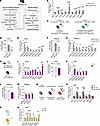 Figure 1
The liver is responsible for increased circulating levels of CERs in cachexia. (A) Regulation of CER synthesis enzymes in the livers of cachectic animals (3). Orange: Upregulated in cancer cachexia; purple: downregulated in cancer cachexia. Image created in BioRender. (B) Hepatic expression of CER synthesis enzymes in another cohort of healthy controls (PBS-injected) and cachectic C26 tumor–bearing mice (n = 8 animals per group). (C) Mice injected with hepatocyte-specific adeno-associated viruses (AAVs) expressing either a control miRNA (miRCTR) or a miRNA against Sptlc2 (miRSPT2), and later with cachexia-inducing C26 carcinoma cells. The experiment ended once each animal had reached 10% weight loss for comparable cachexia severities (n = 3 animals per group). D–G) Total CER levels (D and F) and CER composition relative to PBS controls (E and G) in liver (D and E) and plasma (F and G). Horizontal dotted lines show reference levels of PBS controls (n = 3 animals per group). (H) Mice were fasted for 24 hours to induce a weight loss of greater than 10%, comparable to cachexia (fasting [F]) or were maintained on an ad libitum [AL] chow diet (n = 5 animals per group). (I–M) Hepatic mRNA expression of CER synthesis enzymes (I). (J–M) Total CER levels (J and L) and CER composition relative to AL controls (K and M) in liver (J and K) and plasma (L and M). (N) Mice injected with C26 cells were either untreated (C26), treated with a control IgG antibody (C26-IgG), or treated with an IL-6–neutralizing antibody (C26-IL6-nAB). (O) Hepatic mRNA expression of CER synthesis enzymes (n = 8 animals per group). (P) Mice were injected with LPS or served as untreated controls (CTR) (n = 5 animals per group). (Q) Hepatic mRNA expression of CER synthesis enzymes. Data indicate the mean ± SEM. *P < 0.05, **P < 0.01, ***P < 0.001, and ****P < 0.0001, by unpaired, 2-tailed t test (B, D–G, I, K–M, and Q), Mann-Whitney U test (B, E, and I–K), unpaired, 1-way ANOVA with Tukey’s post hoc test (O), or Kruskal-Wallis with Dunn’s post hoc test (O). (A, C, H, N, P) Image created in BioRender.
We checked whether increased lipolysis and fatty acid overload from adipose tissue to the liver could be the main upstream regulators of CER synthesis in cachexia, assessing CER profiles in 24-hour fasted animals (Figure 1H). These mice exhibited a body composition similar to that of cachectic animals (significant decrease in body weight, adipose tissue, skeletal muscle and liver mass) (Supplemental Figure 1, O–S). Increased lipolysis was confirmed by high circulating levels of glycerol and nonesterified fatty acids (Supplemental Figure 1, T and U). Nevertheless, neither the expression of CER synthesis enzymes (Figure 1I), nor the levels of CER in the liver and plasma were affected by the increased flux of fatty acids to the liver (Figure 1, J–M, Supplemental Figure 1, V–Y), which instead led to an accumulation of intrahepatic triacylglycerols (Supplemental Figure 1Z). Lipolysis slightly increased the levels of a few CER species but to a much smaller extent than in cachexia (Figure 1, K and E, and Supplemental Figure 1, Y and N). Proinflammatory cytokines like IL-6 are suspected upstream regulators of CER synthesis and important tumor-derived factors contributing to cachexia. We therefore assessed the expression of CER synthesis enzymes in the livers of cachectic C26 tumor–bearing mice treated or not with an IL-6–neutralizing antibody (Figure 1N) (31, 32). IL-6 inhibition almost completely normalized CER synthesis enzyme expression to healthy control levels (Figure 1O). Ultimately, we confirmed the strong induction of CER synthesis enzymes in animals with LPS-induced acute inflammation (Figure 1, P and Q).
Altogether, those data indicate that liver is the main tissue responsible for CER synthesis in cachexia and that CER synthesis is not the consequence of enhanced lipid release from adipose tissue but rather is associated with tumor- or host-derived proinflammatory factors.
Pharmacological inhibition of CER synthesis ameliorates body wasting in advanced cachexia. We next applied a pharmacological approach to counteract CER synthesis in the C26 cachexia model to assess the pathway’s therapeutic relevance. Animals were treated with myriocin, a specific SPT inhibitor, once tumors were visible, until most vehicle-treated C26 animals reached an advanced cachectic phenotype characterized by body weight loss of more than 20% (Figure 2A). The dose and route of administration of myriocin were defined on the basis of the literature (13, 33). Treatment did not induce a toxic phenotype in tumor-free, PBS-injected control animals (Supplemental Figure 2) or in C26 tumor–bearing mice (Figure 2, B–E, and Supplemental Figure 3, A–E). Importantly, myriocin efficiently reduced body weight loss without affecting tumor growth (Figure 2, B–D, horizontal dotted lines show reference levels of tumor-free healthy controls). We also observed trends toward an increase in circulating glucose, fatty acids, and triacylglycerols, suggesting an overall improvement in the nutritional status and/or control of energy homeostasis in these animals (Supplemental Figure 3, F–H). We confirmed the strong reduction in all sphingolipids in both liver and plasma of myriocin-treated animals, including CER, HCER, LCER, and SM levels, which were largely comparable to those in healthy controls (Figure 2, F–I, and Supplemental Figure 3, I–P). While myriocin did not affect fat mass (Figure 2, J and K), we observed significant improvements in the weights of cardiac and many skeletal muscles (Figure 2, L–P, and Supplemental Table 1), one of the most important determinants of morbidity and mortality in patients with cancer (2). Accordingly, grip strength of myriocin-treated animals at the endpoint was less significantly impaired than that of vehicle-treated animals compared with PBS-treated controls, suggesting a moderate functional improvement (Figure 2, Q and R). The potential of CER inhibition to counteract muscle proteolysis was further confirmed by the reduction in atrophy and autophagy marker gene expression in heart and skeletal muscles (Figure 2, S–U), together with a significant decrease in ubiquitinylated protein levels in gastrocnemius muscle (Figure 2, V and W). Interestingly, CER levels in gastrocnemius muscles of cachectic animals also mirrored the hepatic and circulating levels (Figure 2, X and Y, and Supplemental Figure 3, Q–T).
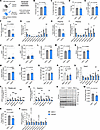 Figure 2
Pharmacological inhibition of CER synthesis ameliorates body wasting in advanced cachexia. (A) Mice were injected with C26 cells and treated with vehicle (C26-V, n = 8 animals, unless stated otherwise) or myriocin (C26-M, n = 10 animals, unless stated otherwise). The experiment was ended once control animals lost more than 20% of their body weight (advanced cachexia experiment). Horizontal dotted lines show reference levels for healthy controls (PBS-V, PBS-injected mice treated with vehicle, n = 4 animals). Image created in BioRender. (B) Final body weights. (C) Body weight loss. (D) Final tumor weights (C26-M, n = 9). (E) Liver weights (C26-V, n = 7). (F–I) Total CER levels (F and H) and CER composition (fold change of PBS-V, G and I) in liver (F and G) and plasma (H and I) (n = 4 animals per group). (J and K) Epididymal white adipose tissue (eWAT) (2 depots) weights (J) and inguinal WAT (iWAT) (1 depot) weights (K). (L) Heart weight. (M–P) Skeletal muscle weights: gastrocnemius (M), soleus (N) (C26-V, n = 7), tibialis anterior (O), and extensor digitorum longus (EDL) (P). (Q and R) Initial (Q) and final (R) (C26-M, n = 9) grip strength. (S–U) Atrogen and autophagy markers mRNA expression in heart (S) and skeletal muscles (T and U). (V) Total ubiquitin levels in gastrocnemius. Ponceau was used as a loading control. (X and Y) Total CER levels (X) and CER composition (Y) in gastrocnemius (C26-V, n = 3 animals; C26-M, n = 4 animals). Data indicate the mean ± SEM. *P < 0.05, **P < 0.01, ***P < 0.001, and ****P < 0.0001, by unpaired, 2-tailed t test (B–I, L–P, S–U, and W–Y), Mann-Whitney U test (I–K, S–U, and Y), unpaired, 1-way ANOVA with Dunnett’s test (R), or Kruskal-Wallis with Dunn’s post hoc test (Q).
Our data therefore highlight the potential of targeting CER synthesis pathways for the treatment of cachexia.
Pharmacological inhibition of CER synthesis improves mitochondrial function in livers of cachectic animals. We next looked for the underlying mechanisms responsible for the beneficial effects of myriocin on cachexia development. To determine the primary chain of events linking CERs to wasting processes, we performed another myriocin experiment, in which C26 tumor–bearing animals were necropsied once vehicle-treated control animals lost more than 8% of their body weight (Supplemental Figure 4A). We found that at such an early stage, CER synthesis inhibition only led to moderate improvements in body weight loss without affecting tumor growth (Supplemental Figure 4, B–F). The use of metabolic cages revealed no effect of myriocin on food intake but a significant increase in water intake during the time course of cachexia development (Supplemental Figure 4, G and H). As cachectic animals tend to crumble their food, water intake may be a more reliable indicator of improved nutritional state. At the endpoint, cachectic C26 tumor–bearing mice showed decreased physical activity and a reduced respiratory exchange ratio (indicating increased lipid oxidation) (Supplemental Figure 4, I and J), as well as increased metabolism and energy expenditure (Supplemental Figure 4, K–M) compared with PBS-treated controls. However, myriocin did not affect those parameters at such an early stage of cachexia. Once again, treatment did not induce any toxicity (Supplemental Figure 4, N–Q) but was very efficient at reducing CER levels (Supplemental Figure 4, R–V). Once again, myriocin did not reduce fat loss (Supplemental Figure 4W) but already caused moderate improvements in cardiac and skeletal muscle mass (Supplemental Figure 4, X and Y, and Supplemental Table 2). Furthermore, cachexia induced significant functional impairment in vehicle- but not myriocin-treated animals (Supplemental Figure 4, Z and AA). The effect on muscle loss could not be explained by a reduction in proteolysis marker expression at such an early stage (Supplemental Figure 4, AB and AC), suggesting that another tissue or tissues may be driving this systemic effect.
As liver is the primary tissue for CER synthesis in cachexia (Figure 1), we explored how this tissue may affect systemic energy homeostasis. Liver is a central organ in the control of systemic insulin sensitivity, and insulin resistance has been reported in animal models and patients with cancer cachexia (34–36), potentially counteracting the anabolic effect of insulin. We measured protein levels of different actors of the insulin signaling cascade, however, neither cachexia nor myriocin interfered with insulin signaling (Supplemental Figure 5, A–F). We also observed no signs of insulin resistance in cachectic C26 tumor–bearing mice at any time in the course of cachexia development, as assessed both by insulin tolerance tests (Supplemental Figure 5, G–O) and the activation of the insulin signaling cascade in liver and muscle after insulin stimulation (Supplemental Figure 5, P–S). C26 tumor–bearing mice were even more responsive to a low dose of insulin, which was too low to induce a response in healthy PBS-treated controls. Beyond insulin sensitivity, we also assessed the effect of CERs on liver acute phase response and systemic inflammation. Neither the expression of genes encoding APR proteins nor the plasma levels of these proteins were altered upon myriocin treatment in cachexia (Supplemental Figure 5, T–W). Plasma IL-6 levels were reduced, but only at an advanced cachexia stage (Supplemental Figure 5, X and Y). Therefore, insulin resistance, liver APR or CER-induced systemic inflammation are unlikely to play a central role in the deleterious effect of CERs on cachexia development. We next performed liver proteomics analysis to understand at what level CERs may interfere with liver function (Supplemental Figure 6, A and B). Pathway analysis of significantly altered proteins highlighted mitochondrial dysfunction as one of the top pathways affected by cachexia and rescued by myriocin (Supplemental Figure 6, C and D). Cachexia was notably characterized by a decrease in many mitochondrial pathways related to energy production, which were reversed upon myriocin treatment (Figure 3, A and B). In accordance, a high number of mitochondrial proteins involved in the TCA cycle or oxidative phosphorylation (OXPHOS) complexes were reduced in cachexia and increased by myriocin (Figure 3C).
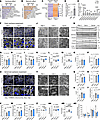 Figure 3
Pharmacological inhibition of CER synthesis improves mitochondrial function in the livers of cachectic animals. (A–C and F–T) C26 tumor–bearing mice were treated with vehicle (C26-V) or myriocin (C26-M). The experiment ended once animals reached weight loss of greater than 8% (early cachexia experiment). (A–C) Liver proteomics (PBS-injected, vehicle-treated mice [PBS-V]: n = 4; C26-V, C26-M: n = 5 animals). Top mitochondria-related pathways affected by cachexia (A) and myriocin (B). Purple: Downregulated pathways; orange: upregulated pathways. (C) Expression of mitochondria-related proteins. (D and E) Total CER levels (D) and CER composition (E) in crude mitochondria from liver of PBS-injected animals and C26 tumor–bearing animals (n = 5 animals per group). (F–I) Confocal microscopy analysis of liver mitochondria (n = 3 animals per group; each dot represents 1 image containing >30 hepatocytes quantified; PBS-V, C26-V: n = 22 images; C26-M: n = 23 images). (F) Original magnification, ×60; insets, ×3.5. Quantification of mitochondrial branches (G), junctions (H), and mean branch length (I). (J–M) Electron microscopy images and analysis of liver mitochondria (n = 3 animals per group; n = 509–646 mitochondria). (J) Original magnification, ×12,000; insets, ×2. Quantification of mitochondrial circularity (K), roundness (L), and form factor (M). (N–T) Western blots of liver mitochondria-related proteins: TOMM20 (O), OXPHOS complexes (P–R, from top to bottom: CV, CIII, CIV, CII, CI), CHOP (S) and cleaved caspase-3. Vinculin as loading control (PBS-V, n = 4, C26-V, -M: n = 10 animals). Quantification relative to PBS-V. (U–AC) Advanced cachexia experiment. Confocal microscopy (U–X, n = 3 animals per group; n = 10 images; Original magnification, ×60; insets, ×3.5) and electron microscopy (Y–AB, n = 3 animals per group; n = 266–385 mitochondria) analyses of liver mitochondria as in F–M. (AC) OXPHOS activity in liver (PBS-V: n = 4; C26-V, C26-M: n = 6 animals). Scale bars: 20 μm (F and U) and 2 μm (J and Y). Original magnification, ×12000; insets, ×3.5. Data indicate the mean ± SEM. (D, E, G–I, O–X, and AC) and the median minimum to maximum values (K–M and Z–AB). *P < 0.05, **P < 0.01, ***P < 0.001, and ****P < 0.0001, by unpaired, 2-tailed t test (D and E), Mann-Whitney U test (E), unpaired, 1-way ANOVA with Tukey’s test (H, O–R, T, and AC), or Kruskal-Wallis with Dunn’s test (G, I, K–M, S, V–X, Z, and AA–AC). FC, fold change; CI, Complex I; CII, Complex II; CIII, Complex III; CIV, Complex IV; CV, Complex V.
To investigate the link between liver CERs and mitochondrial function, we aimed to confirm the increase in mitochondrial CER content upon cachexia. We performed lipidomics analysis of the liver crude mitochondrial fraction in tumor-free controls and C26 tumor–bearing mice. While total CER levels in whole liver tended to be decreased in cachexia due to the strong depletion of CER(22:0) (Figure 2, F and G), total CER content in crude mitochondria increased 2-fold and CER(16:0) levels 4-fold (Figure 3, D and E, and Supplemental Figure 6, E–H). As CERS6-derived CERs [mostly CER(16:0)] have been previously shown to promote mitochondrial fission and dysfunction (14), we next assessed mitochondrial ultrastructural morphology and connectivity in livers of cachectic animals upon myriocin treatment at the early disease stage (Supplemental Figure 4). We observed reduced branch and junction numbers in cachectic vehicle-treated animals, reduced branch length (Figure 3, F–I), decreased mitochondrial circularity and roundness, and increased form factor (Figure 3, J–M). All those effects of cachexia were reversed upon myriocin treatment, confirming the adverse effect of CERs on mitochondrial structure in cachexia. We next assessed protein expression of markers of mitochondrial mass (TOMM20), respiratory function (OXPHOS complexes), and stress (C/EBP homologous protein [CHOP], cleaved caspase 3) (Figure 3, N–T, and Supplemental Figure 6, I and J). While mitochondria numbers did not seem to be affected in early cachexia, we observed decreased levels of some OXPHOS complexes, which was prevented by myriocin, confirming our proteomics data. Mitochondrial stress markers were increased in livers of cachectic animals and partially reversed by myriocin, suggesting an improvement in mitochondrial function. We confirmed the strong effect of CERs on liver mitochondria by performing similar analyses in livers of animals with advanced cachexia (Figure 2). Alteration in mitochondrial morphology and connectivity in cachexia (Figure 3, U–AB, and Supplemental Figure 6, K–S) was associated with reduced activity of several OXPHOS complexes (Figure 3AC and Supplemental Figure 6T), which was rescued upon myriocin treatment.
Overall, our data suggest that CERs affected mitochondrial morphology and connectivity in cachectic livers as a primary event, thereby reducing mitochondrial function and the ability to produce energy early in the development of cachexia.
Liver-specific knockdown of CER synthesis improves cachectic phenotypes and mitochondrial function in livers of cachectic animals. We next wanted to confirm whether the observed effects on mitochondrial function were specific to CERs and not off-target effects of myriocin. To do so, we performed an experiment using the AAV-miRSPT2 previously validated (Figure 1, C–G, and Supplemental Figure 1, A–N) and ended it as soon as the control tumor-bearing animals reached a weight loss of more than 10% (Figure 4A). With this setup, we observed a moderate but significant improvement in body weight loss upon liver-specific SPT knockdown (Figure 4, B and C, and Supplemental Figure 7, A–C), without any effect on final tumor weight (Figure 4D). Once again, we confirmed the strong reduction in circulating CER levels (Supplemental Figure 7, D–F). Although there was no significant difference in fat or muscle tissue weights at the endpoint (Supplemental Figure 7, G–I, and Supplemental Table 3), we still observed an improvement in muscle grip strength and a decrease in muscle atrophy markers (Figure 4E and Supplemental Figure 7, J and K), suggesting an overall improvement of muscle wasting. Interestingly, total CER levels and levels of CER(18:0) and CER(18:1) in muscle, the main CER species produced in this tissue, were not reduced upon liver-specific inhibition of CER synthesis, arguing for a local CER biosynthesis in cachectic muscle (Supplemental Figure 7, L and M). Nevertheless, the levels of CER(16:0), the main species affected in liver and plasma in cachexia, were fully reversed in muscles of C26-miRSPT2 mice, supporting the hypothesis of an inter-tissue crosstalk. Focusing on the liver, we next confirmed that the beneficial effects of CER inhibition on cachexia were not associated with alterations in the APR (Supplemental Figure 7N). Looking at mitochondrial phenotypes, SPT knockdown was associated with a partial improvement in readouts of mitochondrial connectivity (Figure 4, F–I) and activity of citrate synthase in livers of tumor-bearing animals (Figure 4J).
 Figure 4
Liver-specific knockdown of CER synthesis improves cachectic phenotypes and mitochondrial function in livers of cachectic animals. (A) Mice were injected with an AAV expressing a control miRNA (miRCTR) or a miRNA against Sptlc2 (miRSPT2) in a hepatocyte-specific manner. Mice were then injected with cachexia-inducing C26 cells (n = 8 animals per group, unless stated otherwise). The experiment ended once control animals lost more than 10% of their body weight (early cachexia experiment). Image created in BioRender. (B) Final body weights, (C) body weight loss, (D) final tumor weights, and (E) final grip strength. Horizontal dotted lines show reference levels of healthy controls (PBS-injected mice: n = 7). (F–I) Confocal microscopy images and analysis of liver mitochondria from 4 animals per group (n = 12 images quantified per group). Scale bars: 20 μm. Original magnification, ×60; inset, ×3.5. Quantification of mitochondrial morphology: branches (G), junction numbers (H), and mean branch length (I), indicating mitochondrial connectivity. (J) Citrate synthase activity in liver. Data indicate the mean ± SEM. *P < 0.05 and **P < 0.01, by unpaired, 2-tailed t test (B–E and G–I) or Mann-Whitney U test (J).
Genetic inhibition of CER synthesis therefore recapitulated the beneficial effects observed with myriocin, improving mitochondrial function in the liver and body wasting.
CERs directly interfere with mitochondrial function and induce cachexia-like phenotypes in primary hepatocytes and C2C12 myotubes. To further confirm the direct effect of CERs on mitochondrial morphology and capacity to produce energy, we treated primary hepatocytes with different doses of the short analog CER(6:0), a synthetic CER species commonly used for in vitro studies due to its better ability to cross cellular membranes (37, 38). Mitochondrial morphology was similar to that seen in livers of cachectic animals, with reduced branch and junction numbers and branch length (Figure 5, A–D). We also observed an induction of stress markers, as evidenced by cleaved caspase 3 levels (Figure 5, E and F). While OXPHOS protein levels were unchanged after 24 hours of treatment (Figure 5E), we still observed a clear decrease in both basal and maximal respiratory function and ATP production (Figure 5, G–J), further supporting that CERs can be directly responsible for the effect observed in vivo in cachectic animals (Figure 3).
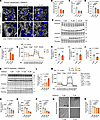 Figure 5
CERs directly interfere with mitochondrial function and induce cachexia-like phenotypes in primary hepatocytes and C2C12 myotubes. (A–J) Primary hepatocytes and (K–R) C2C12 myotubes were treated with CER(6:0) for 16–24 hours. (A and B) Confocal microscopy of mitochondria (data are from 6 replicates; n = 9–10 images quantified per group). Scale bars: 20 μm (A) and 200 μm (Q). Original magnification, ×60, insets, ×3.5. Quantification of mitochondrial morphology: branch numbers (B), junction numbers (C), and mean branch lengths (D). (E, F, K, and L) Western blots of mitochondria-related proteins: OXPHOS (Bands from top to bottom represent: CV, CIII, CIV, CII, CI) and cleaved caspase 3 (c-casp. 3). Ponceau was used as a loading control. (E and K) Representative blots. (F and L) Quantification of protein levels (relative to 0 μM condition; n = 3–4 replicates per group). (G–J and M–P) Mitochondrial respiratory measurements (normalized to protein content). (G and M) Oxygen consumption rate throughout the assay (hepatocytes: n = 17–20 replicates; myotubes: n = 10–15 replicates per group). FCCP, carbonyl cyanide-4-(trifluoromethoxy); Rot/AA, rotenone/antimycin; Min, minutes; Oligo, oligomycin. (H and N) Basal respiration, (I and O) maximal respiration, and (J and P) ATP production. (Q and R) Myotube diameters (n = 8 replicates per group). Data indicate the mean ± SEM. *P < 0.05, **P < 0.01, ***P < 0.001, and ****P < 0.0001 versus the 0 μM condition. Statistical analysis was done using 1-way ANOVA with Dunnett’s post hoc test (C, D, F, L, O, P, and R), Kruskal-Wallis with Dunn’s post hoc test (B and N), unpaired, 2-tailed t test (H and I), Mann-Whitney U test (J), or paired, 2-way ANOVA with Šídák’s (G) or Dunnett’s (M) post hoc test.
Assessing the procachectic potential in other cell types, treatment of 3T3-L1 adipocytes with CER(6:0) did not alter lipolysis (i.e., glycerol release), even at a very high dose (Supplemental Figure 8, A and B), in accordance with the absence of effects of myriocin on adipose tissue wasting in vivo (Figure 2, J and K, and Supplemental Figure 4W). Given the protective effect of CER synthesis inhibition on cardiac and skeletal muscle wasting (Figure 2, L–W, Figure 4E, Supplemental Figure 4, X and Y, and Supplemental Figure 7K), we also treated C2C12 myotubes with CER(6:0). As in hepatocytes, CERs dose-dependently increased mitochondrial stress markers after 24 hours, without affecting OXPHOS protein levels (Figure 5, K and L), and dose-dependently reduced mitochondrial respiration and ATP production (Figure 5, M–P). Accordingly, CERs induced myotube atrophy in a dose-dependent manner, also indicating a direct effect of CERs on muscle wasting in cachexia (Figure 5, Q and R). Ultimately, we treated primary hepatocytes and myotubes with the naturally occurring CER(16:0) —the most enriched CER species in plasma of cachectic animals (Figure 1G, Figure 2I, and Supplemental Figure 7E) — and observed an impairment of mitochondrial function similar to that seen with CER(6:0) treatments (Supplemental Figure 9).
The above data therefore confirm the procachectic potential of CERs in hepatocytes and myotubes.
Inhibition of CER synthesis improves mitochondrial phenotypes in skeletal muscle of cachectic animals. Given the toxic effect of CERs on mitochondrial function we observed in vitro in muscle cells, we next assessed whether CERs could be involved in mitochondrial dysfunction in cachectic muscles. In myriocin-treated, tumor-bearing mice, we did not observe a strong effect of cachexia and myriocin on mitochondrial mass, function, or stress markers in gastrocnemius muscle at an early cachexia stage (Supplemental Figure 10, A–H), but we did find an unexpected increase in OXPHOS complex II (i.e., succinate dehydrogenase, also part of the TCA cycle) and stress markers (CHOP), which tend to be decreased upon myriocin treatment at advanced cachexia stages (Supplemental Figure 10, I–P). Confocal microscopic analyses of skeletal muscle revealed clear alterations of mitochondrial morphology and connectivity in cachexia, characterized by decreased mitochondrial branch and junction numbers and branch lengths (Figure 6, A–D), which were associated with an impairment of citrate synthase and activity of OXPHOS complexes (Figure 6, E and F). All those effects were partially rescued upon myriocin treatment. As validation, we also confirmed the partial rescue of mitochondrial morphology in skeletal muscle of tumor-bearing animals with liver-specific genetic knockdown of CER synthesis (Figure 6, G–J).
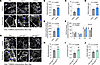 Figure 6
Inhibition of CER synthesis improves mitochondrial phenotypes in skeletal muscle of cachectic animals. (A–F) Mice were injected with C26 cells and treated with vehicle (C26-V) or myriocin (C26-M) (advanced cachexia experiment). Dotted lines represent the values from PBS-V–treated mice. (A–D) Confocal microscopy of mitochondria in tibialis anterior from 4 animals per group (n = 9 images quantified per group). Quantification of mitochondrial morphology: branch numbers (B), junction numbers (C), and mean branch lengths (D), indicating mitochondrial connectivity. (E and F) Citrate synthase (E) and OXPHOS complex (F) activity in gastrocnemius (n = 6 animals per group). (G–J) Mice were injected with an AAV expressing a control miRNA (miRCTR) or a miRNA against Sptlc2 (miRSPT2) in a hepatocyte-specific manner, and then later with C26 cells (early cachexia experiment). Dotted lines represent the values from PBS-injected mice. Confocal microscopy of mitochondria in tibialis anterior from 4 animals per group (n = 9 images quantified per group). Quantification of mitochondrial morphology: branch numbers (H), junction numbers (I), and mean branch lengths (J), indicating mitochondrial connectivity. Scale bars: 20 μm, original magnification, ×60; insets ×3,5 (A and G). Data indicate the mean ± SEM. *P < 0.05, **P < 0.01, ***P < 0.001, and ****P < 0.0001. Statistical analysis was done using an unpaired, 2-tailed t test (B, C, E, and H–J), a Mann-Whitney U test (D), or unpaired, 2-way ANOVA with Tukey’s post hoc test (F).
All in all, our data suggest that CERs affect liver mitochondrial function as an early event, promoting energy loss and muscle wasting in cachexia.
Hepatic expression of CER synthesis enzymes and CER content are positively correlated with the severity of weight loss in patients with cancer. Ultimately, we looked for evidence that hepatic CER synthesis is also a hallmark of cachexia in patients with cancer, to support a finding that could be useful for future targeted therapies. We analyzed tissue samples from patients with gastrointestinal cancers of different entities (Supplemental Table 4) and different degrees of cachexia. Cachexia was defined according to Fearon’s definition (39), and patients were stratified into 4 groups (Figure 7A and Supplemental Table 4): noncachectic, mildly cachectic, cachectic, and severely cachectic. As in our preclinical models (3) (Figure 1, A and B), we measured gene expression levels of a large panel of CER synthesis enzymes (including enzymes of the de novo synthesis and salvage pathways and glycosphingolipid synthesis) in liver, visceral adipose tissue (VAT), subcutaneous adipose tissue (SAT), and skeletal muscle from those patients (Figure 7B). Remarkably, enzymes from all synthesis pathways were significantly upregulated in the livers of patients with severe cachexia, whereas expression of these enzymes was unchanged in other metabolic tissues. Liver enzyme expression gradually increased with disease severity, although it reached significance only at the severe cachexia state. Accordingly, the association between hepatic enzyme expression and cachexia severity (i.e., percentage of body weight loss) in patients was confirmed by significant positive correlations in liver, while no significant or negative correlations were observed in other tissues (Figure 7C). To functionally confirm increased CER synthesis in livers of cachectic patients, we also performed liver lipidomics analysis of the same patients (Figure 7, D–G). Total CER and HCER levels were significantly elevated in the livers of patients with severe cachexia (Figure 7, D and F), mostly due to an increase in CER and HCER (16:0), (18:0), and (24:1) species (Figure 7, E and G). HCER and CER levels were accordingly positively associated with the severity of body weight loss in patients with cancer and with the expression of CER synthesis enzymes in the liver (Figure 7H).
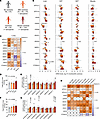 Figure 7
Hepatic expression of CER synthesis enzymes and CER content are positively correlated with the severity of weight loss in patients with cancer. (A) Patients with gastrointestinal cancer were stratified on the basis of their cachectic phenotype (no cachexia, n = 8 individuals; mild cachexia, n = 6; cachexia, n = 12; severe cachexia, n = 11; unless stated otherwise). Image created in BioRender. See also Supplemental Table 4 for patients’ characteristics. WL, weight loss. (B) mRNA expression of CER synthesis enzymes in liver (cachexia, n = 11), VAT (no cachexia n = 5, cachexia n = 8, severe cachexia n = 7), SAT (no cachexia n = 7, mild cachexia n = 5, cachexia n = 6), and skeletal muscle (mild cachexia n = 3, severe cachexia n = 10). (C) Correlation analyses between CER synthesis enzyme expression in liver, VAT, SAT and muscle and the percentage of body weight loss (BWL). Pearson’s r values are displayed for each comparison, together with their significance. (D–G) Total CER (D) and HCER (F) levels in liver (severe cachexia, n = 10). CER (E) and HCER composition (G) in liver (FC in the no-cachexia group). (H) Correlation analyses between CER and HCER levels and the percentage of body weight loss or CER synthesis enzyme expression in liver. Data indicate the median minimum to maximum (B) or the mean ± SEM (D–G). *P < 0.05, **P < 0.01, ***P < 0.001, and ****P < 0.0001 versus the no-cachexia group. Statistical analysis was done by 1-way ANOVA with Dunnett’s post hoc test (B and D–G), Kruskal-Wallis with Dunn’s post hoc test (B, E, and G), and correlation analysis (C and H). No cax, no cachexia.
In summary, our study reveals a clear role of liver-derived CER in the etiology of cachexia and highlights the strong potential and relevance of targeting CER synthesis in patients with cancer cachexia.


Copyright © 2026 American Society for Clinical Investigation
ISSN: 0021-9738 (print), 1558-8238 (online)