
Go to JCI Insight
  • About
  • Editors
  • Consulting Editors
  • For authors
  • Journal stats
  • Publication ethics
  • Publication alerts by email
  • Advertising
  • Job board
  • Contact
  • Clinical Research and Public Health
  • Current issue
  • Past issues
  • By specialty
    • COVID-19
    • Cardiology
    • Gastroenterology
    • Immunology
    • Metabolism
    • Nephrology
    • Neuroscience
    • Oncology
    • Pulmonology
    • Vascular biology
    • All ...
  • Videos
    • ASCI Milestone Awards
    • Video Abstracts
    • Conversations with Giants in Medicine
  • Reviews
    • View all reviews ...
    • Emerging therapeutic strategies in breast cancer (Oct 2026)
    • The cGAS-STING pathway: DNA sensing in health and disease (Jun 2026)
    • Neurodegeneration (Mar 2026)
    • Clinical innovation and scientific progress in GLP-1 medicine (Nov 2025)
    • Pancreatic Cancer (Jul 2025)
    • Complement Biology and Therapeutics (May 2025)
    • Evolving insights into MASLD and MASH pathogenesis and treatment (Apr 2025)
    • View all review series ...
  • Viewpoint
  • Collections
    • In-Press Preview
    • Clinical Research and Public Health
    • Research Letters
    • Letters to the Editor
    • Editorials
    • Commentaries
    • Editor's notes
    • Reviews
    • Viewpoints
    • 100th anniversary
    • Top read articles

  • Current issue
  • Past issues
  • Specialties
  • Reviews
  • Review series
  • ASCI Milestone Awards
  • Video Abstracts
  • Conversations with Giants in Medicine
  • In-Press Preview
  • Clinical Research and Public Health
  • Research Letters
  • Letters to the Editor
  • Editorials
  • Commentaries
  • Editor's notes
  • Reviews
  • Viewpoints
  • 100th anniversary
  • Top read articles
  • About
  • Editors
  • Consulting Editors
  • For authors
  • Journal stats
  • Publication ethics
  • Publication alerts by email
  • Advertising
  • Job board
  • Contact

Citations to this article
Hypothalamic-amygdala gating of caregiving-like prosocial behavior in mice
Kai-Wen Geng, Rui-Rui Wang, Yan Yang, Yan Wang, Ting He, Chun-Li Li, Chong-Shun Xu, Jun Chen
View: Text | PDF
Research Article Cell biology Neuroscience

Hypothalamic-amygdala gating of caregiving-like prosocial behavior in mice

  • Text
  • PDF
Abstract

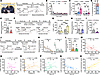
Distress sharing within an ingroup instinctively motivates caregiving-like prosocial behavior in social animals and humans, yet how aversive social stimuli paradoxically trigger such behavior remains unclear. Here, we show that stress-state matching in observer mice elicits caregiving-like behaviors (allogrooming and injury-targeted allolicking) toward cagemates in pain, resulting in synchronized social buffering. Importantly, we identify that the excitation of vasopressin receptor 1a–expressing (V1aR-expressing) neurons in the central medial amygdala (CeM) underlies both emotional-state matching and subsequent allogrooming/allolicking. This excitation is accomplished by arginine vasopressin (AVP) release from presynaptic terminals of the hypothalamic paraventricular nucleus (PVN) to act specifically on postsynaptic V1aR in the CeM. The CeMV1aR neurons then project to the ventral tegmental area (VTA) to drive caregiving-like actions through positive reinforcement, manifested as prosocial preference and recurrent allogrooming/allolicking, and to produce anxiolysis in the caregiver. Collectively, we unravel a dedicated trisynaptic PVNAVP-CeMV1aR-VTA circuit driving and gating caregiving-like behaviors and advance the mechanistic understanding of AVP-V1aR signaling in prosociality.

Authors

Kai-Wen Geng, Rui-Rui Wang, Yan Yang, Yan Wang, Ting He, Chun-Li Li, Chong-Shun Xu, Jun Chen

×

Loading citation information...
Advertisement

Copyright © 2026 American Society for Clinical Investigation
ISSN: 0021-9738 (print), 1558-8238 (online)

Sign up for email alerts