
Abstract
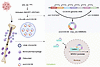
Bone metastasis remains a major cause of morbidity in estrogen receptor–positive breast cancer, with RANKL inhibitor resistance emerging as a critical clinical challenge. Nearly 40% of patients develop progressive skeletal lesions despite denosumab therapy, highlighting an urgent need to identify resistance mechanisms and alternative therapeutic strategies. We identified a RANKL-independent osteoclast activation pathway mediated by the CRKL/circCCDC50/NFATc1 axis. Mechanistically, CRKL promoted EIF4A3-dependent circCCDC50 biogenesis, which was packaged into large oncosomes and transferred to osteoclast precursors. Nuclear circCCDC50 recruited CARM1 to epigenetically activate NFATc1 transcription, establishing a self-reinforcing loop that sustained osteolysis despite RANKL blockade. Pharmacological inhibition of CARM1 (TP-064) effectively suppressed osteoclastogenesis and bone metastasis in denosumab-resistant models. These findings revealed a targetable resistance mechanism and provided a clinically actionable strategy to overcome microenvironment-driven metastasis through dual targeting of tumor and bone niches.
Authors
Qun Lin, Jinpeng Luo, Zhuxi Duan, Jieer Luo, Wei Zhang, Yuan Xia, Yinduo Zeng, Xiaolin Fang, Jiahui Liang, Jiayi Chen, Qianchong Lin, Yilin Quan, Ruiyu Hu, Hongcai Liu, Qiang Liu, Jun Li, Chang Gong
This file is in Adobe Acrobat (PDF) format. If you have not installed and configured the Adobe Acrobat Reader on your system.
Having trouble reading a PDF?
PDFs are designed to be printed out and read, but if you prefer to read them online, you may find it easier if you increase the view size to 125%.
Having trouble saving a PDF?
Many versions of the free Acrobat Reader do not allow Save. You must instead save the PDF from the JCI Online page you downloaded it from. PC users: Right-click on the Download link and choose the option that says something like "Save Link As...". Mac users should hold the mouse button down on the link to get these same options.
Having trouble printing a PDF?
- Try printing one page at a time or to a newer printer.
- Try saving the file to disk before printing rather than opening it "on the fly." This requires that you configure your browser to "Save" rather than "Launch Application" for the file type "application/pdf", and can usually be done in the "Helper Applications" options.
- Make sure you are using the latest version of Adobe's Acrobat Reader.
Supplemental data - Download (21.61 MB)


Copyright © 2026 American Society for Clinical Investigation
ISSN: 0021-9738 (print), 1558-8238 (online)