
Abstract
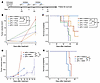
Single-agent anti-PD-1 antibodies are ineffective for pancreatic ductal adenocarcinoma (PDAC) due to the immunosuppressive tumor-microenvironment (TME). KRAS mutations contribute to the inflammatory TME and therapeutic resistance by upregulating IL-8 via MAPK pathways. Thus, this study attempted to overcome the resistance to anti-PD-1 antibodies by targeting downstream KRAS-effectors. The study found that the resistance to anti-PD-1 antibodies can be overcome through MEK1/2-inhibition. The combination of anti-PD-1 antibodies and MEK inhibitors displayed antitumor activity in Kras mutated (Krasmut) KPC mouse tumors, but not WT (KrasWT) Panc02 tumors. The combination of anti-PD-1 antibodies and MEK inhibitors induced recruitment of tumor-associated neutrophils (TANs) via CXCR2, an IL-8 receptor, and increased memory CD8+ T cells and IFN-γ production in treatment-sensitive tumors. However, larger tumors still resisted the combination of anti-PD-1 antibody and MEK inhibitor, likely due to hypoxia/necrosis-induced NETosis and associated paucity of CD8+ T cells. The subsequent addition of anti-CXCR2 antibody overcame this resistance by blocking TAN-infiltration to hypoxic/necrotic areas. Consistently, a risk-score based on the NETosis-MAPK signaling interaction is significantly associated with poorer survival in human PDAC. This study thus provides a new venue for overcoming resistance to strategies targeting KRAS signaling.
Authors
Brian Herbst, Alex Blair, Yiming Li, Elizabeth M. Jaffee, Lei Zheng
This file is in Adobe Acrobat (PDF) format. If you have not installed and configured the Adobe Acrobat Reader on your system.
Having trouble reading a PDF?
PDFs are designed to be printed out and read, but if you prefer to read them online, you may find it easier if you increase the view size to 125%.
Having trouble saving a PDF?
Many versions of the free Acrobat Reader do not allow Save. You must instead save the PDF from the JCI Online page you downloaded it from. PC users: Right-click on the Download link and choose the option that says something like "Save Link As...". Mac users should hold the mouse button down on the link to get these same options.
Having trouble printing a PDF?
- Try printing one page at a time or to a newer printer.
- Try saving the file to disk before printing rather than opening it "on the fly." This requires that you configure your browser to "Save" rather than "Launch Application" for the file type "application/pdf", and can usually be done in the "Helper Applications" options.
- Make sure you are using the latest version of Adobe's Acrobat Reader.
Supplemental data - Download (1.48 MB)


Copyright © 2026 American Society for Clinical Investigation
ISSN: 0021-9738 (print), 1558-8238 (online)