
Abstract
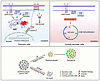
Complete response is rarely observed in lung cancer molecular targeted therapy, despite great clinical success. Here, we found that molecular therapy targeted toward EGFR mutant, KRAS mutant, or ALK fusion lung cancer induced cholesterol biosynthesis, which promoted cancer cells to enter dormancy and thus escape drug killing. Combined statin treatments effectively blocked cholesterol biosynthesis, prevented cancer cells from entering dormancy, and thus resulted in dramatic tumor regression. We further identified a subpopulation of cycling cancer cells that persisted during molecular targeted therapy and remained sensitive to aurora kinase inhibitors. Triple-targeting cholesterol biosynthesis, aurora kinase, and individual oncogenic drivers almost eradicated all the cancer cells. Therapy-induced cancer dormancy was mainly attributed to activation of unfolded protein response, specifically the PERK-eIF2α axis, which triggers cholesterol biosynthesis and AKT signaling. Collectively, this work uncovers an unexpected role of a therapy-induced prosurvival program in promoting cancer dormancy and provides a potentially effective strategy to prevent drug resistance.
Authors
Yikai Zhao, Yijia Zhou, Linnuo Pan, Geng G. Tian, Hsin-Yi Huang, Shijie Tang, Ming Lu, Zhangsen Zhou, Peng Zhang, Luonan Chen, Lele Zhang, Liang Hu, Hongbin Ji
This file is in Adobe Acrobat (PDF) format. If you have not installed and configured the Adobe Acrobat Reader on your system.
Having trouble reading a PDF?
PDFs are designed to be printed out and read, but if you prefer to read them online, you may find it easier if you increase the view size to 125%.
Having trouble saving a PDF?
Many versions of the free Acrobat Reader do not allow Save. You must instead save the PDF from the JCI Online page you downloaded it from. PC users: Right-click on the Download link and choose the option that says something like "Save Link As...". Mac users should hold the mouse button down on the link to get these same options.
Having trouble printing a PDF?
- Try printing one page at a time or to a newer printer.
- Try saving the file to disk before printing rather than opening it "on the fly." This requires that you configure your browser to "Save" rather than "Launch Application" for the file type "application/pdf", and can usually be done in the "Helper Applications" options.
- Make sure you are using the latest version of Adobe's Acrobat Reader.
Supplemental data - Download (2.85 MB)


Copyright © 2026 American Society for Clinical Investigation
ISSN: 0021-9738 (print), 1558-8238 (online)