
Advertisement
Research ArticleImmunologyOncology
Open Access |  10.1172/JCI190778
Tissue-specific antitumor NK cell subsets identified in colorectal cancer liver metastases express candidate therapeutic targets
Joanna Mikulak,1 Domenico Supino,2 Paolo Marzano,1,3 Sara Terzoli,1,4 Roberta Carriero,5 Valentina Cazzetta,1 Rocco Piazza,6 Elena Bruni,3 Paolo Kunderfranco,5 Alessia Donato,2 Sarah Natalia Mapelli,2 Roberto Garuti,2,4 Silvia Carnevale,7 Francesco Scavello,2 Elena Magrini,2 Jelena Zeleznjak,2,8 Clelia Peano,9,10 Matteo Donadon,11 Guido Costa,12 Guido Torzilli,4,12 Alberto Mantovani,2,4,13 Cecilia Garlanda,2,4 and Domenico Mavilio1,3
1Unit of Clinical and Experimental Immunology, IRCCS Humanitas Research Hospital, Rozzano, Milan, Italy.
2Unit of Experimental Immunopathology, IRCCS Humanitas Research Hospital, Rozzano, Milan, Italy.
3Department of Medical Biotechnology and Translational Medicine, University of Milan, Milan, Italy.
4Department of Biomedical Sciences, Humanitas University, Pieve Emanuele, Milan, Italy.
5Bioinformatics Unit, IRCCS Humanitas Research Hospital, Rozzano, Milan, Italy.
6Department of Medicine and Surgery, University of Milan-Bicocca, Monza, Italy.
7Unit of Innate Immunity in Inflammation and Cancer, IRCCS Humanitas Research Hospital, Rozzano, Milan, Italy.
8Center for Proteomics, Faculty of Medicine, University of Rijeka, Rijeka, Croatia.
9Institute of Genetics and Biomedical Research, National Research Council, Rozzano, Milan, Italy.
10Human Technopole, Milan, Italy.
11Department of Health Sciences, Università del Piemonte Orientale, Novara, Italy; Department of General Surgery, University Maggiore Hospital Della Carità, Novara, Italy.
12Unit of Hepatobiliary and General Surgery, IRCCS Humanitas Research Hospital, Rozzano, Milan, Italy.
13William Harvey Research Institute, Queen Mary University of London, London, United Kingdom.
Address correspondence to: Cecilia Garlanda, IRCCS Humanitas Research Hospital, Via Alessandro Manzoni, 56, 20089 Rozzano, Milan, Italy. Email: cecilia.garlanda@humanitasresearch.it. Or to: Domenico Mavilio, Unit of Clinical and Experimental Immunology, Department of Medical Biotechnology and Translational Medicine, IRCCS Humanitas Research Hospital, Via Alessandro Manzoni, 56, 20089 Rozzano, Milan, Italy. Phone: 39.02.8224.5157; Email: domenico.mavilio@unimi.it.
Authorship note: JM and DS contributed equally to this work and have been designated as co–first authors. DM and CG contributed equally to this work and have been designated as co–last authors.
Find articles by Mikulak, J. in: PubMed | Google Scholar
1Unit of Clinical and Experimental Immunology, IRCCS Humanitas Research Hospital, Rozzano, Milan, Italy.
2Unit of Experimental Immunopathology, IRCCS Humanitas Research Hospital, Rozzano, Milan, Italy.
3Department of Medical Biotechnology and Translational Medicine, University of Milan, Milan, Italy.
4Department of Biomedical Sciences, Humanitas University, Pieve Emanuele, Milan, Italy.
5Bioinformatics Unit, IRCCS Humanitas Research Hospital, Rozzano, Milan, Italy.
6Department of Medicine and Surgery, University of Milan-Bicocca, Monza, Italy.
7Unit of Innate Immunity in Inflammation and Cancer, IRCCS Humanitas Research Hospital, Rozzano, Milan, Italy.
8Center for Proteomics, Faculty of Medicine, University of Rijeka, Rijeka, Croatia.
9Institute of Genetics and Biomedical Research, National Research Council, Rozzano, Milan, Italy.
10Human Technopole, Milan, Italy.
11Department of Health Sciences, Università del Piemonte Orientale, Novara, Italy; Department of General Surgery, University Maggiore Hospital Della Carità, Novara, Italy.
12Unit of Hepatobiliary and General Surgery, IRCCS Humanitas Research Hospital, Rozzano, Milan, Italy.
13William Harvey Research Institute, Queen Mary University of London, London, United Kingdom.
Address correspondence to: Cecilia Garlanda, IRCCS Humanitas Research Hospital, Via Alessandro Manzoni, 56, 20089 Rozzano, Milan, Italy. Email: cecilia.garlanda@humanitasresearch.it. Or to: Domenico Mavilio, Unit of Clinical and Experimental Immunology, Department of Medical Biotechnology and Translational Medicine, IRCCS Humanitas Research Hospital, Via Alessandro Manzoni, 56, 20089 Rozzano, Milan, Italy. Phone: 39.02.8224.5157; Email: domenico.mavilio@unimi.it.
Authorship note: JM and DS contributed equally to this work and have been designated as co–first authors. DM and CG contributed equally to this work and have been designated as co–last authors.
Find articles by Supino, D. in: PubMed | Google Scholar
1Unit of Clinical and Experimental Immunology, IRCCS Humanitas Research Hospital, Rozzano, Milan, Italy.
2Unit of Experimental Immunopathology, IRCCS Humanitas Research Hospital, Rozzano, Milan, Italy.
3Department of Medical Biotechnology and Translational Medicine, University of Milan, Milan, Italy.
4Department of Biomedical Sciences, Humanitas University, Pieve Emanuele, Milan, Italy.
5Bioinformatics Unit, IRCCS Humanitas Research Hospital, Rozzano, Milan, Italy.
6Department of Medicine and Surgery, University of Milan-Bicocca, Monza, Italy.
7Unit of Innate Immunity in Inflammation and Cancer, IRCCS Humanitas Research Hospital, Rozzano, Milan, Italy.
8Center for Proteomics, Faculty of Medicine, University of Rijeka, Rijeka, Croatia.
9Institute of Genetics and Biomedical Research, National Research Council, Rozzano, Milan, Italy.
10Human Technopole, Milan, Italy.
11Department of Health Sciences, Università del Piemonte Orientale, Novara, Italy; Department of General Surgery, University Maggiore Hospital Della Carità, Novara, Italy.
12Unit of Hepatobiliary and General Surgery, IRCCS Humanitas Research Hospital, Rozzano, Milan, Italy.
13William Harvey Research Institute, Queen Mary University of London, London, United Kingdom.
Address correspondence to: Cecilia Garlanda, IRCCS Humanitas Research Hospital, Via Alessandro Manzoni, 56, 20089 Rozzano, Milan, Italy. Email: cecilia.garlanda@humanitasresearch.it. Or to: Domenico Mavilio, Unit of Clinical and Experimental Immunology, Department of Medical Biotechnology and Translational Medicine, IRCCS Humanitas Research Hospital, Via Alessandro Manzoni, 56, 20089 Rozzano, Milan, Italy. Phone: 39.02.8224.5157; Email: domenico.mavilio@unimi.it.
Authorship note: JM and DS contributed equally to this work and have been designated as co–first authors. DM and CG contributed equally to this work and have been designated as co–last authors.
Find articles by
Marzano, P.
in:
PubMed
|
Google Scholar
|

1Unit of Clinical and Experimental Immunology, IRCCS Humanitas Research Hospital, Rozzano, Milan, Italy.
2Unit of Experimental Immunopathology, IRCCS Humanitas Research Hospital, Rozzano, Milan, Italy.
3Department of Medical Biotechnology and Translational Medicine, University of Milan, Milan, Italy.
4Department of Biomedical Sciences, Humanitas University, Pieve Emanuele, Milan, Italy.
5Bioinformatics Unit, IRCCS Humanitas Research Hospital, Rozzano, Milan, Italy.
6Department of Medicine and Surgery, University of Milan-Bicocca, Monza, Italy.
7Unit of Innate Immunity in Inflammation and Cancer, IRCCS Humanitas Research Hospital, Rozzano, Milan, Italy.
8Center for Proteomics, Faculty of Medicine, University of Rijeka, Rijeka, Croatia.
9Institute of Genetics and Biomedical Research, National Research Council, Rozzano, Milan, Italy.
10Human Technopole, Milan, Italy.
11Department of Health Sciences, Università del Piemonte Orientale, Novara, Italy; Department of General Surgery, University Maggiore Hospital Della Carità, Novara, Italy.
12Unit of Hepatobiliary and General Surgery, IRCCS Humanitas Research Hospital, Rozzano, Milan, Italy.
13William Harvey Research Institute, Queen Mary University of London, London, United Kingdom.
Address correspondence to: Cecilia Garlanda, IRCCS Humanitas Research Hospital, Via Alessandro Manzoni, 56, 20089 Rozzano, Milan, Italy. Email: cecilia.garlanda@humanitasresearch.it. Or to: Domenico Mavilio, Unit of Clinical and Experimental Immunology, Department of Medical Biotechnology and Translational Medicine, IRCCS Humanitas Research Hospital, Via Alessandro Manzoni, 56, 20089 Rozzano, Milan, Italy. Phone: 39.02.8224.5157; Email: domenico.mavilio@unimi.it.
Authorship note: JM and DS contributed equally to this work and have been designated as co–first authors. DM and CG contributed equally to this work and have been designated as co–last authors.
Find articles by Terzoli, S. in: PubMed | Google Scholar
1Unit of Clinical and Experimental Immunology, IRCCS Humanitas Research Hospital, Rozzano, Milan, Italy.
2Unit of Experimental Immunopathology, IRCCS Humanitas Research Hospital, Rozzano, Milan, Italy.
3Department of Medical Biotechnology and Translational Medicine, University of Milan, Milan, Italy.
4Department of Biomedical Sciences, Humanitas University, Pieve Emanuele, Milan, Italy.
5Bioinformatics Unit, IRCCS Humanitas Research Hospital, Rozzano, Milan, Italy.
6Department of Medicine and Surgery, University of Milan-Bicocca, Monza, Italy.
7Unit of Innate Immunity in Inflammation and Cancer, IRCCS Humanitas Research Hospital, Rozzano, Milan, Italy.
8Center for Proteomics, Faculty of Medicine, University of Rijeka, Rijeka, Croatia.
9Institute of Genetics and Biomedical Research, National Research Council, Rozzano, Milan, Italy.
10Human Technopole, Milan, Italy.
11Department of Health Sciences, Università del Piemonte Orientale, Novara, Italy; Department of General Surgery, University Maggiore Hospital Della Carità, Novara, Italy.
12Unit of Hepatobiliary and General Surgery, IRCCS Humanitas Research Hospital, Rozzano, Milan, Italy.
13William Harvey Research Institute, Queen Mary University of London, London, United Kingdom.
Address correspondence to: Cecilia Garlanda, IRCCS Humanitas Research Hospital, Via Alessandro Manzoni, 56, 20089 Rozzano, Milan, Italy. Email: cecilia.garlanda@humanitasresearch.it. Or to: Domenico Mavilio, Unit of Clinical and Experimental Immunology, Department of Medical Biotechnology and Translational Medicine, IRCCS Humanitas Research Hospital, Via Alessandro Manzoni, 56, 20089 Rozzano, Milan, Italy. Phone: 39.02.8224.5157; Email: domenico.mavilio@unimi.it.
Authorship note: JM and DS contributed equally to this work and have been designated as co–first authors. DM and CG contributed equally to this work and have been designated as co–last authors.
Find articles by Carriero, R. in: PubMed | Google Scholar
1Unit of Clinical and Experimental Immunology, IRCCS Humanitas Research Hospital, Rozzano, Milan, Italy.
2Unit of Experimental Immunopathology, IRCCS Humanitas Research Hospital, Rozzano, Milan, Italy.
3Department of Medical Biotechnology and Translational Medicine, University of Milan, Milan, Italy.
4Department of Biomedical Sciences, Humanitas University, Pieve Emanuele, Milan, Italy.
5Bioinformatics Unit, IRCCS Humanitas Research Hospital, Rozzano, Milan, Italy.
6Department of Medicine and Surgery, University of Milan-Bicocca, Monza, Italy.
7Unit of Innate Immunity in Inflammation and Cancer, IRCCS Humanitas Research Hospital, Rozzano, Milan, Italy.
8Center for Proteomics, Faculty of Medicine, University of Rijeka, Rijeka, Croatia.
9Institute of Genetics and Biomedical Research, National Research Council, Rozzano, Milan, Italy.
10Human Technopole, Milan, Italy.
11Department of Health Sciences, Università del Piemonte Orientale, Novara, Italy; Department of General Surgery, University Maggiore Hospital Della Carità, Novara, Italy.
12Unit of Hepatobiliary and General Surgery, IRCCS Humanitas Research Hospital, Rozzano, Milan, Italy.
13William Harvey Research Institute, Queen Mary University of London, London, United Kingdom.
Address correspondence to: Cecilia Garlanda, IRCCS Humanitas Research Hospital, Via Alessandro Manzoni, 56, 20089 Rozzano, Milan, Italy. Email: cecilia.garlanda@humanitasresearch.it. Or to: Domenico Mavilio, Unit of Clinical and Experimental Immunology, Department of Medical Biotechnology and Translational Medicine, IRCCS Humanitas Research Hospital, Via Alessandro Manzoni, 56, 20089 Rozzano, Milan, Italy. Phone: 39.02.8224.5157; Email: domenico.mavilio@unimi.it.
Authorship note: JM and DS contributed equally to this work and have been designated as co–first authors. DM and CG contributed equally to this work and have been designated as co–last authors.
Find articles by Cazzetta, V. in: PubMed | Google Scholar
1Unit of Clinical and Experimental Immunology, IRCCS Humanitas Research Hospital, Rozzano, Milan, Italy.
2Unit of Experimental Immunopathology, IRCCS Humanitas Research Hospital, Rozzano, Milan, Italy.
3Department of Medical Biotechnology and Translational Medicine, University of Milan, Milan, Italy.
4Department of Biomedical Sciences, Humanitas University, Pieve Emanuele, Milan, Italy.
5Bioinformatics Unit, IRCCS Humanitas Research Hospital, Rozzano, Milan, Italy.
6Department of Medicine and Surgery, University of Milan-Bicocca, Monza, Italy.
7Unit of Innate Immunity in Inflammation and Cancer, IRCCS Humanitas Research Hospital, Rozzano, Milan, Italy.
8Center for Proteomics, Faculty of Medicine, University of Rijeka, Rijeka, Croatia.
9Institute of Genetics and Biomedical Research, National Research Council, Rozzano, Milan, Italy.
10Human Technopole, Milan, Italy.
11Department of Health Sciences, Università del Piemonte Orientale, Novara, Italy; Department of General Surgery, University Maggiore Hospital Della Carità, Novara, Italy.
12Unit of Hepatobiliary and General Surgery, IRCCS Humanitas Research Hospital, Rozzano, Milan, Italy.
13William Harvey Research Institute, Queen Mary University of London, London, United Kingdom.
Address correspondence to: Cecilia Garlanda, IRCCS Humanitas Research Hospital, Via Alessandro Manzoni, 56, 20089 Rozzano, Milan, Italy. Email: cecilia.garlanda@humanitasresearch.it. Or to: Domenico Mavilio, Unit of Clinical and Experimental Immunology, Department of Medical Biotechnology and Translational Medicine, IRCCS Humanitas Research Hospital, Via Alessandro Manzoni, 56, 20089 Rozzano, Milan, Italy. Phone: 39.02.8224.5157; Email: domenico.mavilio@unimi.it.
Authorship note: JM and DS contributed equally to this work and have been designated as co–first authors. DM and CG contributed equally to this work and have been designated as co–last authors.
Find articles by
Piazza, R.
in:
PubMed
|
Google Scholar
|
1Unit of Clinical and Experimental Immunology, IRCCS Humanitas Research Hospital, Rozzano, Milan, Italy.
2Unit of Experimental Immunopathology, IRCCS Humanitas Research Hospital, Rozzano, Milan, Italy.
3Department of Medical Biotechnology and Translational Medicine, University of Milan, Milan, Italy.
4Department of Biomedical Sciences, Humanitas University, Pieve Emanuele, Milan, Italy.
5Bioinformatics Unit, IRCCS Humanitas Research Hospital, Rozzano, Milan, Italy.
6Department of Medicine and Surgery, University of Milan-Bicocca, Monza, Italy.
7Unit of Innate Immunity in Inflammation and Cancer, IRCCS Humanitas Research Hospital, Rozzano, Milan, Italy.
8Center for Proteomics, Faculty of Medicine, University of Rijeka, Rijeka, Croatia.
9Institute of Genetics and Biomedical Research, National Research Council, Rozzano, Milan, Italy.
10Human Technopole, Milan, Italy.
11Department of Health Sciences, Università del Piemonte Orientale, Novara, Italy; Department of General Surgery, University Maggiore Hospital Della Carità, Novara, Italy.
12Unit of Hepatobiliary and General Surgery, IRCCS Humanitas Research Hospital, Rozzano, Milan, Italy.
13William Harvey Research Institute, Queen Mary University of London, London, United Kingdom.
Address correspondence to: Cecilia Garlanda, IRCCS Humanitas Research Hospital, Via Alessandro Manzoni, 56, 20089 Rozzano, Milan, Italy. Email: cecilia.garlanda@humanitasresearch.it. Or to: Domenico Mavilio, Unit of Clinical and Experimental Immunology, Department of Medical Biotechnology and Translational Medicine, IRCCS Humanitas Research Hospital, Via Alessandro Manzoni, 56, 20089 Rozzano, Milan, Italy. Phone: 39.02.8224.5157; Email: domenico.mavilio@unimi.it.
Authorship note: JM and DS contributed equally to this work and have been designated as co–first authors. DM and CG contributed equally to this work and have been designated as co–last authors.
Find articles by
Bruni, E.
in:
PubMed
|
Google Scholar
|
1Unit of Clinical and Experimental Immunology, IRCCS Humanitas Research Hospital, Rozzano, Milan, Italy.
2Unit of Experimental Immunopathology, IRCCS Humanitas Research Hospital, Rozzano, Milan, Italy.
3Department of Medical Biotechnology and Translational Medicine, University of Milan, Milan, Italy.
4Department of Biomedical Sciences, Humanitas University, Pieve Emanuele, Milan, Italy.
5Bioinformatics Unit, IRCCS Humanitas Research Hospital, Rozzano, Milan, Italy.
6Department of Medicine and Surgery, University of Milan-Bicocca, Monza, Italy.
7Unit of Innate Immunity in Inflammation and Cancer, IRCCS Humanitas Research Hospital, Rozzano, Milan, Italy.
8Center for Proteomics, Faculty of Medicine, University of Rijeka, Rijeka, Croatia.
9Institute of Genetics and Biomedical Research, National Research Council, Rozzano, Milan, Italy.
10Human Technopole, Milan, Italy.
11Department of Health Sciences, Università del Piemonte Orientale, Novara, Italy; Department of General Surgery, University Maggiore Hospital Della Carità, Novara, Italy.
12Unit of Hepatobiliary and General Surgery, IRCCS Humanitas Research Hospital, Rozzano, Milan, Italy.
13William Harvey Research Institute, Queen Mary University of London, London, United Kingdom.
Address correspondence to: Cecilia Garlanda, IRCCS Humanitas Research Hospital, Via Alessandro Manzoni, 56, 20089 Rozzano, Milan, Italy. Email: cecilia.garlanda@humanitasresearch.it. Or to: Domenico Mavilio, Unit of Clinical and Experimental Immunology, Department of Medical Biotechnology and Translational Medicine, IRCCS Humanitas Research Hospital, Via Alessandro Manzoni, 56, 20089 Rozzano, Milan, Italy. Phone: 39.02.8224.5157; Email: domenico.mavilio@unimi.it.
Authorship note: JM and DS contributed equally to this work and have been designated as co–first authors. DM and CG contributed equally to this work and have been designated as co–last authors.
Find articles by
Kunderfranco, P.
in:
PubMed
|
Google Scholar
|
1Unit of Clinical and Experimental Immunology, IRCCS Humanitas Research Hospital, Rozzano, Milan, Italy.
2Unit of Experimental Immunopathology, IRCCS Humanitas Research Hospital, Rozzano, Milan, Italy.
3Department of Medical Biotechnology and Translational Medicine, University of Milan, Milan, Italy.
4Department of Biomedical Sciences, Humanitas University, Pieve Emanuele, Milan, Italy.
5Bioinformatics Unit, IRCCS Humanitas Research Hospital, Rozzano, Milan, Italy.
6Department of Medicine and Surgery, University of Milan-Bicocca, Monza, Italy.
7Unit of Innate Immunity in Inflammation and Cancer, IRCCS Humanitas Research Hospital, Rozzano, Milan, Italy.
8Center for Proteomics, Faculty of Medicine, University of Rijeka, Rijeka, Croatia.
9Institute of Genetics and Biomedical Research, National Research Council, Rozzano, Milan, Italy.
10Human Technopole, Milan, Italy.
11Department of Health Sciences, Università del Piemonte Orientale, Novara, Italy; Department of General Surgery, University Maggiore Hospital Della Carità, Novara, Italy.
12Unit of Hepatobiliary and General Surgery, IRCCS Humanitas Research Hospital, Rozzano, Milan, Italy.
13William Harvey Research Institute, Queen Mary University of London, London, United Kingdom.
Address correspondence to: Cecilia Garlanda, IRCCS Humanitas Research Hospital, Via Alessandro Manzoni, 56, 20089 Rozzano, Milan, Italy. Email: cecilia.garlanda@humanitasresearch.it. Or to: Domenico Mavilio, Unit of Clinical and Experimental Immunology, Department of Medical Biotechnology and Translational Medicine, IRCCS Humanitas Research Hospital, Via Alessandro Manzoni, 56, 20089 Rozzano, Milan, Italy. Phone: 39.02.8224.5157; Email: domenico.mavilio@unimi.it.
Authorship note: JM and DS contributed equally to this work and have been designated as co–first authors. DM and CG contributed equally to this work and have been designated as co–last authors.
Find articles by Donato, A. in: PubMed | Google Scholar
1Unit of Clinical and Experimental Immunology, IRCCS Humanitas Research Hospital, Rozzano, Milan, Italy.
2Unit of Experimental Immunopathology, IRCCS Humanitas Research Hospital, Rozzano, Milan, Italy.
3Department of Medical Biotechnology and Translational Medicine, University of Milan, Milan, Italy.
4Department of Biomedical Sciences, Humanitas University, Pieve Emanuele, Milan, Italy.
5Bioinformatics Unit, IRCCS Humanitas Research Hospital, Rozzano, Milan, Italy.
6Department of Medicine and Surgery, University of Milan-Bicocca, Monza, Italy.
7Unit of Innate Immunity in Inflammation and Cancer, IRCCS Humanitas Research Hospital, Rozzano, Milan, Italy.
8Center for Proteomics, Faculty of Medicine, University of Rijeka, Rijeka, Croatia.
9Institute of Genetics and Biomedical Research, National Research Council, Rozzano, Milan, Italy.
10Human Technopole, Milan, Italy.
11Department of Health Sciences, Università del Piemonte Orientale, Novara, Italy; Department of General Surgery, University Maggiore Hospital Della Carità, Novara, Italy.
12Unit of Hepatobiliary and General Surgery, IRCCS Humanitas Research Hospital, Rozzano, Milan, Italy.
13William Harvey Research Institute, Queen Mary University of London, London, United Kingdom.
Address correspondence to: Cecilia Garlanda, IRCCS Humanitas Research Hospital, Via Alessandro Manzoni, 56, 20089 Rozzano, Milan, Italy. Email: cecilia.garlanda@humanitasresearch.it. Or to: Domenico Mavilio, Unit of Clinical and Experimental Immunology, Department of Medical Biotechnology and Translational Medicine, IRCCS Humanitas Research Hospital, Via Alessandro Manzoni, 56, 20089 Rozzano, Milan, Italy. Phone: 39.02.8224.5157; Email: domenico.mavilio@unimi.it.
Authorship note: JM and DS contributed equally to this work and have been designated as co–first authors. DM and CG contributed equally to this work and have been designated as co–last authors.
Find articles by Mapelli, S. in: PubMed | Google Scholar
1Unit of Clinical and Experimental Immunology, IRCCS Humanitas Research Hospital, Rozzano, Milan, Italy.
2Unit of Experimental Immunopathology, IRCCS Humanitas Research Hospital, Rozzano, Milan, Italy.
3Department of Medical Biotechnology and Translational Medicine, University of Milan, Milan, Italy.
4Department of Biomedical Sciences, Humanitas University, Pieve Emanuele, Milan, Italy.
5Bioinformatics Unit, IRCCS Humanitas Research Hospital, Rozzano, Milan, Italy.
6Department of Medicine and Surgery, University of Milan-Bicocca, Monza, Italy.
7Unit of Innate Immunity in Inflammation and Cancer, IRCCS Humanitas Research Hospital, Rozzano, Milan, Italy.
8Center for Proteomics, Faculty of Medicine, University of Rijeka, Rijeka, Croatia.
9Institute of Genetics and Biomedical Research, National Research Council, Rozzano, Milan, Italy.
10Human Technopole, Milan, Italy.
11Department of Health Sciences, Università del Piemonte Orientale, Novara, Italy; Department of General Surgery, University Maggiore Hospital Della Carità, Novara, Italy.
12Unit of Hepatobiliary and General Surgery, IRCCS Humanitas Research Hospital, Rozzano, Milan, Italy.
13William Harvey Research Institute, Queen Mary University of London, London, United Kingdom.
Address correspondence to: Cecilia Garlanda, IRCCS Humanitas Research Hospital, Via Alessandro Manzoni, 56, 20089 Rozzano, Milan, Italy. Email: cecilia.garlanda@humanitasresearch.it. Or to: Domenico Mavilio, Unit of Clinical and Experimental Immunology, Department of Medical Biotechnology and Translational Medicine, IRCCS Humanitas Research Hospital, Via Alessandro Manzoni, 56, 20089 Rozzano, Milan, Italy. Phone: 39.02.8224.5157; Email: domenico.mavilio@unimi.it.
Authorship note: JM and DS contributed equally to this work and have been designated as co–first authors. DM and CG contributed equally to this work and have been designated as co–last authors.
Find articles by Garuti, R. in: PubMed | Google Scholar
1Unit of Clinical and Experimental Immunology, IRCCS Humanitas Research Hospital, Rozzano, Milan, Italy.
2Unit of Experimental Immunopathology, IRCCS Humanitas Research Hospital, Rozzano, Milan, Italy.
3Department of Medical Biotechnology and Translational Medicine, University of Milan, Milan, Italy.
4Department of Biomedical Sciences, Humanitas University, Pieve Emanuele, Milan, Italy.
5Bioinformatics Unit, IRCCS Humanitas Research Hospital, Rozzano, Milan, Italy.
6Department of Medicine and Surgery, University of Milan-Bicocca, Monza, Italy.
7Unit of Innate Immunity in Inflammation and Cancer, IRCCS Humanitas Research Hospital, Rozzano, Milan, Italy.
8Center for Proteomics, Faculty of Medicine, University of Rijeka, Rijeka, Croatia.
9Institute of Genetics and Biomedical Research, National Research Council, Rozzano, Milan, Italy.
10Human Technopole, Milan, Italy.
11Department of Health Sciences, Università del Piemonte Orientale, Novara, Italy; Department of General Surgery, University Maggiore Hospital Della Carità, Novara, Italy.
12Unit of Hepatobiliary and General Surgery, IRCCS Humanitas Research Hospital, Rozzano, Milan, Italy.
13William Harvey Research Institute, Queen Mary University of London, London, United Kingdom.
Address correspondence to: Cecilia Garlanda, IRCCS Humanitas Research Hospital, Via Alessandro Manzoni, 56, 20089 Rozzano, Milan, Italy. Email: cecilia.garlanda@humanitasresearch.it. Or to: Domenico Mavilio, Unit of Clinical and Experimental Immunology, Department of Medical Biotechnology and Translational Medicine, IRCCS Humanitas Research Hospital, Via Alessandro Manzoni, 56, 20089 Rozzano, Milan, Italy. Phone: 39.02.8224.5157; Email: domenico.mavilio@unimi.it.
Authorship note: JM and DS contributed equally to this work and have been designated as co–first authors. DM and CG contributed equally to this work and have been designated as co–last authors.
Find articles by Carnevale, S. in: PubMed | Google Scholar
1Unit of Clinical and Experimental Immunology, IRCCS Humanitas Research Hospital, Rozzano, Milan, Italy.
2Unit of Experimental Immunopathology, IRCCS Humanitas Research Hospital, Rozzano, Milan, Italy.
3Department of Medical Biotechnology and Translational Medicine, University of Milan, Milan, Italy.
4Department of Biomedical Sciences, Humanitas University, Pieve Emanuele, Milan, Italy.
5Bioinformatics Unit, IRCCS Humanitas Research Hospital, Rozzano, Milan, Italy.
6Department of Medicine and Surgery, University of Milan-Bicocca, Monza, Italy.
7Unit of Innate Immunity in Inflammation and Cancer, IRCCS Humanitas Research Hospital, Rozzano, Milan, Italy.
8Center for Proteomics, Faculty of Medicine, University of Rijeka, Rijeka, Croatia.
9Institute of Genetics and Biomedical Research, National Research Council, Rozzano, Milan, Italy.
10Human Technopole, Milan, Italy.
11Department of Health Sciences, Università del Piemonte Orientale, Novara, Italy; Department of General Surgery, University Maggiore Hospital Della Carità, Novara, Italy.
12Unit of Hepatobiliary and General Surgery, IRCCS Humanitas Research Hospital, Rozzano, Milan, Italy.
13William Harvey Research Institute, Queen Mary University of London, London, United Kingdom.
Address correspondence to: Cecilia Garlanda, IRCCS Humanitas Research Hospital, Via Alessandro Manzoni, 56, 20089 Rozzano, Milan, Italy. Email: cecilia.garlanda@humanitasresearch.it. Or to: Domenico Mavilio, Unit of Clinical and Experimental Immunology, Department of Medical Biotechnology and Translational Medicine, IRCCS Humanitas Research Hospital, Via Alessandro Manzoni, 56, 20089 Rozzano, Milan, Italy. Phone: 39.02.8224.5157; Email: domenico.mavilio@unimi.it.
Authorship note: JM and DS contributed equally to this work and have been designated as co–first authors. DM and CG contributed equally to this work and have been designated as co–last authors.
Find articles by Scavello, F. in: PubMed | Google Scholar
1Unit of Clinical and Experimental Immunology, IRCCS Humanitas Research Hospital, Rozzano, Milan, Italy.
2Unit of Experimental Immunopathology, IRCCS Humanitas Research Hospital, Rozzano, Milan, Italy.
3Department of Medical Biotechnology and Translational Medicine, University of Milan, Milan, Italy.
4Department of Biomedical Sciences, Humanitas University, Pieve Emanuele, Milan, Italy.
5Bioinformatics Unit, IRCCS Humanitas Research Hospital, Rozzano, Milan, Italy.
6Department of Medicine and Surgery, University of Milan-Bicocca, Monza, Italy.
7Unit of Innate Immunity in Inflammation and Cancer, IRCCS Humanitas Research Hospital, Rozzano, Milan, Italy.
8Center for Proteomics, Faculty of Medicine, University of Rijeka, Rijeka, Croatia.
9Institute of Genetics and Biomedical Research, National Research Council, Rozzano, Milan, Italy.
10Human Technopole, Milan, Italy.
11Department of Health Sciences, Università del Piemonte Orientale, Novara, Italy; Department of General Surgery, University Maggiore Hospital Della Carità, Novara, Italy.
12Unit of Hepatobiliary and General Surgery, IRCCS Humanitas Research Hospital, Rozzano, Milan, Italy.
13William Harvey Research Institute, Queen Mary University of London, London, United Kingdom.
Address correspondence to: Cecilia Garlanda, IRCCS Humanitas Research Hospital, Via Alessandro Manzoni, 56, 20089 Rozzano, Milan, Italy. Email: cecilia.garlanda@humanitasresearch.it. Or to: Domenico Mavilio, Unit of Clinical and Experimental Immunology, Department of Medical Biotechnology and Translational Medicine, IRCCS Humanitas Research Hospital, Via Alessandro Manzoni, 56, 20089 Rozzano, Milan, Italy. Phone: 39.02.8224.5157; Email: domenico.mavilio@unimi.it.
Authorship note: JM and DS contributed equally to this work and have been designated as co–first authors. DM and CG contributed equally to this work and have been designated as co–last authors.
Find articles by Magrini, E. in: PubMed | Google Scholar
1Unit of Clinical and Experimental Immunology, IRCCS Humanitas Research Hospital, Rozzano, Milan, Italy.
2Unit of Experimental Immunopathology, IRCCS Humanitas Research Hospital, Rozzano, Milan, Italy.
3Department of Medical Biotechnology and Translational Medicine, University of Milan, Milan, Italy.
4Department of Biomedical Sciences, Humanitas University, Pieve Emanuele, Milan, Italy.
5Bioinformatics Unit, IRCCS Humanitas Research Hospital, Rozzano, Milan, Italy.
6Department of Medicine and Surgery, University of Milan-Bicocca, Monza, Italy.
7Unit of Innate Immunity in Inflammation and Cancer, IRCCS Humanitas Research Hospital, Rozzano, Milan, Italy.
8Center for Proteomics, Faculty of Medicine, University of Rijeka, Rijeka, Croatia.
9Institute of Genetics and Biomedical Research, National Research Council, Rozzano, Milan, Italy.
10Human Technopole, Milan, Italy.
11Department of Health Sciences, Università del Piemonte Orientale, Novara, Italy; Department of General Surgery, University Maggiore Hospital Della Carità, Novara, Italy.
12Unit of Hepatobiliary and General Surgery, IRCCS Humanitas Research Hospital, Rozzano, Milan, Italy.
13William Harvey Research Institute, Queen Mary University of London, London, United Kingdom.
Address correspondence to: Cecilia Garlanda, IRCCS Humanitas Research Hospital, Via Alessandro Manzoni, 56, 20089 Rozzano, Milan, Italy. Email: cecilia.garlanda@humanitasresearch.it. Or to: Domenico Mavilio, Unit of Clinical and Experimental Immunology, Department of Medical Biotechnology and Translational Medicine, IRCCS Humanitas Research Hospital, Via Alessandro Manzoni, 56, 20089 Rozzano, Milan, Italy. Phone: 39.02.8224.5157; Email: domenico.mavilio@unimi.it.
Authorship note: JM and DS contributed equally to this work and have been designated as co–first authors. DM and CG contributed equally to this work and have been designated as co–last authors.
Find articles by Zeleznjak, J. in: PubMed | Google Scholar
1Unit of Clinical and Experimental Immunology, IRCCS Humanitas Research Hospital, Rozzano, Milan, Italy.
2Unit of Experimental Immunopathology, IRCCS Humanitas Research Hospital, Rozzano, Milan, Italy.
3Department of Medical Biotechnology and Translational Medicine, University of Milan, Milan, Italy.
4Department of Biomedical Sciences, Humanitas University, Pieve Emanuele, Milan, Italy.
5Bioinformatics Unit, IRCCS Humanitas Research Hospital, Rozzano, Milan, Italy.
6Department of Medicine and Surgery, University of Milan-Bicocca, Monza, Italy.
7Unit of Innate Immunity in Inflammation and Cancer, IRCCS Humanitas Research Hospital, Rozzano, Milan, Italy.
8Center for Proteomics, Faculty of Medicine, University of Rijeka, Rijeka, Croatia.
9Institute of Genetics and Biomedical Research, National Research Council, Rozzano, Milan, Italy.
10Human Technopole, Milan, Italy.
11Department of Health Sciences, Università del Piemonte Orientale, Novara, Italy; Department of General Surgery, University Maggiore Hospital Della Carità, Novara, Italy.
12Unit of Hepatobiliary and General Surgery, IRCCS Humanitas Research Hospital, Rozzano, Milan, Italy.
13William Harvey Research Institute, Queen Mary University of London, London, United Kingdom.
Address correspondence to: Cecilia Garlanda, IRCCS Humanitas Research Hospital, Via Alessandro Manzoni, 56, 20089 Rozzano, Milan, Italy. Email: cecilia.garlanda@humanitasresearch.it. Or to: Domenico Mavilio, Unit of Clinical and Experimental Immunology, Department of Medical Biotechnology and Translational Medicine, IRCCS Humanitas Research Hospital, Via Alessandro Manzoni, 56, 20089 Rozzano, Milan, Italy. Phone: 39.02.8224.5157; Email: domenico.mavilio@unimi.it.
Authorship note: JM and DS contributed equally to this work and have been designated as co–first authors. DM and CG contributed equally to this work and have been designated as co–last authors.
Find articles by Peano, C. in: PubMed | Google Scholar
1Unit of Clinical and Experimental Immunology, IRCCS Humanitas Research Hospital, Rozzano, Milan, Italy.
2Unit of Experimental Immunopathology, IRCCS Humanitas Research Hospital, Rozzano, Milan, Italy.
3Department of Medical Biotechnology and Translational Medicine, University of Milan, Milan, Italy.
4Department of Biomedical Sciences, Humanitas University, Pieve Emanuele, Milan, Italy.
5Bioinformatics Unit, IRCCS Humanitas Research Hospital, Rozzano, Milan, Italy.
6Department of Medicine and Surgery, University of Milan-Bicocca, Monza, Italy.
7Unit of Innate Immunity in Inflammation and Cancer, IRCCS Humanitas Research Hospital, Rozzano, Milan, Italy.
8Center for Proteomics, Faculty of Medicine, University of Rijeka, Rijeka, Croatia.
9Institute of Genetics and Biomedical Research, National Research Council, Rozzano, Milan, Italy.
10Human Technopole, Milan, Italy.
11Department of Health Sciences, Università del Piemonte Orientale, Novara, Italy; Department of General Surgery, University Maggiore Hospital Della Carità, Novara, Italy.
12Unit of Hepatobiliary and General Surgery, IRCCS Humanitas Research Hospital, Rozzano, Milan, Italy.
13William Harvey Research Institute, Queen Mary University of London, London, United Kingdom.
Address correspondence to: Cecilia Garlanda, IRCCS Humanitas Research Hospital, Via Alessandro Manzoni, 56, 20089 Rozzano, Milan, Italy. Email: cecilia.garlanda@humanitasresearch.it. Or to: Domenico Mavilio, Unit of Clinical and Experimental Immunology, Department of Medical Biotechnology and Translational Medicine, IRCCS Humanitas Research Hospital, Via Alessandro Manzoni, 56, 20089 Rozzano, Milan, Italy. Phone: 39.02.8224.5157; Email: domenico.mavilio@unimi.it.
Authorship note: JM and DS contributed equally to this work and have been designated as co–first authors. DM and CG contributed equally to this work and have been designated as co–last authors.
Find articles by Donadon, M. in: PubMed | Google Scholar
1Unit of Clinical and Experimental Immunology, IRCCS Humanitas Research Hospital, Rozzano, Milan, Italy.
2Unit of Experimental Immunopathology, IRCCS Humanitas Research Hospital, Rozzano, Milan, Italy.
3Department of Medical Biotechnology and Translational Medicine, University of Milan, Milan, Italy.
4Department of Biomedical Sciences, Humanitas University, Pieve Emanuele, Milan, Italy.
5Bioinformatics Unit, IRCCS Humanitas Research Hospital, Rozzano, Milan, Italy.
6Department of Medicine and Surgery, University of Milan-Bicocca, Monza, Italy.
7Unit of Innate Immunity in Inflammation and Cancer, IRCCS Humanitas Research Hospital, Rozzano, Milan, Italy.
8Center for Proteomics, Faculty of Medicine, University of Rijeka, Rijeka, Croatia.
9Institute of Genetics and Biomedical Research, National Research Council, Rozzano, Milan, Italy.
10Human Technopole, Milan, Italy.
11Department of Health Sciences, Università del Piemonte Orientale, Novara, Italy; Department of General Surgery, University Maggiore Hospital Della Carità, Novara, Italy.
12Unit of Hepatobiliary and General Surgery, IRCCS Humanitas Research Hospital, Rozzano, Milan, Italy.
13William Harvey Research Institute, Queen Mary University of London, London, United Kingdom.
Address correspondence to: Cecilia Garlanda, IRCCS Humanitas Research Hospital, Via Alessandro Manzoni, 56, 20089 Rozzano, Milan, Italy. Email: cecilia.garlanda@humanitasresearch.it. Or to: Domenico Mavilio, Unit of Clinical and Experimental Immunology, Department of Medical Biotechnology and Translational Medicine, IRCCS Humanitas Research Hospital, Via Alessandro Manzoni, 56, 20089 Rozzano, Milan, Italy. Phone: 39.02.8224.5157; Email: domenico.mavilio@unimi.it.
Authorship note: JM and DS contributed equally to this work and have been designated as co–first authors. DM and CG contributed equally to this work and have been designated as co–last authors.
Find articles by Costa, G. in: PubMed | Google Scholar
1Unit of Clinical and Experimental Immunology, IRCCS Humanitas Research Hospital, Rozzano, Milan, Italy.
2Unit of Experimental Immunopathology, IRCCS Humanitas Research Hospital, Rozzano, Milan, Italy.
3Department of Medical Biotechnology and Translational Medicine, University of Milan, Milan, Italy.
4Department of Biomedical Sciences, Humanitas University, Pieve Emanuele, Milan, Italy.
5Bioinformatics Unit, IRCCS Humanitas Research Hospital, Rozzano, Milan, Italy.
6Department of Medicine and Surgery, University of Milan-Bicocca, Monza, Italy.
7Unit of Innate Immunity in Inflammation and Cancer, IRCCS Humanitas Research Hospital, Rozzano, Milan, Italy.
8Center for Proteomics, Faculty of Medicine, University of Rijeka, Rijeka, Croatia.
9Institute of Genetics and Biomedical Research, National Research Council, Rozzano, Milan, Italy.
10Human Technopole, Milan, Italy.
11Department of Health Sciences, Università del Piemonte Orientale, Novara, Italy; Department of General Surgery, University Maggiore Hospital Della Carità, Novara, Italy.
12Unit of Hepatobiliary and General Surgery, IRCCS Humanitas Research Hospital, Rozzano, Milan, Italy.
13William Harvey Research Institute, Queen Mary University of London, London, United Kingdom.
Address correspondence to: Cecilia Garlanda, IRCCS Humanitas Research Hospital, Via Alessandro Manzoni, 56, 20089 Rozzano, Milan, Italy. Email: cecilia.garlanda@humanitasresearch.it. Or to: Domenico Mavilio, Unit of Clinical and Experimental Immunology, Department of Medical Biotechnology and Translational Medicine, IRCCS Humanitas Research Hospital, Via Alessandro Manzoni, 56, 20089 Rozzano, Milan, Italy. Phone: 39.02.8224.5157; Email: domenico.mavilio@unimi.it.
Authorship note: JM and DS contributed equally to this work and have been designated as co–first authors. DM and CG contributed equally to this work and have been designated as co–last authors.
Find articles by
Torzilli, G.
in:
PubMed
|
Google Scholar
|
1Unit of Clinical and Experimental Immunology, IRCCS Humanitas Research Hospital, Rozzano, Milan, Italy.
2Unit of Experimental Immunopathology, IRCCS Humanitas Research Hospital, Rozzano, Milan, Italy.
3Department of Medical Biotechnology and Translational Medicine, University of Milan, Milan, Italy.
4Department of Biomedical Sciences, Humanitas University, Pieve Emanuele, Milan, Italy.
5Bioinformatics Unit, IRCCS Humanitas Research Hospital, Rozzano, Milan, Italy.
6Department of Medicine and Surgery, University of Milan-Bicocca, Monza, Italy.
7Unit of Innate Immunity in Inflammation and Cancer, IRCCS Humanitas Research Hospital, Rozzano, Milan, Italy.
8Center for Proteomics, Faculty of Medicine, University of Rijeka, Rijeka, Croatia.
9Institute of Genetics and Biomedical Research, National Research Council, Rozzano, Milan, Italy.
10Human Technopole, Milan, Italy.
11Department of Health Sciences, Università del Piemonte Orientale, Novara, Italy; Department of General Surgery, University Maggiore Hospital Della Carità, Novara, Italy.
12Unit of Hepatobiliary and General Surgery, IRCCS Humanitas Research Hospital, Rozzano, Milan, Italy.
13William Harvey Research Institute, Queen Mary University of London, London, United Kingdom.
Address correspondence to: Cecilia Garlanda, IRCCS Humanitas Research Hospital, Via Alessandro Manzoni, 56, 20089 Rozzano, Milan, Italy. Email: cecilia.garlanda@humanitasresearch.it. Or to: Domenico Mavilio, Unit of Clinical and Experimental Immunology, Department of Medical Biotechnology and Translational Medicine, IRCCS Humanitas Research Hospital, Via Alessandro Manzoni, 56, 20089 Rozzano, Milan, Italy. Phone: 39.02.8224.5157; Email: domenico.mavilio@unimi.it.
Authorship note: JM and DS contributed equally to this work and have been designated as co–first authors. DM and CG contributed equally to this work and have been designated as co–last authors.
Find articles by Mantovani, A. in: PubMed | Google Scholar
1Unit of Clinical and Experimental Immunology, IRCCS Humanitas Research Hospital, Rozzano, Milan, Italy.
2Unit of Experimental Immunopathology, IRCCS Humanitas Research Hospital, Rozzano, Milan, Italy.
3Department of Medical Biotechnology and Translational Medicine, University of Milan, Milan, Italy.
4Department of Biomedical Sciences, Humanitas University, Pieve Emanuele, Milan, Italy.
5Bioinformatics Unit, IRCCS Humanitas Research Hospital, Rozzano, Milan, Italy.
6Department of Medicine and Surgery, University of Milan-Bicocca, Monza, Italy.
7Unit of Innate Immunity in Inflammation and Cancer, IRCCS Humanitas Research Hospital, Rozzano, Milan, Italy.
8Center for Proteomics, Faculty of Medicine, University of Rijeka, Rijeka, Croatia.
9Institute of Genetics and Biomedical Research, National Research Council, Rozzano, Milan, Italy.
10Human Technopole, Milan, Italy.
11Department of Health Sciences, Università del Piemonte Orientale, Novara, Italy; Department of General Surgery, University Maggiore Hospital Della Carità, Novara, Italy.
12Unit of Hepatobiliary and General Surgery, IRCCS Humanitas Research Hospital, Rozzano, Milan, Italy.
13William Harvey Research Institute, Queen Mary University of London, London, United Kingdom.
Address correspondence to: Cecilia Garlanda, IRCCS Humanitas Research Hospital, Via Alessandro Manzoni, 56, 20089 Rozzano, Milan, Italy. Email: cecilia.garlanda@humanitasresearch.it. Or to: Domenico Mavilio, Unit of Clinical and Experimental Immunology, Department of Medical Biotechnology and Translational Medicine, IRCCS Humanitas Research Hospital, Via Alessandro Manzoni, 56, 20089 Rozzano, Milan, Italy. Phone: 39.02.8224.5157; Email: domenico.mavilio@unimi.it.
Authorship note: JM and DS contributed equally to this work and have been designated as co–first authors. DM and CG contributed equally to this work and have been designated as co–last authors.
Find articles by Garlanda, C. in: PubMed | Google Scholar
1Unit of Clinical and Experimental Immunology, IRCCS Humanitas Research Hospital, Rozzano, Milan, Italy.
2Unit of Experimental Immunopathology, IRCCS Humanitas Research Hospital, Rozzano, Milan, Italy.
3Department of Medical Biotechnology and Translational Medicine, University of Milan, Milan, Italy.
4Department of Biomedical Sciences, Humanitas University, Pieve Emanuele, Milan, Italy.
5Bioinformatics Unit, IRCCS Humanitas Research Hospital, Rozzano, Milan, Italy.
6Department of Medicine and Surgery, University of Milan-Bicocca, Monza, Italy.
7Unit of Innate Immunity in Inflammation and Cancer, IRCCS Humanitas Research Hospital, Rozzano, Milan, Italy.
8Center for Proteomics, Faculty of Medicine, University of Rijeka, Rijeka, Croatia.
9Institute of Genetics and Biomedical Research, National Research Council, Rozzano, Milan, Italy.
10Human Technopole, Milan, Italy.
11Department of Health Sciences, Università del Piemonte Orientale, Novara, Italy; Department of General Surgery, University Maggiore Hospital Della Carità, Novara, Italy.
12Unit of Hepatobiliary and General Surgery, IRCCS Humanitas Research Hospital, Rozzano, Milan, Italy.
13William Harvey Research Institute, Queen Mary University of London, London, United Kingdom.
Address correspondence to: Cecilia Garlanda, IRCCS Humanitas Research Hospital, Via Alessandro Manzoni, 56, 20089 Rozzano, Milan, Italy. Email: cecilia.garlanda@humanitasresearch.it. Or to: Domenico Mavilio, Unit of Clinical and Experimental Immunology, Department of Medical Biotechnology and Translational Medicine, IRCCS Humanitas Research Hospital, Via Alessandro Manzoni, 56, 20089 Rozzano, Milan, Italy. Phone: 39.02.8224.5157; Email: domenico.mavilio@unimi.it.
Authorship note: JM and DS contributed equally to this work and have been designated as co–first authors. DM and CG contributed equally to this work and have been designated as co–last authors.
Find articles by
Mavilio, D.
in:
PubMed
|
Google Scholar
|
Published October 28, 2025 - More info
J Clin Invest. 2025;135(24):e190778. https://doi.org/10.1172/JCI190778.
© 2025 Mikulak et al. This work is licensed under the Creative Commons Attribution 4.0 International License. To view a copy of this license, visit http://creativecommons.org/licenses/by/4.0/.
Received: December 30, 2024; Accepted: October 21, 2025


-
Results
Dissection of intrahepatic NK cell heterogeneity in CRLM by single-cell RNA sequencing. To decipher the heterogeneity of intrahepatic NK cells, single-cell RNA sequencing (scRNA-Seq) was performed. FACS-sorted NK cells (Lin–CD56+, excluding CD3+, B, and myeloid cells) were isolated from CRLM and peripheral blood (PB) samples from 3 patients (2 male and 1 female) undergoing limited surgical liver resection for synchronous CRLM disease after na-CHT treatment (Supplemental Figure 1, A and B; supplemental material available online with this article; https://doi.org/10.1172/JCI190778DS1). Samples were collected from the peritumor (PT) and invasive margin (IM) areas of CRLM. The integrated transcriptomic profiles of 14,091 PT and 9,208 IM liver NK (NKLR) cells were interrogated by nonlinear dimension reduction with uniform manifold approximation and projection (UMAP) (Figure 1A and Supplemental Figure 1C). In total, 18 liver cell clusters (cLR) were obtained. PT and IM NKLR cells were equally distributed among clusters with minor differences between individual patients (Figure 1B and Supplemental Figure 1D) and were thus merged for subsequent analyses. Contaminating clusters enriched in CD3+ lymphocytes and myeloid and B cells (c10LR, c12–17LR) represented less than 0.07% of total events and were excluded from further analysis (Figure 1C and Supplemental Figure 1E).
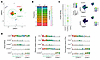 Figure 1
Single-cell RNA-Seq analysis of liver NK cells from invasive margin and peritumor CRLM tissue sites. (A) UMAP projection of liver NK (NKLR) cells from invasive margin (IM; n = 9,208) and peritumor (PT; n = 14,091) of 3 CRLM patients. CD56bright clusters are circled in green, CD56dim in red. (B) Bar plot showing relative frequency of clusters in IM and PT (normalized per tissue). (C) Left: Dot plot of NCAM1, FCGR3A, and CD3G expression. Right: Kernel density of NCAM1 and FCGR3A on UMAP plot. (D) Violin plots of selected genes across NKLR cell clusters, ordered according to CD56bright or CD56dim.
Unsupervised analysis subdivided NKLR cells into two CD56dim and CD56bright macro-clusters that differed in the expression of CD16 (FCGR3A) and CD56 (NCAM1) (Figure 1C, Supplemental Figure 1F, and Supplemental Table 2) (33, 34). CD56dim and CD56bright NKLR cells included 3 clusters (c3–4LR, c6LR) and 8 clusters (c0–2LR, c5LR, c7–9LR, c11LR), respectively. As expected, the majority of the NKLR fraction (69%) was represented by CD56bright cells (Figure 1, A and B) (26). Differentially expressed gene (DEG) analysis confirmed the liver-residency profile of CD56bright NKLR cells, characterized by coexpression of CXCR6, EOMES, and CD69 and lack of CD52 (Figure 1D and Supplemental Figure 2) (21). In addition, CD56bright NKLR cells shared high expression of the chemokines XCL1 and XCL2, the cytokine receptor IL2RB, the costimulatory molecule ICAM1, and a peculiar coexpression of transcription factors (TFs) both inhibiting (TCF7) and promoting (IRF8, TOX2) NK cell maturation (35–39). On the other hand, CD56dim NKLR cells expressed FGFBP2, the memory NK cell marker CD52, and TFs such as PRDM1, KLF2, and the CX3CR1 receptor, which is involved in NK cell migration from PB to peripheral tissues (40–42), thus suggesting they are not a resident population (Figure 1D). Although we cannot entirely exclude the presence of intravascular NK cells, given the highly perfused nature of the liver, the transcriptional profile of CD56dim NKLR cells strongly suggests peripheral recruitment or transient retention.
Pseudotime analysis was applied to unravel the developmental trajectories between NKLR cell clusters in CRLM. The pseudotime results by Monocle2 showed CD56bright and CD56dim cells along 3 separated branches (Figure 2, A and B, and Supplemental Figure 3A). 97.2% of CD56dim NK cells were located on the right branch; in contrast, the majority of CD56bright NK cells were distributed among the left (62.7%) and upper (28.1%) branches (Figure 2B). Importantly, we observed a minimal developmental relationship between CD56bright and CD56dim NK cells (9.1%) (Figure 2B), suggesting that a direct transition between the 2 subsets may be less evident in this setting. To validate this observation, pseudotime trajectories were also inferred using the Slingshot algorithm (Supplemental Figure 3B). This analysis confirmed the relative independence of intrahepatic CD56bright and CD56dim NK cells and highlighted the enrichment of CD56bright clusters with distinct functional profiles within the CRLM immune environment.
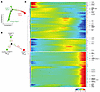 Figure 2
Pseudotime analysis of CD56bright and CD56dim NKLR cells. (A) Monocle2 pseudotime trajectory of NKLR cells. CD56bright and CD56dim cells are shown in green and red, respectively. (B) Relative frequency of CD56bright (green) and CD56dim (red) cells across branches, normalized within each branch. (C) Heatmap of selected driver genes along pseudotime. Cells are ordered left to right; colors indicate scaled (z score) expression.
Highly proliferative cells in CD56bright c8LR and c7LR expressing hallmark genes of DNA replication (e.g., TUBB, MIKI67, STMN1) were located at the starting root node of the CD56bright cell branch (Figure 2, A–C, and Supplemental Figure 3, A and C). These were associated with a liver tissue-residency profile, as suggested by the expression of EOMES and CXCR6, and terminal maturation markers such as TOX2 and CD244 (Figure 1D, Figure 2C, and Supplemental Figure 3C), indicating their high transcriptional dynamics. From these, we observed a progression toward a full effector stage following the CD56bright cell fate of c0–2LR, as suggested by pseudotime-dependent DEGs including cytokines (e.g., XCL1, IL16, and TNF), effector function molecules (e.g., GZMB, GZMK, and PRF1), and TFs (e.g., EOMES and TOX2) (Figure 2C and Supplemental Figure 3C). Finally, we further identified CD56bright c9LR and c11LR clusters, characterized by more advanced pseudotime positions, showing high expression of adaptive-like (KLRC2, CD3E) (43) and mitochondrial-active (e.g., MTRNR2L1/8/12/18) signature genes, respectively (Figure 1D, Figure 2C, Supplemental Figure 2, and Supplemental Figure 3, A and C).
On the other hand, CD56dim NK cells showed lower transcriptional heterogeneity as highlighted by the expression of terminally mature NK cell markers (KIRs, B3GAT1, CD52, TBX21, KLRG1, FGFBP2, NKG7, CD226), cytotoxic mediators (GZMB, GZMH, PRF1, GNLY, CTSW), and the tissue-homing receptor CX3CR1 (Figure 1D, Figure 2C, and Supplemental Figure 2).
Overall, pseudotime analysis revealed that intratumoral hepatic CD56bright and CD56dim NK cells followed largely independent trajectories with minimal overlap, with CD56bright cells displaying multiple intermediate states, whereas CD56dim cells predominantly occupied terminally differentiated states with limited heterogeneity.
Functional status and immune checkpoint profile of liver NK cells in CRLM. We then performed Gene Ontology (GO) enrichment analysis of DEGs for biological processes to elucidate pathways associated with intrahepatic NK cell clusters. GO enrichment analysis highlighted a strong association of NKLR cells with “cell killing” (Figure 3A). “NK cell–mediated cytotoxicity” mainly correlated with the CD56dim transcriptomic profile. Cell cycle and proliferation pathways were associated with c7LR and c8LR CD56bright clusters, whereas “cellular oxidant detoxification” and electron transport chain pathways were enriched in c11LR, as marked by mitochondrial genes. “Type I IFN production” was exclusively observed in CD56dim cells, whereas pathways of IFN-γ production were shared by CD56bright and CD56dim NKLR cells. In particular, we identified 2 clusters, CD56bright c5LR and CD56dim c6LR, associated with a distinctive IFNGhigh transcriptomic profile (Figure 3B), suggesting their effector activation. IFNGhigh cell subsets showed higher expression of heat shock proteins (HSPs) (e.g., HSPA1A, HSPA1B, HSPB1), chaperone and co-chaperone for HSP (DNAJA1, CHORDC1), and signaling molecules such as JUN, GIMAP4, and DUSP1 (Figure 4, A and B). Similar results were observed both in PT and IM compartments (Supplemental Figure 4A).
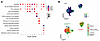 Figure 3
Functional enrichment and IFNG expression in NKLR cells. (A) Dot plot of GO biological process terms (q ≤ 0.01) enriched in intrahepatic NKLR cell clusters [DEGs: FDR ≤ 0.05, log(fold change) > 0.25]. Dots are colored by EnrichFold and sized by adjusted P value. (B) Kernel density of IFNG expression on the UMAP plot (top). The clustering of cells is shown at the bottom, with clusters grouped according to their transcriptional features.
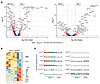 Figure 4
Comparison of liver CD56bright and CD56dim NKLR cells. (A) Volcano plot of DEGs in CD56bright c5LR versus c0–1–2LR (left) and CD56dim c6LR versus c3–4LR (right). (B) Heatmap of IFNGhigh signature gene expression across NKLR clusters. (C) Violin plots of selected immune checkpoint genes.
To decipher the mechanisms that regulate these IFNG-expressing cells conserved across CD56bright and CD56dim NKLR, we investigated the expression of ICs. CD56bright and CD56dim cell subsets were distinguished for their IC pattern (Figure 4C). KLRC1, TIGIT, CD96, and CD160 were mainly associated with the CD56bright phenotype. In addition, ENTDP1 (CD39) was expressed by cycling CD56bright cells in c7–8LR. LAG3 identified adaptive-like (c9LR) CD56bright cells. In contrast, CD56dim cells were marked by HAVCR2 (TIM-3) and KLRG1, and higher expression of specific KIRs (Supplemental Figure 4B). We found low expression of PDCD1 (PD-1) and CTLA4 in all NKLR cells. Notably, SIGIRR (IL-1R8), which we previously identified as an NK cell IC (31), was ubiquitously expressed by all NKLR cell clusters. In addition, lower expression of CXCR4, an unconventional IC of liver NK cells (44), was observed in the IFNGhigh c5LR and c6LR (Figure 4C), as also shown in the heatmap (Figure 4B).
To precisely define the contribution of CRLM microenvironment to the orientation of intrahepatic NK cells, we harmonized scRNA-Seq data from healthy liver samples (45) (see Methods). In the healthy liver, we identified CD56bright, CD56dim, and cycling NK cell subsets, with a clear separation between the CD56bright and CD56dim populations (Figure 5, A and B, and Supplemental Table 2) (26, 33, 34). This distinction mirrors what we observed in CRLM samples, as illustrated by UMAP embedding annotated with phenotype-specific gene signature scores (Figure 5B).
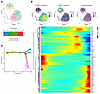 Figure 5
Healthy hepatic NK cells. (A) Top: UMAP projection of integrated NK cells (n = 5,760) from 5 healthy donors. Bottom: The bar plot shows the cluster frequencies normalized on total cells. (B) Kernel density of CD56bright, CD56dim, and cycling signature scores on UMAP. (C) Left: Pseudotime trajectory of hepatic NK cells (colored by cluster). Right: Heatmap of selected driver genes ordered by pseudotime, with scaled (z score) expression shown by color.
As in the pathological condition, pseudotime analysis in healthy liver also revealed only a minimal developmental connection between CD56bright and CD56dim NK cells (Figure 5C), with cycling NK cells located at the starting root of the trajectory. However, when we projected the pathological pseudotime ordering genes (Figure 2C) onto the healthy dataset (Figure 5C), many of them were absent (e.g., GZMA, TNF, CD244 [2B4], IL16, PRF1), indicating that the pathological milieu shapes the developmental trajectory of NK cells.
To investigate the NK cell subset–specific transcriptional changes induced by CRLM, we performed DEG analysis (Figure 6, A and B). Volcano plots highlighted that both CD56bright and CD56dim NK cells exhibited features of activation, including the upregulation of transcriptional programs mediated by AP-1 and NF-κB, as well as activation of MAPK signaling pathways. In both subsets, we observed increased expression of IFNG, cytotoxic effectors (GZMB, GNLY, PRF1), activating receptors (FCGR3A, NKG7), and transcriptional regulators such as TOP2B, BRD4, and POLR2A. Notably, CD56bright NK cells showed elevated expression of effector-associated genes such as EOMES, FAS, TOX, CRTAM, and TNFRSF9. Similarly, CD56dim NK cells upregulated the effector-associated gene CD226 (DNAM-1) and differentiation markers such as B3GAT1 (CD57) along with KIRs and TGFB1, TGFBR2, and TGFBR3, important regulators of NK cell activity (46). We also observed changes in the expression of immune checkpoint molecules: CD56bright NK cells expressed higher levels of TIGIT and ENTPD1, while CD56dim NK cells upregulated KLRC1 and LAIR2, supporting our findings of subset-specific immune regulation (Figure 4C).
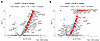 Figure 6
Comparison of CD56bright and CD56dim NK cells in CRLM versus healthy liver. Volcano plots of DEGs for CD56bright clusters (A) and CD56dim clusters (B) in CRLM versus healthy liver.
Together, these data demonstrate that CRLM profoundly reshapes the transcriptional landscape of both CD56bright and CD56dim NK cells, fostering an effector-like phenotype marked by a strong IFNG signature alongside finely tuned immune checkpoint modulation. While both subsets exhibit activation features, they preserve their distinct transcriptional and phenotypic identities, challenging the notion that effector functions in intrahepatic NK cells are confined to the CD56dim population.
Ligand-receptor interactions shaping NKLR crosstalk in CRLM. The identification of an IFNG-associated signature within intrahepatic CD56bright and CD56dim cells suggests that the activation of this immune pattern might be elicited by common signals in CRLM patients. We thus investigated how intrahepatic CD56bright and CD56dim NK cell subsets interact with different components of the CRLM immune microenvironment. We used NicheNet, an algorithm that infers ligand-target activities on the basis of their expressed genes (47). First, scRNA-Seq analysis of intrahepatic CD45+ cells of the same patients was used to annotate leukocyte clusters (Figure 7A) (48). We set the three NK cell clusters emerging from CD45+ cell analysis (CD56bright, CD56dim, and cycling NKLR cells) as “receiver” populations, focusing our analysis on the top-scored predicted NK ligands expressed in the “sender” myeloid and lymphoid cells (Figure 7B). Intrahepatic CD56bright and CD56dim NK cells shared most of their ligands upon interaction with either lymphoid or myeloid compartments. In contrast, cycling intrahepatic NK cells established specific ligand-target interactions. Ligands interacting with intrahepatic CD56bright and CD56dim NK cells, including IFNG, TGFB1, CD40LG, and the cytokines IL2, IL21, and IL23A, were largely expressed in lymphoid cells. IL18, IL1B, IL27, PTGS2, and IL15 were mainly expressed by myeloid senders (Figure 7C). Predicted ligands were involved in intrahepatic NK cell–mediated killing (e.g., PRF1, GZMs, FASLG), cytokine secretion (e.g., CCL3–5, XCL1, IRFs), activation and maturation (e.g., JUN, NFKBIA, MAFF, TBX21, NCR3), and cell migration (e.g., ICAM1–2, ITGAM). These results suggested that intrahepatic NK cell cytotoxicity was regulated by IL2 and TGFB1 expressed by CD4+ T cells, type 3 innate lymphoid cells (ILC3s), and γδ T cells (Figure 8A). In addition, we found IL18 as a key IFNG-upstream ligand for both intrahepatic CD56bright and CD56dim NK cells in CRLM patients. Kupffer cells (KCs) and type 2 conventional dendritic cells (cDC2s) were identified as a major source of IL18. Focusing on IFNG-expressing cells, we found that intrahepatic NK cell ligands were broadly expressed among lymphocytes and myeloid cells (Figure 8, B and C). In contrast, CXCL12, the ligand for CXCR4 receptor, was uniquely expressed by KCs, suggesting they regulate the CXCL12/CXCR4 axis in the CRLM milieu.
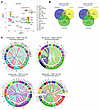 Figure 7
Intercellular communication in the immunological milieu of CRLM. (A) UMAP projection of intrahepatic CD45+ cells colored by cell family. (B) Venn diagrams of common and specific ligands from lymphoid (left) and myeloid (right) cells interacting with CD56bright, CD56dim, and cycling NK cells. (C) Chord plots of the top 100 predicted interactions (NicheNet) for CD56bright (top) and CD56dim (bottom) NK cells, ranked by regulatory potential. In each circular plot, one arc contains the ligands (derived from lymphoid [left] or myeloid [right] cells) and the opposite arc contains the downstream NK target genes. Directional chords connect each ligand to its predicted NK target genes, with the pointed end of each chord indicating the direction of regulation. Bars above the ligand arc represent the proportion of downstream target genes regulated by each ligand.
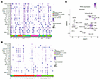 Figure 8
Ligand expression and IFNG interactions in intrahepatic CD45+ cells. (A) Dot plot of selected ligands in intrahepatic CD45+ populations, stratified by biological function. (B) Dot plot of ligands from intrahepatic CD45+ populations interacting with IFNG+ NK cells, stratified by function. (C) Feature plot of IFNG expression on intrahepatic CD45+ cells.
Checkpoint landscape defines NK cell identity in CRLM. Using the scRNA-Seq dataset of CD45+ cells in CRLMs (Supplemental Figure 5), we conducted a parallel evaluation of NK cells and other lymphocyte types. Peculiarly, most lymphocyte clusters showed high expression of tissue-affinity genes such as EOMES, CXCR6, and CD69, especially mucosal-associated invariant T (MAIT), CD8+, and γδ T cells. In addition, CD3+ T cells displayed effector function molecules described in intrahepatic CD56bright NK cells, but not in CD56dim clusters. For instance, γδ T cells and ILC3s are characterized by high levels of XCL1 and XCL2. Furthermore, GZMK has been detected in several clusters but not in CD56dim NK cells. Notably, MAIT, CD8+, and γδ T cells markedly contribute to TNF and IFN-γ production, while CD56dim NK cells are the predominant cytotoxic population, as suggested by the combination of GZMB, GNLY, and PRF1 levels. The evaluation of TFs has further revealed that TOX2, a strong terminal maturation/exhaustion marker in lymphocytes, is unexpectedly characteristic of CD56bright NK cells and ILC3s.
IC analysis revealed a shared expression of regulatory molecules such as CD96, SIGIRR, and CXCR4, across distinct immune lymphocyte types, suggesting their common involvement in orchestrating immune regulation within CRLM. However, combinatorial IC pattern analysis uncovered cell type–specific IC signatures. For instance, NKLR cells differed markedly from T cells by lacking expression of LAG3, PDCD1, and KLRG1. In contrast, NKLR cell subsets displayed elevated expression of KLRC1, ENTPD1, HAVCR2, and CD160, with expression levels varying between CD56dim and CD56bright NKLR cells. These data point to a finely tuned, subset-specific regulatory landscape that defines NK cell identity and function within the CRLM microenvironment. These distinct checkpoint architectures may pave the way for subset-tailored immunotherapeutic strategies aimed at reinvigorating NK cell–mediated antitumor activity in CRLM.
Dissection of PB NK cell heterogeneity in CRLM. In parallel, we performed scRNA-Seq analysis of NK cells isolated from matched PB samples. Based on transcriptomic profiles, a total of 12,820 PB NK (NKPB) cells were projected by UMAP. The unsupervised analysis identified 14 cell clusters (c0–13PB) with a similar relative frequency among each donor (Figure 9A and Supplemental Figure 6A). The lack of FCGR3A and NCAM1 expression together with a myeloid cell signature prompted us to exclude c9PB from further analysis (Figure 9B and Supplemental Figure 6B). Two main CD56bright and CD56dim phenotypes were annotated by hierarchical clustering and by transcriptional profiles (Figure 9, C and D, Supplemental Figure 6, C and D, and Supplemental Table 2) (33, 34). CD56bright NKPB cells included 3 clusters (c8PB, c4PB, c13PB) that represented a minority (9.6%) of total NKPB cells. CD56dim NKPB cells were grouped into 4 major (c0–3PB) and 5 minor (c5–7PB, c11–12PB) clusters. In contrast to their intrahepatic counterparts, CD56bright and CD56dim NKPB cells showed interrelated differentiation states with continuous progression. The pseudotime trajectory began with the CD56bright c8PB cluster expressing immature NK cell markers such as COTL1, SELL, CD44, CD2, XCL1, XCL2, and GZMK (Figure 9, E and F, and Supplemental Figure 7, A–C). Transitional states between CD56bright and CD56dim phenotypes were observed in clusters c4PB and c2PB, as suggested by increased effector potential (e.g., GZMs, FCGR3A, CTSW, KLRB1, NKG7, TBX21, NCR3) and lower expression of CD56bright markers (e.g., XCL1, XCL2, CD44, GZMK, NCR1) in comparison with c8PB (Figure 9, D and F, and Figure 10A). Likewise, NK cells in c2PB showed a less mature phenotype in comparison with the other CD56dim clusters (Figure 10B). We further detected increased expression of CX3CR1 in c1PB indicating preferential migration of mature CD56dim cells to the CRLM microenvironment (Figure 1D).
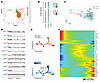 Figure 9
Single-cell RNA-Seq analysis of PB NK cells in CRLM patients. (A) UMAP projection of integrated PB NK (NKPB) cells (n = 12,820) from 3 patients, showing CD56bright (green) and CD56dim (red) clusters. (B) Dot plot of NCAM1, FCGR3A, and CD3G expression. (C) Overlaying clustering tree of PC3 and PC4 showing CD56bright and CD56dim cells at resolutions 0.2 (pink) and 0.7 (blue). (D) Violin plots of selected genes characteristic of CD56bright (green) and CD56dim (red). (E) Pseudotime trajectory of NKPB cells colored by cell family (top) or pseudotime value (bottom). (F) Heatmap of selected genes along pseudotime.
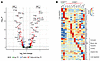 Figure 10
Differential gene expression in NKPB cell clusters. (A) Volcano plot of DEGs for CD56bright c8PB versus c4PB. (B) Heatmap of selected DEGs from CD56bright c8PB versus c13PB, and CD56dim c1–7PB and c10–12PB clusters. Expression values are zero-centered and scaled per gene.
CD56bright (c13PB) and CD56dim (c5–7PB and c10–12PB) cells showed tumor-related transcriptomic profiles (Figure 10B). In particular, c13PB showed tissue residency and effector genes previously identified in intrahepatic CD56bright cells (e.g., CXCR6, FASLG, IRF8, TIGIT, CD160, TOX2, CHORDC1), thus suggesting their egression from the liver to the blood. CD56dim cells in c6PB expressed a family of mitochondrial genes (e.g., MTRNR2L8/12) (49, 50). CD56dim NKPB cells in c5PB and c11PB were characterized by an apoptotic (e.g., BAX, BBC3, MDM2) and a proliferating (e.g., MIK67, PCNA, STMN1) phenotype, respectively. CD56dim c12PB cells, similarly to c13PB, mirrored a liver signature (i.e., IFNG, DNAJB1, HSPA1A, HSPB1). Finally, CD56dim c10PB showed an activated phenotype (e.g., IRF8, IER5, IER2, NFKBIA, RELB) and c7PB an adaptive-like profile as indicated by higher expression of CD3E, CD3G, CD52, and LAG3 and lower expression of FCER1G (FcεRγ), ZBTB16, SYK, SH2D1B (EAT2), and KLRB1 (43, 51).
Multiparametric flow cytometry profiling of NK cells in CRLM patients. scRNA-Seq analysis highlighted a specific IC pattern in intrahepatic NK cells depending on tissue residency, effector stage, response to CRLM, and likely egress of intrahepatic NK cells to bloodstream. We next proceeded to validate the NK cell expression of ICs by multiparametric flow cytometry of liver samples and PB isolated from CRLM patients and compared with PB of healthy donors (HDs). We confirmed that intrahepatic NK cells expressed high levels of TIGIT, CD39, NKG2A, and CD96, although with high heterogeneity among patients. Notably, TIGIT and CD39 were mainly enriched on CD56bright NKLR cells from CRLM patients (Figure 11A), and in line with the transcriptional profiles, the expression of these two ICs was higher on CD56bright NKLR cells compared with their PB counterparts. In contrast, CD56bright NKPB cells presented higher expression of NKG2A and CD96 compared with CD56bright NKLR cells. TIM-3 and KLRG1 were preferentially expressed by both intrahepatic and circulating CD56dim NK cells (Figure 11B). The coexpression of different ICs was evaluated by multiparametric PhenoGraph algorithms (Figure 11, C and D), which generated 3 clusters of CD56bright NK cells (c1–2, c6) and 4 clusters of CD56dim NK cells (c3–5, c7). These analyses confirmed the differential and peculiar NK cell expression patterns of ICs in CRLM. Indeed, CD56bright NKLR cells in c1 and c2 showed higher expression of TIGIT and CD39, each mutually excluded (Figure 11D). High expression of NKG2A was found in c6 embedded in both circulating and intrahepatic CD56bright cells. The 2 CD56dim NKPB cell clusters c4–5, highly enriched in CRLM, were also characterized by high expression of TIM-3, LAIR-1, and KLRG1 (Figure 11D).
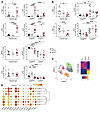 Figure 11
Flow cytometry analysis of blood and tissue NK cells in CRLM patients. (A and B) Flow cytometry of immune checkpoint expression in NK cells from HDPB, CRLMPB, and CRLMLR. Data are shown as mean ± SEM. *P ≤ 0.05; **P ≤ 0.01; ***P ≤ 0.001; ****P ≤ 0.0001. One-way ANOVA (left) or 2-way ANOVA (right); n = 10 per group. (C) UMAP projection showing relative abundance of NK cell clusters in HDPB, CRLMPB, and CRLMLR. (D) Dot plot of marker frequency (percent) and MFI across NK cell clusters.
We then evaluated the expression of CXCR4 and IL-1R8 (SIGIRR). IL-1R8 is an IC whose expression is upregulated following NK cell maturation (31, 52). Accordingly, CD56dim NKPB cells expressed high levels of this molecule (Figure 12A). Surprisingly, we also observed an increased amount of IL-1R8 on CD56bright NKPB cells from CRLM patients compared with HDs. In line with our transcriptional scRNA-Seq analysis, both intrahepatic CD56bright and CD56dim NK cells showed the highest levels of IL-1R8 in CRLM (Figure 12A). Similarly, the highest percentages of CXCR4+ cells were found in both intrahepatic CD56bright and CD56dim NK cells (Figure 12, B and C). We then investigated the association between the levels of CXCR4 expression and IFN-γ production. To this end, CD56bright and CD56dim cells were stratified on the basis of the different intensity of CXCR4 expression. First, our results confirmed that CD56bright NKLR cells produced IFN-γ (Figure 12B). Then, CXCR4dim/neg showed higher IFN-γ levels compared with CXCR4bright in CRLM from both intrahepatic CD56bright and CD56dim NK cells (Figure 12, B and C). These results were also confirmed by multiparametric PhenoGraph analysis (Figure 12, D and E). CXCR4 was associated with the liver residency marker CXCR6, TIGIT, and CD39 in cluster 6 (Figure 12E). Finally, CXCR4+CXCR6+ NK cells (cluster 5) were observed only in the PB of patients with CRLM, not in HDs.
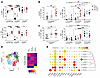 Figure 12
Evaluation of IL-1R8 and CXCR4+ NK cell profiling in CRLM. (A) IL-1R8 expression in NK cells from HDPB, CRLMPB, and CRLMLR. Top: Relative frequency (percent) in total NK, CD56bright, and CD56dim subsets. Bottom: The MFI in the same subsets. (B and C) CXCR4 (left) and IFN-γ (right) expression in CD56bright (B) and CD56dim (C) NK cells from HDPB, CRLMPB, and CRLMLR, stratified by CXCR4 levels. (A–C) Data are shown as mean ± SEM. *P ≤ 0.05; **P ≤ 0.01; ***P ≤ 0.001; ****P ≤ 0.0001. One-way ANOVA (A; B and C, left) or 2-way ANOVA (B and C, right). (A) n = 15 (HDPB, CRLMPB), n = 14 (CRLMLR); (B and C) n = 9. (D) UMAP projection showing NK cell cluster distribution across HDPB, CRLMPB, and CRLMLR. (E) Dot plot of marker frequency (percent) and MFI in NK cell clusters.
CXCR4 and IL-1R8 blockade enhances NK cell effector function in CRLM. We next investigated the functional relevance of IL-1R8 and CXCR4 in NKLR and NKPB cells. To properly activate NK cells, we stimulated isolated CRLM lymphocytes and PBMCs with the cytokines IL-2, IL-12, and IL-18 (53). Targeting IL-1R8 with a blocking mAb increased the effector functions of intrahepatic CD56dim NK cells, as indicated by the higher intracellular levels of TNF-α and IFN-γ upon stimulation with IL-2, IL-12, and IL-18, in 5 of 6 and 4 of 6 CRLM patients, respectively (Figure 13, A and B, and Supplemental Figure 8, A and B). These results indicate that despite NK cell subsets expressing comparable levels of IL-1R8, they exhibit distinct functional properties upon IL-1R8 blockade in this experimental condition. In addition, blocking IL-1R8 would result in unleashing specific functional features, depending on the effector potential, transcriptional profile, and repertoire of activating and inhibitory molecules of NK cell subsets (Figure 13C).
 Figure 13
Targeting IL-1R8 and CXCR4 in NK cells from CRLM. (A and B) TNF-α (A) and IFN-γ (B) expression in liver CD56dim and CD56bright NK cells from CRLMLR patients stimulated with anti–IL-1R8 mAb or isotype control. (C) Cytokine-stimulated PB NK cells (n = 6, HDs) show increased cytotoxicity upon IL-1R8 blockade in HT-29 killing assay at indicated effector-to-target (E:T) ratios (1:5, 1:2.5, 1:1). (D) IFN-γ expression in CXCR4+CD56dim liver NK cells from CRLM patients stimulated with CXCL12 and/or plerixafor. (A–D) Data are shown as mean ± SEM. *P ≤ 0.05; **P ≤ 0.01; ***P ≤ 0.001. Statistical analysis was performed using paired 2 tailed parametric t test (A and B), paired 2 tailed non-parametric test (C), and 2-way ANOVA (D). Sample size: n = 3–6 for A–C; n = 4–6 for D.
Finally, we investigated the role of CXCR4 in intrahepatic NK cells by stimulating them with CXCL12 and/or with the CXCR4 antagonist plerixafor. Intrahepatic CD56dim NK cells (but not CD56bright) showed a significantly decreased production of IFN-γ upon stimulation with CXCL12 when compared with controls (Figure 13D). This impairment was restored by plerixafor, which counteracted CXCL12-mediated inhibition of IFN-γ production of intrahepatic CD56dim NK cells (Figure 13D). These results indicate that the effector functions of CXCR4+CD56dim NK cells infiltrating CRLM are tuned by the CXCR4-ligand interactions.


Copyright © 2026 American Society for Clinical Investigation
ISSN: 0021-9738 (print), 1558-8238 (online)