
Abstract
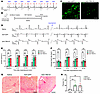
Gene therapy–based biological pacemakers have been proposed as an alternative to their hardware-based counterparts. In this context, short-term ectopic expression of the T-box transcription factor 18 (TBX18) in the ventricle has been reported to generate potent, short-term pacemaker function in various animal models. Here, we investigated the impact of adeno-associated virus–mediated (AAV-mediated), long-term expression of TBX18 and compared the outcomes with those of the pacemaker ion channel hyperpolarization-activated cyclic nucleotide-gated potassium and sodium channel 2 (Hcn2). Our findings revealed that CMV-driven ectopic TBX18 expression in mouse hearts led to severe cardiac fibrosis. At lower, nonfibrogenic levels, TBX18 maintained its transcriptional function but failed to induce pacemaker phenotypes. TBX18-expressing cells showed suppressed expression of key working myocardial genes, but the pacemaker gene program was not induced. Electrophysiological studies showed abnormal automaticity in TBX18-expressing cells, combined with prolonged repolarization and various current changes. However, no hyperpolarization-activated funny current was detected. In a complete atrioventricular block rat model, AAV-mediated Hcn2 expression induced robust ectopic pacemaker activity in the presence of isoproterenol, whereas TBX18 expression neither generated such activity nor augmented Hcn2-mediated pacing. In conclusion, at functionally nonfibrogenic levels, TBX18 is neither sufficient nor necessary to induce pacemaker activity. In contrast, Hcn2 generates reliable pacing, making it a more viable candidate for biological pacemaker development.
Authors
Jianan Wang, Mathilde R. Rivaud, Mischa Klerk, Arie R. Boender, Ruud N. Visser, Rinske Sparrius, Hee Young Lee, Karel van Duijvenboden, Huiling Zhou, Yuting Yang, Emiel J.M. Kramer, Kyung Ho Park, Larry C. Park, Silke Schrödel, Christian Thirion, Eric Ehrke-Schulz, Anja Ehrhardt, Osne F. Kirzner, Klaus Neef, Hanno L. Tan, Arie O. Verkerk, Vincent M. Christoffels, Gerard J.J. Boink
This file is in Adobe Acrobat (PDF) format. If you have not installed and configured the Adobe Acrobat Reader on your system.
Having trouble reading a PDF?
PDFs are designed to be printed out and read, but if you prefer to read them online, you may find it easier if you increase the view size to 125%.
Having trouble saving a PDF?
Many versions of the free Acrobat Reader do not allow Save. You must instead save the PDF from the JCI Online page you downloaded it from. PC users: Right-click on the Download link and choose the option that says something like "Save Link As...". Mac users should hold the mouse button down on the link to get these same options.
Having trouble printing a PDF?
- Try printing one page at a time or to a newer printer.
- Try saving the file to disk before printing rather than opening it "on the fly." This requires that you configure your browser to "Save" rather than "Launch Application" for the file type "application/pdf", and can usually be done in the "Helper Applications" options.
- Make sure you are using the latest version of Adobe's Acrobat Reader.
Unedited blot and gel images - Download (1.23 MB)


Copyright © 2026 American Society for Clinical Investigation
ISSN: 0021-9738 (print), 1558-8238 (online)