
Go to JCI Insight
  • About
  • Editors
  • Consulting Editors
  • For authors
  • Publication ethics
  • Publication alerts by email
  • Advertising
  • Job board
  • Contact
  • Clinical Research and Public Health
  • Current issue
  • Past issues
  • By specialty
    • COVID-19
    • Cardiology
    • Gastroenterology
    • Immunology
    • Metabolism
    • Nephrology
    • Neuroscience
    • Oncology
    • Pulmonology
    • Vascular biology
    • All ...
  • Videos
    • Conversations with Giants in Medicine
    • Video Abstracts
  • Reviews
    • View all reviews ...
    • Clinical innovation and scientific progress in GLP-1 medicine (Nov 2025)
    • Pancreatic Cancer (Jul 2025)
    • Complement Biology and Therapeutics (May 2025)
    • Evolving insights into MASLD and MASH pathogenesis and treatment (Apr 2025)
    • Microbiome in Health and Disease (Feb 2025)
    • Substance Use Disorders (Oct 2024)
    • Clonal Hematopoiesis (Oct 2024)
    • View all review series ...
  • Viewpoint
  • Collections
    • In-Press Preview
    • Clinical Research and Public Health
    • Research Letters
    • Letters to the Editor
    • Editorials
    • Commentaries
    • Editor's notes
    • Reviews
    • Viewpoints
    • 100th anniversary
    • Top read articles

  • Current issue
  • Past issues
  • Specialties
  • Reviews
  • Review series
  • Conversations with Giants in Medicine
  • Video Abstracts
  • In-Press Preview
  • Clinical Research and Public Health
  • Research Letters
  • Letters to the Editor
  • Editorials
  • Commentaries
  • Editor's notes
  • Reviews
  • Viewpoints
  • 100th anniversary
  • Top read articles
  • About
  • Editors
  • Consulting Editors
  • For authors
  • Publication ethics
  • Publication alerts by email
  • Advertising
  • Job board
  • Contact
CTLA-4 blockade shifts the B cell repertoire toward autoimmunity
Elif Çakan, Meng Wang, Yile Dai, Adrien Mirouse, Clarence Rachel Villanueva-Pachas, Delphine Bouis, Joshua M. Boeckers, Ruchi Gera, Sally Yraita, Leslie Clapp, Ana Luisa Perdigoto, Fabien R. Delmotte, Christopher Massad, Antonietta Bacchiocchi, Aaron M. Ring, Yuval Kluger, Harriet M. Kluger, Kevan C. Herold, Eric Meffre
View: Text | PDF
Research Article Autoimmunity Immunology

CTLA-4 blockade shifts the B cell repertoire toward autoimmunity

  • Text
  • PDF
Abstract

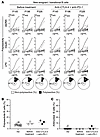
Checkpoint inhibitors targeting CTLA-4 and PD-1 revolutionized the treatment of cancer patients, but their use is limited by the emergence of immune-related adverse events (irAEs). We assessed autoreactive B cell frequencies in the blood of cancer patients before and after treatment with checkpoint inhibitors by testing the reactivity of recombinant antibodies cloned from single B cells. We found that anti–PD-1 and anti–CTLA-4 combination therapy induced the emergence of autoreactive mature naive B cells, whereas central B cell tolerance remained functional. In contrast, anti–PD-1 alone did not alter autoreactive B cell counterselection. Anti–CTLA-4 injections in humanized mice also resulted in the production of autoreactive B cells, whereas anti–PD-1 did not. We conclude that CTLA-4 but not PD-1 is required for the removal of developing autoreactive mature naive B cells and that CTLA-4 blockade broadens the peripheral B cell repertoire, which likely contains clones that promote not only irAEs but also antitumor responses.

Authors

Elif Çakan, Meng Wang, Yile Dai, Adrien Mirouse, Clarence Rachel Villanueva-Pachas, Delphine Bouis, Joshua M. Boeckers, Ruchi Gera, Sally Yraita, Leslie Clapp, Ana Luisa Perdigoto, Fabien R. Delmotte, Christopher Massad, Antonietta Bacchiocchi, Aaron M. Ring, Yuval Kluger, Harriet M. Kluger, Kevan C. Herold, Eric Meffre

×
Problems with a PDF?

This file is in Adobe Acrobat (PDF) format. If you have not installed and configured the Adobe Acrobat Reader on your system.

Having trouble reading a PDF?

PDFs are designed to be printed out and read, but if you prefer to read them online, you may find it easier if you increase the view size to 125%.

Having trouble saving a PDF?

Many versions of the free Acrobat Reader do not allow Save. You must instead save the PDF from the JCI Online page you downloaded it from. PC users: Right-click on the Download link and choose the option that says something like "Save Link As...". Mac users should hold the mouse button down on the link to get these same options.

Having trouble printing a PDF?

  1. Try printing one page at a time or to a newer printer.
  2. Try saving the file to disk before printing rather than opening it "on the fly." This requires that you configure your browser to "Save" rather than "Launch Application" for the file type "application/pdf", and can usually be done in the "Helper Applications" options.
  3. Make sure you are using the latest version of Adobe's Acrobat Reader.

Supplemental data - Download (4.37 MB)

Advertisement

Copyright © 2025 American Society for Clinical Investigation
ISSN: 0021-9738 (print), 1558-8238 (online)

Sign up for email alerts