
Go to JCI Insight
  • About
  • Editors
  • Consulting Editors
  • For authors
  • Publication ethics
  • Publication alerts by email
  • Advertising
  • Job board
  • Contact
  • Clinical Research and Public Health
  • Current issue
  • Past issues
  • By specialty
    • COVID-19
    • Cardiology
    • Gastroenterology
    • Immunology
    • Metabolism
    • Nephrology
    • Neuroscience
    • Oncology
    • Pulmonology
    • Vascular biology
    • All ...
  • Videos
    • Conversations with Giants in Medicine
    • Video Abstracts
  • Reviews
    • View all reviews ...
    • Clinical innovation and scientific progress in GLP-1 medicine (Nov 2025)
    • Pancreatic Cancer (Jul 2025)
    • Complement Biology and Therapeutics (May 2025)
    • Evolving insights into MASLD and MASH pathogenesis and treatment (Apr 2025)
    • Microbiome in Health and Disease (Feb 2025)
    • Substance Use Disorders (Oct 2024)
    • Clonal Hematopoiesis (Oct 2024)
    • View all review series ...
  • Viewpoint
  • Collections
    • In-Press Preview
    • Clinical Research and Public Health
    • Research Letters
    • Letters to the Editor
    • Editorials
    • Commentaries
    • Editor's notes
    • Reviews
    • Viewpoints
    • 100th anniversary
    • Top read articles

  • Current issue
  • Past issues
  • Specialties
  • Reviews
  • Review series
  • Conversations with Giants in Medicine
  • Video Abstracts
  • In-Press Preview
  • Clinical Research and Public Health
  • Research Letters
  • Letters to the Editor
  • Editorials
  • Commentaries
  • Editor's notes
  • Reviews
  • Viewpoints
  • 100th anniversary
  • Top read articles
  • About
  • Editors
  • Consulting Editors
  • For authors
  • Publication ethics
  • Publication alerts by email
  • Advertising
  • Job board
  • Contact

Citations to this article
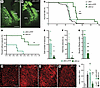
Dysfunctional LHX6 pallido-subthalamic projections mediate epileptic events in a mouse model of Leigh Syndrome
Laura Sánchez-Benito, … , Elisenda Sanz, Albert Quintana
Published October 2, 2025
Citation Information: J Clin Invest. 2025. https://doi.org/10.1172/JCI187571.
View: Text | PDF
Research In-Press Preview Inflammation Neuroscience

Dysfunctional LHX6 pallido-subthalamic projections mediate epileptic events in a mouse model of Leigh Syndrome

  • Text
  • PDF
Abstract

Deficits in the mitochondrial energy-generating machinery cause mitochondrial disease (MD), a group of untreatable and usually fatal disorders. Among many severe symptoms, refractory epileptic events are a common neurological presentation of MD. However, the neuronal substrates and circuits for MD-induced epilepsy remain unclear. Here, using mouse models of Leigh Syndrome, a severe form of MD associated to epilepsy, that lack mitochondrial complex I subunit NDUFS4 in a constitutive or conditional manner, we demonstrate that mitochondrial dysfunction leads to a reduction in the number of GABAergic neurons in the rostral external globus pallidus (GPe), and identify a specific affectation of pallidal Lhx6-expressing inhibitory neurons, contributing to altered GPe excitability. Our findings further reveal that viral vector-mediated Ndufs4 re-expression in the GPe effectively prevents seizures and improves the survival in the models. Additionally, we highlight the subthalamic nucleus (STN) as a critical structure in the neural circuit involved in mitochondrial epilepsy, as its inhibition effectively reduces epileptic events. Thus, we have identified a role for pallido-subthalamic projections in the development of epilepsy in the context of mitochondrial dysfunction. Our results suggest STN inhibition as a potential therapeutic intervention for refractory epilepsy in patients with MD providing promising leads in the quest to identify effective treatments.

Authors

Laura Sánchez-Benito, Melania González-Torres, Irene Fernández-González, Laura Cutando, María Royo, Joan Compte, Miquel Vila, Sandra Jurado, Elisenda Sanz, Albert Quintana

×

Loading citation information...
Advertisement

Copyright © 2025 American Society for Clinical Investigation
ISSN: 0021-9738 (print), 1558-8238 (online)

Sign up for email alerts