
Branching out
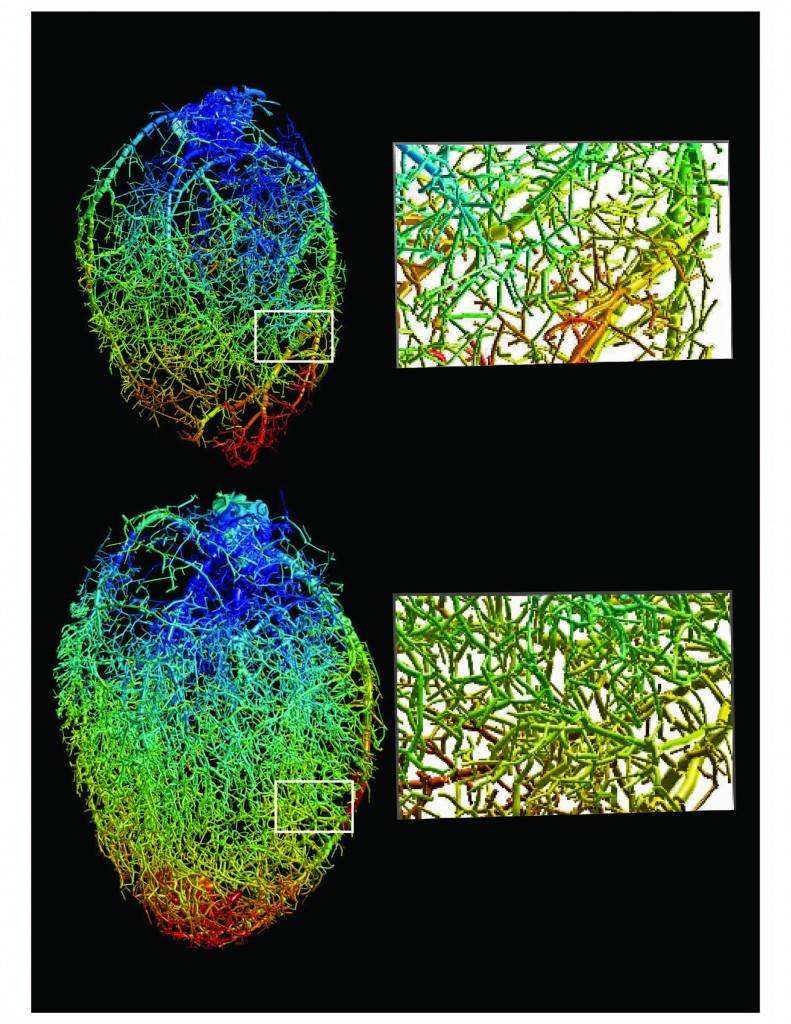
Myocardial hypertrophy, a thickening of the heart muscle, is an adaptation that occurs with increased stress on the heart, such as high blood pressure. As the heart muscle expands, it also requires greater blood flow to maintain access to oxygen and nutrients, necessitating an expansion of the cardiac vasculature. Daniela Tirziu and colleagues identified a molecular mechanism by which the growth of new blood vessels (angiogenesis) and heart muscle growth are coordinated. Using a mouse model of myocardial hypertrophy, Tirziu and colleagues determined that nitric oxide triggers the destruction of a protein known as RGS4. Nitric oxide typically drives physiological changes associated with the relaxation of blood vessels, while RGS4 attenuates the activity of a cellular signaling pathway that promotes cardiac growth. These findings reveal how increases in heart muscle and blood vessel growth are coordinated, linking changes in vasculature to changes in heart size. The accompanying image is a computational reconstruction of the mouse arterial tree using a rainbow color map from blye to red to indicate the branching level of each vascular segment. The image emphasizes the idea that an increase in vascular tree and arterial branching drives the increase in heart size (lower panel).
Related articles

Abstract
Myocardial hypertrophy is an adaptation to increased hemodynamic demands. An increase in heart tissue must be matched by a corresponding expansion of the coronary vasculature to maintain and adequate supply of oxygen and nutrients for the heart. The physiological mechanisms that underlie the coordination of angiogenesis and cardiomyocyte growth are unknown. We report that induction of myocardial angiogenesis promotes cardiomyocyte growth and cardiac hypertrophy through a novel NO-dependent mechanism. We used transgenic, conditional overexpression of placental growth factor (PlGF) in murine cardiac tissues to stimulate myocardial angiogenesis and increase endothelial-derived NO release. NO production, in turn, induced myocardial hypertrophy by promoting proteasomal degradation of regulator of G protein signaling type 4 (RGS4), thus relieving the repression of the Gβγ/PI3Kγ/AKT/mTORC1 pathway that stimulates cardiomyocyte growth. This hypertrophic response was prevented by concomitant transgenic expression of RGS4 in cardiomyocytes. NOS inhibitor L-NAME also significantly attenuated RGS4 degradation, and reduced activation of AKT/mTORC1 signaling and induction of myocardial hypertrophy in PlGF transgenic mice, while conditional cardiac-specific PlGF expression in eNOS knockout mice did not induce myocardial hypertrophy. These findings describe a novel NO/RGS4/Gβγ/PI3Kγ/AKT mechanism that couples cardiac vessel growth with myocyte growth and heart size.
Authors
Irina M. Jaba, Zhen W. Zhuang, Na Li, Yifeng Jiang, Kathleen A. Martin, Albert J. Sinusas, Xenophon Papademetris, Michael Simons, William C. Sessa, Lawrence H. Young, Daniela Tirziu


Copyright © 2026 American Society for Clinical Investigation
ISSN: 0021-9738 (print), 1558-8238 (online)