
Submit a comment
Abstract
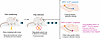
Trauma-related neuropsychiatric disorders are commonly treated with exposure-based therapy, an approach based on fear extinction, in which fear memory and expression are suppressed by repeated exposure to the inciting fear stimulus. Fear extinction–focused research often investigates mechanisms of fear inhibition, but positive affect may also contribute to facilitating extinction. In this issue of the JCI, Lin et al. used activity-dependent neuronal labeling in a model of fear extinction to tag extinction-activated medial prefrontal cortex (mPFC) ensembles, identifying functionally distinct projections to the zona incerta (ZI) and supramamillary nucleus (SuM). While mPFC-ZI projections governed extinction retrieval, mPFC-SuM projections encoded positive affect and reinforced fear extinction persistence. Additionally, Lin et al. discovered that SIRT1-expressing mPFC-SuM extinction-recruited projections control extinction relapse vulnerability, showing that SIRT1 overexpression can be leveraged to reduce fear relapse. Overall, this study shows that key cortico-hypothalamic projections manage extinction retrieval and positive affect to promote fear extinction.
Authors
Quan-Son Eric Le, Luis E. Rosas-Vidal
Guidelines
The Editorial Board will only consider comments that are deemed relevant and of interest to readers. The Journal will not post data that have not been subjected to peer review; or a comment that is essentially a reiteration of another comment.
- Comments appear on the Journal’s website and are linked from the original article’s web page.
- Authors are notified by email if their comments are posted.
- The Journal reserves the right to edit comments for length and clarity.
- No appeals will be considered.
- Comments are not indexed in PubMed.
Specific requirements
- Maximum length, 400 words
- Entered as plain text or HTML
- Author’s name and email address, to be posted with the comment
- Declaration of all potential conflicts of interest (even if these are not ultimately posted); see the Journal’s conflict-of-interest policy
- Comments may not include figures


Copyright © 2026 American Society for Clinical Investigation
ISSN: 0021-9738 (print), 1558-8238 (online)