
Submit a comment
Abstract
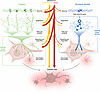
Most neurodegenerative diseases reflect patient-specific combinations of polygenic risk variants interacting with aging and environmental factors, rather than a single causative mutation. Phase III clinical trial failure rates for neurodegenerative indications exceed 95%, reflecting in part the limitations of existing preclinical systems to fully model the human genetic context of disease. Patient-derived induced pluripotent stem cells (iPSCs) have the potential to address this shortcoming by faithfully recapitulating human cell biology and preserving each patient’s complete genetic architecture. This Review examines iPSC-based models of neurodegeneration across three themes. First, we discuss mechanisms revealed by these models, from convergent pathways uncovered by familial mutations to early evidence that sporadic disease biology is accessible at sufficient cohort scale. Second, we evaluate culture systems from 2-dimensional monocultures to organoids, examining how increasing complexity expands addressable biological questions while introducing trade-offs. Third, we address the aging problem: reprogramming erases epigenetic signatures of donor aging, removing the cellular context in which late-onset sporadic neurodegeneration emerges. We discuss strategies approximating aging in iPSC-derived neurons and highlight direct conversion strategies that preserve native epigenetic age, enabling access to age-dependent phenotypes. We propose a framework matching model systems to biological questions, improving mechanistic understanding and therapeutic development.
Authors
Shijie Wang, Lisa Elia, Weiyi Liu, Steven Finkbeiner
Guidelines
The Editorial Board will only consider comments that are deemed relevant and of interest to readers. The Journal will not post data that have not been subjected to peer review; or a comment that is essentially a reiteration of another comment.
- Comments appear on the Journal’s website and are linked from the original article’s web page.
- Authors are notified by email if their comments are posted.
- The Journal reserves the right to edit comments for length and clarity.
- No appeals will be considered.
- Comments are not indexed in PubMed.
Specific requirements
- Maximum length, 400 words
- Entered as plain text or HTML
- Author’s name and email address, to be posted with the comment
- Declaration of all potential conflicts of interest (even if these are not ultimately posted); see the Journal’s conflict-of-interest policy
- Comments may not include figures


Copyright © 2026 American Society for Clinical Investigation
ISSN: 0021-9738 (print), 1558-8238 (online)