
Submit a comment
Abstract
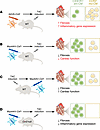
Cardiac macrophages (CMs) preserve homeostasis in the heart by clearing cellular debris and facilitating electrical conduction. During tissue injury, embryonically derived CMs (em-CMs) have traditionally been deemed beneficial for promoting tissue repair, whereas monocyte-derived CMs (mo-CMs) are considered detrimental, contributing to inflammation and tissue damage. However, Kasam et al. challenge this binary classification using cardiac-specific strategies to expand either em-CM or mo-CM populations. As expected, mice with cardiac-specific mo-CM expansion exhibited adverse outcomes following transverse aortic constriction (TAC). Surprisingly, mice with expanded em-CMs also showed a marked decline in cardiac function after TAC, which was associated with an unexpected interaction with mo-CMs. This deterioration was temporally regulated, occurring only if em-CMs were expanded before TAC induction. Together, these findings suggest that simplistic classification of CMs as either beneficial or harmful underestimates their complex roles in cardiac pathology, highlighting the need to reassess current views of macrophage function in heart injury.
Authors
Janmes Karunamurthy, Ziyi Li, Ajitha Thanabalasuriar
Guidelines
The Editorial Board will only consider comments that are deemed relevant and of interest to readers. The Journal will not post data that have not been subjected to peer review; or a comment that is essentially a reiteration of another comment.
- Comments appear on the Journal’s website and are linked from the original article’s web page.
- Authors are notified by email if their comments are posted.
- The Journal reserves the right to edit comments for length and clarity.
- No appeals will be considered.
- Comments are not indexed in PubMed.
Specific requirements
- Maximum length, 400 words
- Entered as plain text or HTML
- Author’s name and email address, to be posted with the comment
- Declaration of all potential conflicts of interest (even if these are not ultimately posted); see the Journal’s conflict-of-interest policy
- Comments may not include figures


Copyright © 2026 American Society for Clinical Investigation
ISSN: 0021-9738 (print), 1558-8238 (online)