
Submit a comment
Abstract
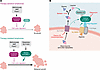
Malignant cells must rapidly synthesize nucleotides to grow and proliferate. Antimetabolite chemotherapies throw a wrench in this process by administering decoy molecules resembling nucleotide precursors that cells cannot use, such as 6-mercaptopurine (6MP) and methotrexate. While this approach remains an essential tool in the treatment of lymphoblastic leukemias and B cell non-Hodgkin lymphomas, approximately 1 in 3 patients will eventually develop therapy-resistant malignancies. In this issue of the JCI, Yang et al. investigated the metabolic adaptations that enable therapy-resistant tumors to grow in the presence of these drugs. Using their previously described mouse model of MYC-driven large B cell lymphoma, they identified that increased expression of the vesicular oligopeptide and histidine transporter SLC15A3 drives dipeptide accumulation in therapy-resistant cells. In lieu of finding other ways to make more nucleotides, these adaptations force cell growth by boosting mTOR signaling. This cunning adaptation, however, is also a vulnerability that can be targeted clinically.
Authors
Carlos Carmona-Fontaine
Guidelines
The Editorial Board will only consider comments that are deemed relevant and of interest to readers. The Journal will not post data that have not been subjected to peer review; or a comment that is essentially a reiteration of another comment.
- Comments appear on the Journal’s website and are linked from the original article’s web page.
- Authors are notified by email if their comments are posted.
- The Journal reserves the right to edit comments for length and clarity.
- No appeals will be considered.
- Comments are not indexed in PubMed.
Specific requirements
- Maximum length, 400 words
- Entered as plain text or HTML
- Author’s name and email address, to be posted with the comment
- Declaration of all potential conflicts of interest (even if these are not ultimately posted); see the Journal’s conflict-of-interest policy
- Comments may not include figures


Copyright © 2026 American Society for Clinical Investigation
ISSN: 0021-9738 (print), 1558-8238 (online)