
Submit a comment
Abstract
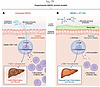
Metabolic dysfunction–associated steatohepatitis (MASH) is increasingly linked to disruptions of the gut/liver axis, yet the microbial mechanisms driving disease progression remain incompletely defined. Here, Qu et al. have identified ileal microbial ammonia production by Clostridium perfringens as a mechanistic driver of epithelial barrier dysfunction and hepatic CD8+ T cell remodeling in MASH. In nonhuman primate and mouse models of MASH, the authors demonstrated that the glycine-based tripeptide DT-109 restored gut barrier integrity and attenuated FosB-mediated CCL5 expression in CD8+ T cells via inhibition of bacterial nitrite reductase A–mediated microbial ammonia production. These findings position microbial nitrogen metabolism as a tractable therapeutic target and highlight metabolite-focused microbiome interventions as a potential MASH intervention.
Authors
Vanessa A. Leone, Arion Kennedy
Guidelines
The Editorial Board will only consider comments that are deemed relevant and of interest to readers. The Journal will not post data that have not been subjected to peer review; or a comment that is essentially a reiteration of another comment.
- Comments appear on the Journal’s website and are linked from the original article’s web page.
- Authors are notified by email if their comments are posted.
- The Journal reserves the right to edit comments for length and clarity.
- No appeals will be considered.
- Comments are not indexed in PubMed.
Specific requirements
- Maximum length, 400 words
- Entered as plain text or HTML
- Author’s name and email address, to be posted with the comment
- Declaration of all potential conflicts of interest (even if these are not ultimately posted); see the Journal’s conflict-of-interest policy
- Comments may not include figures


Copyright © 2026 American Society for Clinical Investigation
ISSN: 0021-9738 (print), 1558-8238 (online)