
Submit a comment
Abstract
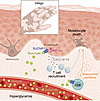
Vitiligo is a depigmenting disease marked by progressive T cell–driven destruction of melanocytes in the skin, hair, and mucosa. While vitiligo is known to be a T cell–mediated autoimmune disease, its triggers have remained poorly understood and treatment options limited. In this issue of the JCI, Kang et al. demonstrated how hyperglycemia exacerbates vitiligo progression through the succinate/SUCNR1 axis. These findings identify succinate as a potential biomarker for disease activity and highlight an independent pathway for targeting in therapeutic intervention. More broadly, the findings linking succinate and glucose metabolism to vitiligo suggest that lifestyle factors could be modified to slow development of vitiligo and other autoimmune diseases linked to succinate.
Authors
Kaitlyn G. O’Donnell, I. Caroline Le Poole
Guidelines
The Editorial Board will only consider comments that are deemed relevant and of interest to readers. The Journal will not post data that have not been subjected to peer review; or a comment that is essentially a reiteration of another comment.
- Comments appear on the Journal’s website and are linked from the original article’s web page.
- Authors are notified by email if their comments are posted.
- The Journal reserves the right to edit comments for length and clarity.
- No appeals will be considered.
- Comments are not indexed in PubMed.
Specific requirements
- Maximum length, 400 words
- Entered as plain text or HTML
- Author’s name and email address, to be posted with the comment
- Declaration of all potential conflicts of interest (even if these are not ultimately posted); see the Journal’s conflict-of-interest policy
- Comments may not include figures


Copyright © 2026 American Society for Clinical Investigation
ISSN: 0021-9738 (print), 1558-8238 (online)