
Submit a comment
Abstract
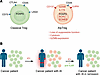
Immune checkpoint inhibitor–induced inflammatory arthritis (ICI-IA) is an immune-related adverse event (irAE) following treatment with PD-1, PD-L1, or CTLA-4 inhibitors in patients with cancer. In this issue of the JCI, Ma and colleagues identified a subset of regulatory T cells (Tregs) that coexpress CD137 and IL-6 receptor (IL6R), termed atypical Tregs (AtpTregs), which are selectively enriched in patients with ICI-IA. Functionally, AtpTregs exhibited reduced suppressive capacity and a Th17-like proinflammatory phenotype. Notably, these cells were associated with more severe arthritis, yet improved cancer outcomes, suggesting a potential role in tumor control. The anti-IL6R therapy tocilizumab, administered as an off-label intervention for ICI-IA, reduced AtpTreg abundance and alleviated arthritis while maintaining antitumor immunity in a small cohort of patients with new-onset ICI-IA. Thus, anti-IL6R could be a targeted approach to manage ICI-IA and potentially other irAEs involving AtpTregs.
Authors
Smriti Parashar, Klaus Ley
Guidelines
The Editorial Board will only consider comments that are deemed relevant and of interest to readers. The Journal will not post data that have not been subjected to peer review; or a comment that is essentially a reiteration of another comment.
- Comments appear on the Journal’s website and are linked from the original article’s web page.
- Authors are notified by email if their comments are posted.
- The Journal reserves the right to edit comments for length and clarity.
- No appeals will be considered.
- Comments are not indexed in PubMed.
Specific requirements
- Maximum length, 400 words
- Entered as plain text or HTML
- Author’s name and email address, to be posted with the comment
- Declaration of all potential conflicts of interest (even if these are not ultimately posted); see the Journal’s conflict-of-interest policy
- Comments may not include figures


Copyright © 2026 American Society for Clinical Investigation
ISSN: 0021-9738 (print), 1558-8238 (online)