
Submit a comment
Abstract
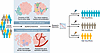
Immune checkpoint inhibitors (ICIs) have improved patient outcomes substantially in non–small cell lung cancer (NSCLC). Despite considerable effort, our understanding of the features that predict for immunotherapy response and resistance in patients remains incomplete. In this issue of the JCI, Isomoto and colleagues utilized a multiplex IHC platform to profile the spatial organization of the lung cancer tumor immune microenvironment, enabling the identification of spatial immune features that correlate with immunotherapy efficacy. This study enhances our knowledge of the spatial organization of features impacting ICI efficacy by identifying a three-variable spatial composite — including CD73 upregulation in EGFR-mutant NSCLC — that substantially outperforms PD-L1 expression in predicting immunotherapy efficacy. Moreover, it establishes spatial proteomic profiling as a platform for generating therapeutic hypotheses that are actionable and mechanistic in NSCLC.
Authors
Tao Zou, John D. Minna
Guidelines
The Editorial Board will only consider comments that are deemed relevant and of interest to readers. The Journal will not post data that have not been subjected to peer review; or a comment that is essentially a reiteration of another comment.
- Comments appear on the Journal’s website and are linked from the original article’s web page.
- Authors are notified by email if their comments are posted.
- The Journal reserves the right to edit comments for length and clarity.
- No appeals will be considered.
- Comments are not indexed in PubMed.
Specific requirements
- Maximum length, 400 words
- Entered as plain text or HTML
- Author’s name and email address, to be posted with the comment
- Declaration of all potential conflicts of interest (even if these are not ultimately posted); see the Journal’s conflict-of-interest policy
- Comments may not include figures


Copyright © 2026 American Society for Clinical Investigation
ISSN: 0021-9738 (print), 1558-8238 (online)