
Submit a comment
Abstract
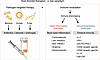
Each year, sepsis claims more lives in the United States than many major cancers and HIV/AIDS combined, yet therapeutic progress has been modest. Adding to this crisis is the alarming rise of multidrug-resistant “superbugs,” which increasingly render conventional antibiotics ineffective. Pathogen-targeted antibiotics will always remain a cornerstone of sepsis treatment, and research into novel antibiotics must continue unabated. However, the consistent mortality in sepsis tells us this approach is insufficient. Most deaths in sepsis do not occur during the early cytokine storm–driven hyper-inflammatory phase but rather days or weeks after the initial insult, during a protracted phase of immune suppression. Here, we make the case that a crucial way to reduce sepsis mortality lies in restoration of the patient’s immune competence, enabling the patient to contain and kill the invading microbes. Adjuvant immune therapies will not only enable killing of the initial, invading pathogens but also prevent secondary, hospital-acquired infections. Immunotherapy revolutionized oncology by challenging the assumption that cancer was best treated through cytotoxic or targeted tumor-directed approaches, and sepsis now stands at a similar inflection point. We argue that embracing immune restoration as a core therapeutic objective offers the most promising means to improve survival in this lethal disorder.
Authors
Richard S. Hotchkiss, Guillaume Monneret
Guidelines
The Editorial Board will only consider comments that are deemed relevant and of interest to readers. The Journal will not post data that have not been subjected to peer review; or a comment that is essentially a reiteration of another comment.
- Comments appear on the Journal’s website and are linked from the original article’s web page.
- Authors are notified by email if their comments are posted.
- The Journal reserves the right to edit comments for length and clarity.
- No appeals will be considered.
- Comments are not indexed in PubMed.
Specific requirements
- Maximum length, 400 words
- Entered as plain text or HTML
- Author’s name and email address, to be posted with the comment
- Declaration of all potential conflicts of interest (even if these are not ultimately posted); see the Journal’s conflict-of-interest policy
- Comments may not include figures


Copyright © 2026 American Society for Clinical Investigation
ISSN: 0021-9738 (print), 1558-8238 (online)