
Submit a comment
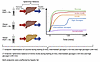
Abstract
BACKGROUND Amino acid (AA) concentrations are increased in prediabetes and diabetes. Since AAs stimulate glucagon secretion, which should then increase hepatic AA catabolism, it has been hypothesized that hepatic resistance (associated with hepatic fat content) to glucagon’s actions on AA metabolism leads to hyperglucagonemia and hyperglycemia.METHODS To test this hypothesis, we therefore studied lean and obese individuals, the latter group with and without hepatic steatosis as defined by proton density fat fraction (PDFF) > 5%. After an overnight fast, femoral vein, femoral artery, and hepatic vein catheters were placed. [3-3H] glucose and l-[1-13C,15N]-leucine were used to measure glucose turnover and leucine oxidation, respectively. During a hyperglycemic clamp, an AA mixture was infused together with insulin and glucagon (1.5 ng/kg/min 0–120 minutes; 3.0 ng/kg/min 120–240 minutes). Tracer-based measurement of hepatic leucine oxidation in response to rising glucagon concentrations and splanchnic balance (measured using arteriovenous differences across the liver) of the other AAs were the main outcomes measured.RESULTS The presence of hepatic steatosis did not alter hepatic glucose metabolism and leucine oxidation in response to insulin and rising concentrations of glucagon. Splanchnic balance of a few AAs and related metabolites differed among the groups. However, across-group differences of AA splanchnic balance in response to glucagon were unaffected by the presence of hepatic steatosis.CONCLUSION The action of glucagon on hepatic AA metabolism is unaffected by hepatic steatosis in humans.TRIAL REGISTRATION Clinical Trials.gov: NCT05500586.FUNDING NIH National Institute of Diabetes and Digestive and Kidney Diseases DK116231, DK78646, DK116231, DK126206, and DK116231.
Authors
Hannah E. Christie, Sneha Mohan, Aoife M. Egan, Federica Boscolo, Chiara Dalla Man, Scott M. Thompson, Michael Jundt, Chad J. Fleming, James C. Andrews, Kent R. Bailey, Michael D. Jensen, K. Sree Nair, Adrian Vella
Guidelines
The Editorial Board will only consider comments that are deemed relevant and of interest to readers. The Journal will not post data that have not been subjected to peer review; or a comment that is essentially a reiteration of another comment.
- Comments appear on the Journal’s website and are linked from the original article’s web page.
- Authors are notified by email if their comments are posted.
- The Journal reserves the right to edit comments for length and clarity.
- No appeals will be considered.
- Comments are not indexed in PubMed.
Specific requirements
- Maximum length, 400 words
- Entered as plain text or HTML
- Author’s name and email address, to be posted with the comment
- Declaration of all potential conflicts of interest (even if these are not ultimately posted); see the Journal’s conflict-of-interest policy
- Comments may not include figures


Copyright © 2026 American Society for Clinical Investigation
ISSN: 0021-9738 (print), 1558-8238 (online)