
Go to JCI Insight
  • About
  • Editors
  • Consulting Editors
  • For authors
  • Publication ethics
  • Publication alerts by email
  • Advertising
  • Job board
  • Contact
  • Clinical Research and Public Health
  • Current issue
  • Past issues
  • By specialty
    • COVID-19
    • Cardiology
    • Gastroenterology
    • Immunology
    • Metabolism
    • Nephrology
    • Neuroscience
    • Oncology
    • Pulmonology
    • Vascular biology
    • All ...
  • Videos
    • ASCI Milestone Awards
    • Video Abstracts
    • Conversations with Giants in Medicine
  • Reviews
    • View all reviews ...
    • Neurodegeneration (Mar 2026)
    • Clinical innovation and scientific progress in GLP-1 medicine (Nov 2025)
    • Pancreatic Cancer (Jul 2025)
    • Complement Biology and Therapeutics (May 2025)
    • Evolving insights into MASLD and MASH pathogenesis and treatment (Apr 2025)
    • Microbiome in Health and Disease (Feb 2025)
    • Substance Use Disorders (Oct 2024)
    • View all review series ...
  • Viewpoint
  • Collections
    • In-Press Preview
    • Clinical Research and Public Health
    • Research Letters
    • Letters to the Editor
    • Editorials
    • Commentaries
    • Editor's notes
    • Reviews
    • Viewpoints
    • 100th anniversary
    • Top read articles

  • Current issue
  • Past issues
  • Specialties
  • Reviews
  • Review series
  • ASCI Milestone Awards
  • Video Abstracts
  • Conversations with Giants in Medicine
  • In-Press Preview
  • Clinical Research and Public Health
  • Research Letters
  • Letters to the Editor
  • Editorials
  • Commentaries
  • Editor's notes
  • Reviews
  • Viewpoints
  • 100th anniversary
  • Top read articles
  • About
  • Editors
  • Consulting Editors
  • For authors
  • Publication ethics
  • Publication alerts by email
  • Advertising
  • Job board
  • Contact

Submit a comment

Metastatic tropism of molecularly defined clear-cell renal cell carcinoma clusters
Gaelle Haddad, Junyu Guo, Yin Xi, Emin Albayrak, Mahrukh Huseni, Habib Hamidi, Romain Banchereau, Edward Kadel, Sarita Dubey, Corey Carter, Payal Kapur, James Brugarolas, Ivan Pedrosa
View: Text | PDF
Clinical Research and Public Health Clinical Research Oncology Public Health

Metastatic tropism of molecularly defined clear-cell renal cell carcinoma clusters

  • Text
  • PDF
Abstract

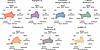
BACKGROUND The relationship between molecular subgroups in clear-cell renal cell carcinoma (ccRCC) and metastatic tropism is poorly understood.METHODS We analyzed over 5,000 metastatic sites from 305 treatment-naive ccRCC patients in the IMmotion150 phase II clinical trial, where patients were randomized to atezolizumab, atezolizumab/bevacizumab, or sunitinib.RESULTS Angiogenic tumors (clusters 1 and 2) had a higher rate of pancreatic (21% vs. 6.9%; P = 0.002) and lower absolute number of lymph node (2.5 vs. 4.2; P = 0.006) metastases. In contrast, proliferative tumors (clusters 4 and 5) exhibited a higher absolute number of lymph node metastases (5.5 vs. 3.5; P = 0.019). Patients with pancreatic metastases receiving sunitinib had higher odds of overall response (OR, 7.13; 95% CI, 1.81–28.07; P = 0.0049) and longer progression-free survival than those without pancreatic metastases (P = 0.02).CONCLUSION ccRCC metastatic tropism relates to molecular clusters that predict response to therapy for tumors that metastasize to the pancreas.TRIAL REGISTRATION ClinicalTrials.gov NCT01984242FUNDING NIH grants R01CA154475 and P50CA196516.

Authors

Gaelle Haddad, Junyu Guo, Yin Xi, Emin Albayrak, Mahrukh Huseni, Habib Hamidi, Romain Banchereau, Edward Kadel, Sarita Dubey, Corey Carter, Payal Kapur, James Brugarolas, Ivan Pedrosa

×

Guidelines

The Editorial Board will only consider comments that are deemed relevant and of interest to readers. The Journal will not post data that have not been subjected to peer review; or a comment that is essentially a reiteration of another comment.

  • Comments appear on the Journal’s website and are linked from the original article’s web page.
  • Authors are notified by email if their comments are posted.
  • The Journal reserves the right to edit comments for length and clarity.
  • No appeals will be considered.
  • Comments are not indexed in PubMed.

Specific requirements

  • Maximum length, 400 words
  • Entered as plain text or HTML
  • Author’s name and email address, to be posted with the comment
  • Declaration of all potential conflicts of interest (even if these are not ultimately posted); see the Journal’s conflict-of-interest policy
  • Comments may not include figures
This field is required

Copyright © 2026 American Society for Clinical Investigation
ISSN: 0021-9738 (print), 1558-8238 (online)

Sign up for email alerts