
Submit a comment
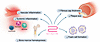
Abstract
The incretin hormone glucagon-like peptide-1 (GLP-1) exerts potent effects on glucose metabolism, prompting the development of therapeutic strategies that enhance activity of the GLP-1 receptor (GLP-1R) pathway. Inhibitors of dipeptidyl peptidase 4 (DPP-4) prolong the half-life of endogenous GLP-1 and typically achieve reductions in HbA1c of 0.5%–0.8%. However, large-scale cardiovascular (CV) outcomes trials (CVOTs) with DPP-4 inhibitors demonstrated CV safety but did not show a reduction in CV events. A second incretin-based therapeutic approach was the development of GLP-1R agonists (GLP-1RAs). Various GLP-1RAs, including liraglutide, semaglutide, and dulaglutide, demonstrated a reduction in CV outcomes in large CVOTs. Initially, these medications were only available as injectable agents for subcutaneous administration, but recent technological advancements have enabled the development of orally available GLP-1RAs. A third incretin-based approach is tirzepatide, a dual agonist of GLP-1R and glucose-dependent insulinotropic polypeptide receptor (GIPR), which achieves greater HbA1c reduction and weight loss compared with GLP-1RAs alone. Ongoing large-scale CVOTs will determine its effects on hard cardiovascular endpoints. This Review summarizes the effects of GLP-1 and GLP-1RAs in the CV system as well as clinical data of GLP-1RAs in individuals with CV disease or high CV risk.
Authors
Florian Kahles, Andreas L. Birkenfeld, Nikolaus Marx
Guidelines
The Editorial Board will only consider comments that are deemed relevant and of interest to readers. The Journal will not post data that have not been subjected to peer review; or a comment that is essentially a reiteration of another comment.
- Comments appear on the Journal’s website and are linked from the original article’s web page.
- Authors are notified by email if their comments are posted.
- The Journal reserves the right to edit comments for length and clarity.
- No appeals will be considered.
- Comments are not indexed in PubMed.
Specific requirements
- Maximum length, 400 words
- Entered as plain text or HTML
- Author’s name and email address, to be posted with the comment
- Declaration of all potential conflicts of interest (even if these are not ultimately posted); see the Journal’s conflict-of-interest policy
- Comments may not include figures


Copyright © 2026 American Society for Clinical Investigation
ISSN: 0021-9738 (print), 1558-8238 (online)