
Submit a comment
Abstract
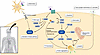
Glucagon-like peptide-1 receptor agonists (GLP-1RAs), established therapies for type 2 diabetes and obesity, are increasingly recognized for their potential in neurodegenerative diseases. Preclinical studies across diverse neurodegenerative conditions consistently demonstrate neuroprotective effects of GLP-1RAs, including reduced protein aggregation, enhanced autophagy, improved mitochondrial function, suppression of neuroinflammation, and preservation of synaptic integrity. Epidemiological analyses further suggest reduced incidence of dementia, Parkinson disease, and multiple sclerosis among long-term GLP-1RA users. Early human trials provide signals of target engagement, such as preserved cerebral glucose metabolism, altered inflammatory biomarkers, and slowed brain atrophy, although clinical outcomes to date remain mixed and trials in rarer disorders are sparse. Translation is constrained by uncertainty around optimal molecule choice, CNS penetrance, tolerability, adherence, and heterogeneity of response. Furthermore, next-generation dual and triple agonists may offer enhanced efficacy but remain untested in neurodegeneration. Conceptually, GLP-1RAs share pleiotropic effects with exercise — one of the few interventions with proven disease-modifying potential — by enhancing insulin signaling, stabilizing mitochondria, reducing inflammation, and promoting synaptic plasticity. This overlap highlights their promise as “pharmacological analogues of exercise,” and underscores the need for biomarker-driven, disease-specific trials to establish whether GLP-1RAs can deliver durable disease modification across the spectrum of neurodegenerative diseases.
Authors
Dilan Athauda, Nigel H. Greig, Wassilios G. Meissner, Thomas Foltynie, Sonia Gandhi
Guidelines
The Editorial Board will only consider comments that are deemed relevant and of interest to readers. The Journal will not post data that have not been subjected to peer review; or a comment that is essentially a reiteration of another comment.
- Comments appear on the Journal’s website and are linked from the original article’s web page.
- Authors are notified by email if their comments are posted.
- The Journal reserves the right to edit comments for length and clarity.
- No appeals will be considered.
- Comments are not indexed in PubMed.
Specific requirements
- Maximum length, 400 words
- Entered as plain text or HTML
- Author’s name and email address, to be posted with the comment
- Declaration of all potential conflicts of interest (even if these are not ultimately posted); see the Journal’s conflict-of-interest policy
- Comments may not include figures


Copyright © 2026 American Society for Clinical Investigation
ISSN: 0021-9738 (print), 1558-8238 (online)