
Go to JCI Insight
  • About
  • Editors
  • Consulting Editors
  • For authors
  • Publication ethics
  • Publication alerts by email
  • Advertising
  • Job board
  • Contact
  • Clinical Research and Public Health
  • Current issue
  • Past issues
  • By specialty
    • COVID-19
    • Cardiology
    • Gastroenterology
    • Immunology
    • Metabolism
    • Nephrology
    • Neuroscience
    • Oncology
    • Pulmonology
    • Vascular biology
    • All ...
  • Videos
    • ASCI Milestone Awards
    • Video Abstracts
    • Conversations with Giants in Medicine
  • Reviews
    • View all reviews ...
    • Clinical innovation and scientific progress in GLP-1 medicine (Nov 2025)
    • Pancreatic Cancer (Jul 2025)
    • Complement Biology and Therapeutics (May 2025)
    • Evolving insights into MASLD and MASH pathogenesis and treatment (Apr 2025)
    • Microbiome in Health and Disease (Feb 2025)
    • Substance Use Disorders (Oct 2024)
    • Clonal Hematopoiesis (Oct 2024)
    • View all review series ...
  • Viewpoint
  • Collections
    • In-Press Preview
    • Clinical Research and Public Health
    • Research Letters
    • Letters to the Editor
    • Editorials
    • Commentaries
    • Editor's notes
    • Reviews
    • Viewpoints
    • 100th anniversary
    • Top read articles

  • Current issue
  • Past issues
  • Specialties
  • Reviews
  • Review series
  • ASCI Milestone Awards
  • Video Abstracts
  • Conversations with Giants in Medicine
  • In-Press Preview
  • Clinical Research and Public Health
  • Research Letters
  • Letters to the Editor
  • Editorials
  • Commentaries
  • Editor's notes
  • Reviews
  • Viewpoints
  • 100th anniversary
  • Top read articles
  • About
  • Editors
  • Consulting Editors
  • For authors
  • Publication ethics
  • Publication alerts by email
  • Advertising
  • Job board
  • Contact
Epithelial-mesenchymal transitions: the importance of changing cell state in development and disease
Hervé Acloque, Meghan S. Adams, Katherine Fishwick, Marianne Bronner-Fraser, M. Angela Nieto
View: Text | PDF
Review Series

Epithelial-mesenchymal transitions: the importance of changing cell state in development and disease

  • Text
  • PDF
Abstract

The events that convert adherent epithelial cells into individual migratory cells that can invade the extracellular matrix are known collectively as epithelial-mesenchymal transition (EMT). Throughout evolution, the capacity of cells to switch between these two cellular states has been fundamental in the generation of complex body patterns. Here, we review the EMT events that build the embryo and further discuss two prototypical processes governed by EMT in amniotes: gastrulation and neural crest formation. Cells undergo EMT to migrate and colonize distant territories. Not surprisingly, this is also the mechanism used by cancer cells to disperse throughout the body.

Authors

Hervé Acloque, Meghan S. Adams, Katherine Fishwick, Marianne Bronner-Fraser, M. Angela Nieto

×

Figure 4

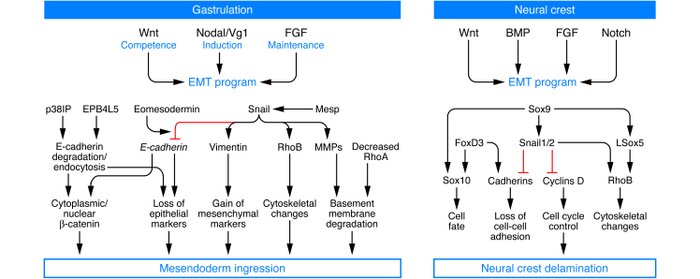
Similar signaling pathways control the EMTs at gastrulation and neural crest delamination in the amniote embryo.
Options: View larger image (or click on image) Download as PowerPoint
Similar signaling pathways control the EMTs at gastrulation and neural c...
Signaling molecules of the TFG-β superfamily (Nodal, Vg1, and BMPs), together with Wnt and FGF, initiate the formation of the primitive streak and operate at the neural folds to drive the ingression of the mesendoderm and the delamination of the neural crest, respectively. Some downstream targets are also conserved, such as the Snail genes. While Snail factors are key regulators of the EMT program during gastrulation, the coordinated induction of several transcription factors is required to control the robust program of neural crest delamination. EPB4L5, FERM and actin-binding domain–containing band 4.1 superfamily member; p38IP, p38-interacting protein; Rho, members of the Rho family of small GTPases.

Copyright © 2026 American Society for Clinical Investigation
ISSN: 0021-9738 (print), 1558-8238 (online)

Sign up for email alerts