
Advertisement
Viewpoint
Open Access |  10.1172/JCI212215
Kunihiro Hattori, Tomoyuki Igawa, and Takehisa Kitazawa share Lasker Award honors for revolutionary hemophilia A therapy
Robert Flaumenhaft
Division of Hemostasis and Thrombosis, Department of Medicine, Beth Israel Deaconess Medical Center, Harvard Medical School, Boston, Massachusetts, USA.
Address correspondence to: Robert Flaumenhaft, Division of Hemostasis and Thrombosis, Department of Medicine, Beth Israel Deaconess Medical Center, 330 Brookline Avenue, Boston, Massachusetts, 02215, USA. Phone: 617.735.4005; Email: rflaumen@bidmc.harvard.edu.
Find articles by Flaumenhaft, R. in: PubMed | Google Scholar
Published September 9, 2026 - More info
J Clin Invest. 2026;136(18):e212215. https://doi.org/10.1172/JCI212215.
© 2026 Flaumenhaft This work is licensed under the Creative Commons Attribution 4.0 International License. To view a copy of this license, visit http://creativecommons.org/licenses/by/4.0/.

The 2026 Lasker~DeBakey Clinical Medical Research Award has been awarded to Kunihiro Hattori, Tomoyuki Igawa, and Takehisa Kitazawa for the development of a bispecific antibody that serves as a surrogate for factor VIIIa, bridging factors IXa and X to restore hemostasis in hemophilia A. This humanized bispecific monoclonal antibody, named emicizumab, has revolutionized hemophilia management because of its long half-life, subcutaneous bioavailability, and low immunogenicity. Furthermore, emicizumab can be used in the presence FVIII inhibitors, which complicate approximately 30% of cases of hemophilia A treated with recombinant FVIII.
-
An inspirational step
It was in this setting, in 2000, that Dr. Kunihiro Hattori, who led a group at Chugai Pharmaceuticals Co. Ltd. working on antibody-based therapies, conceived of a paradigm-shifting approach to hemophilia A therapy. Dr. Hattori noted that the distance between the two antigen-binding sites of human IgG is similar to that between the FIXa and FX-binding sites of FVIIIa. He reasoned that if an anti-FIXa/FX-bispecific antibody could be designed that places the catalytic center of FIXa at the FX cleavage site, such an antibody could potentially substitute for FVIIIa in catalyzing the activation of FX by FIXa (Figure 1). He and his team began work on a series of FIXa/FX-bispecific antibodies. In an effort led by Drs. Tomoyuki Igawa and Takehisa Kitazawa, the team immunized mice, rats, and rabbits with either FIXa or FX and cloned the genes of approximately 200 anti-FIXa antibodies and a similar number of anti-FX antibodies. They subsequently expressed these genes in HEK cells, creating a library of approximately 40,000 bispecific IgG combinations (9). These antibodies were screened for the ability to promote the generation of FXa following incubation with FIXa and FX. This program identified and subsequently characterized a lead bispecific IgG capable of promoting activation of FX to FXa (9).
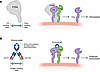 Figure 1
Emicizumab mimics the cofactor activity of FVIIIa by bridging FIXa and FX, thereby facilitating the generation of FXa. (A) FVIIIa is shown (gray), and the distance between the binding sites for FX and FIXa is depicted. The cofactor activity of FVIIIa requires positioning the catalytic site of FIXa (green) so that it will hydrolyze the cleavage site on FX (purple) to generate FXa. (B) Emicizumab is a bispecific IgG that binds the epidermal growth factor–like (EGF-like) domain 1 of FIX/FIXa with one arm and the EGF-like domain 2 of FX/FXa with the other arm. It was designed to have a common light chain (brown) and mutations in the Fc portion to facilitate heavy chain heterodimerization. These modifications reduced the number of possible permutations of antibodies during IgG assembly and enabled efficient production of the asymmetric bispecific IgG. Emicizumab mimics FVIIIa cofactor activity enabling the generation of FXa (9).
In 2012, Dr. Kitazawa and colleagues published the description of a bispecific antibody capable of substituting for FVIIIa cofactor function (10). Although less potent than FVIIIa in promoting FXa generation, this bispecific antibody improved hemostasis in a nonhuman primate (NHP) model of acquired hemophilia A (10). The research team next optimized this bispecific by augmenting its binding properties to both FIXa and FX and improving its pharmacokinetics (11). They identified a common light chain compatible with the anti-FIXa and anti-FX heavy chains and incorporated additional improvements by protein engineering to optimize both manufacturing and functional properties (Figure 1). The active bispecific IgG had only a moderate affinity for binding FIX/FIXa and FX/FXa, allowing release of FXa from the antibody for participation in prothrombinase assembly (9). Molecular engineering of the bispecific antibody increased VIIIa-cofactor activity, enhanced solubility and decreased nonspecific binding to facilitate subcutaneous bioavailability, improved physicochemical stability to extend shelf life, and decreased immunogenicity score. The resultant antibody, termed ACE910 and later emicizumab, demonstrated activity in a thrombin generation assay comparable to that of FVIIIa, showed 86% bioavailability in NHPs with a half-life of approximately 3 weeks, and remained active in the presence of FVIII inhibitors (11). Subsequent studies of acquired hemophilia A in NHPs showed efficacy comparable to recombinant FVIIIa when used on demand in a model of acute bleeding (12) and when used as prophylaxis in a long-term model of joint bleeds (13). These preclinical studies provided robust proof of concept for the clinical development of ACE910 as a nonfactor alternative to FVIII replacement therapy in hemophilia A.
Article tools
- Download citation information
- Send a comment
- Terms of use
- Standard abbreviations
- Need help? Email the journal
Related Collection:
2026 Lasker Awards
-
The Lasker-Bloomberg Public Service Award honors Michael J. Fox’s advocacy for Parkinson’s disease patients and research
-
Mignot and Yanagisawa win Lasker prize for discovery of the role of orexins in wake, sleep, and narcolepsy
Related posts
Metrics


Copyright © 2026 American Society for Clinical Investigation
ISSN: 0021-9738 (print), 1558-8238 (online)