
Advertisement
Viewpoint
Open Access |  10.1172/JCI211621
Mignot and Yanagisawa win Lasker prize for discovery of the role of orexins in wake, sleep, and narcolepsy
Clifford B. Saper
Department of Neurology, Division of Sleep Medicine, and Program in Neuroscience, Beth Israel Deaconess Medical Center and Harvard Medical School, Boston, Massachusetts, USA.
Address correspondence to: C.B. Saper, Department of Neurology, Beth Israel Deaconess Medical Center, 330 Brookline Avenue, Boston, Massachusetts 02215, USA. Phone: 617.667.0519; Email: csaper@bidmc.harvard.edu.
Find articles by
Saper, C.
in:
PubMed
|
Google Scholar
|

Published September 9, 2026 - More info
J Clin Invest. 2026;136(18):e211621. https://doi.org/10.1172/JCI211621.
© 2026 Saper This work is licensed under the Creative Commons Attribution 4.0 International License. To view a copy of this license, visit http://creativecommons.org/licenses/by/4.0/.

The Albert Lasker Basic Medical Research Award for 2026 has been awarded to Dr. Emmanuel Mignot and Dr. Masashi Yanagisawa for the identification of the role of orexins (also known as hypocretins) in the regulation of sleep and wakefulness and that deficiency of orexin signaling is the cause of the sleep disorder, type 1 narcolepsy. Their discoveries were the culmination of complementary lines of research that led to the understanding of both brain functions and disorders that have long puzzled scientists and physicians and to the development of new drugs that improve patients’ lives.
-
New insights into narcolepsy
Orexins/hypocretins were named by two independent lab groups who discovered them in the late 1990s. Luis de Lecea and Greg Sutcliffe used a screen for peptides that were most highly expressed in the hypothalamus to find the mRNA for the peptides they named hypocretins (1). While they were doing this work, Masashi Yanagisawa and Takeshi Sakurai screened for ligands for orphan G protein–coupled receptors and identified the orexin peptides in brain, reporting their definitive structure, gene, and receptors (2). Their reports were published a month apart, and only after reading both papers did scientists realize that the two groups had discovered the same peptides.
The name hypocretins reflected a homology of the peptides with secretin, while the term orexins was chosen because the only neurons in the brain that express the peptides were in the lateral hypothalamus, which had previously been associated with regulation of feeding. Injection of the orexins into the lateral ventricle indeed caused feeding when this was done in the morning when mice are generally asleep (2). However, the injections at other times of day did not cause feeding (3). In an effort to solve this paradox, Yanagisawa’s group generated orexin-null mice (4). Although the mice had only subtle differences in feeding and body weight, other experiments showed that orexin neurons are more active during wakefulness than during sleep. Infrared video imaging of the mice soon showed that during the night, when mice usually are awake, they would have brief attacks of immobility or would suddenly fall asleep, particularly while interacting with their cagemates. These symptoms, sleep attacks and immobility due to sudden loss of muscle tone while awake, are hallmarks of narcolepsy.
Again, by remarkable coincidence, Emmanuel Mignot and his colleagues were studying the basis of inherited canine narcolepsy. By painstaking genetic analysis, they deduced that inherited narcolepsy was caused by a mutation in the hypocretin 2 receptor gene (also known as OX2R) (5). In August 1999, both groups published these results and described their findings in Cell, two weeks apart, and at a stroke the mystery of the origin of narcolepsy was solved; it could be caused by the loss of a single neurotransmitter in a single group of neurons in the hypothalamus, or by its type 2 receptor.
Further studies showed that human narcolepsy is only rarely caused by mutations in orexin receptors, but it is mainly due to loss of the orexin neurons in the hypothalamus (Figure 1) (6, 7). The availability of a spinal fluid assay for orexin soon led to the discovery that patients with narcolepsy with cataplexy almost invariably had low levels of orexin in their spinal fluid, while patients with sleep attacks but without cataplexy tended to have much higher orexin levels, separating the two groups into type 1 and type 2 narcolepsy, respectively (8). Type 1 narcolepsy typically starts in the second or third decade of life, prime time for the onset of various autoimmune disorders. Spikes in the incidence of type 1 narcolepsy after epidemics of H1N1 influenza in China and after administering an H1N1 vaccine in Scandinavia supported an autoimmune origin (9, 10).
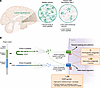 Figure 1
Molecular pharmacology of orexin action. (A) A schematic drawing showing the location of the orexin neurons in the lateral hypothalamus and the loss of orexin neurons in a patient with type 1 narcolepsy. (B) Shows a schematic view of the orexin gene, which contains the sequences for both the orexin A and orexin B peptides. Orexin A acts on both receptors, OX1R and OX2R, but orexin B acts mainly on OX2R. OX2R has been associated mainly with wake-sleep regulation and OX1R with reward seeking and addiction behavior. Dual orexin receptor antagonists are being used clinically to treat insomnia, but specific OX1R antagonists are under development to treat addiction and OX2R agonists are being tested for treating type 1 narcolepsy and may be useful in other disorders of increased daytime sleepiness. Adapted with permission from the New England Journal of Medicine (12).
Article tools
- Download citation information
- Send a comment
- Terms of use
- Standard abbreviations
- Need help? Email the journal
Related Collection:
2026 Lasker Awards
-
Kunihiro Hattori, Tomoyuki Igawa, and Takehisa Kitazawa share Lasker Award honors for revolutionary hemophilia A therapy
-
The Lasker-Bloomberg Public Service Award honors Michael J. Fox’s advocacy for Parkinson’s disease patients and research
Related posts
Metrics


Copyright © 2026 American Society for Clinical Investigation
ISSN: 0021-9738 (print), 1558-8238 (online)