
Citations to this article
Abstract
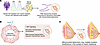
Lactation insufficiency in postpartum women has been associated with obesity and insulin resistance, among other risk factors. Challenges related to translating findings from animal models of lactation and the limited ability to study pregnant and lactating women in clinical trials have impeded more detailed mechanistic understanding of this relationship. In this issue of the JCI, Meng et al. combined studies in human milk samples and in vitro mammary epithelial cell models from humans and rodents to provide compelling evidence that mitochondrial dysfunction mediates the link between insulin resistance and lactation insufficiency. Notably, they observed that chronic exposure to high levels of insulin led to mitochondrial fragmentation and loss of volume in mouse mammary epithelial cells. This framework linking mitochondria, insulin signaling, and lactation should be extended to in vivo models and primary human tissues to better define the mechanisms supporting successful lactation.
Authors
Laura L. Hernandez
Loading citation information...


Copyright © 2026 American Society for Clinical Investigation
ISSN: 0021-9738 (print), 1558-8238 (online)