
Citations to this article
Abstract
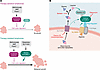
Malignant cells must rapidly synthesize nucleotides to grow and proliferate. Antimetabolite chemotherapies throw a wrench in this process by administering decoy molecules resembling nucleotide precursors that cells cannot use, such as 6-mercaptopurine (6MP) and methotrexate. While this approach remains an essential tool in the treatment of lymphoblastic leukemias and B cell non-Hodgkin lymphomas, approximately 1 in 3 patients will eventually develop therapy-resistant malignancies. In this issue of the JCI, Yang et al. investigated the metabolic adaptations that enable therapy-resistant tumors to grow in the presence of these drugs. Using their previously described mouse model of MYC-driven large B cell lymphoma, they identified that increased expression of the vesicular oligopeptide and histidine transporter SLC15A3 drives dipeptide accumulation in therapy-resistant cells. In lieu of finding other ways to make more nucleotides, these adaptations force cell growth by boosting mTOR signaling. This cunning adaptation, however, is also a vulnerability that can be targeted clinically.
Authors
Carlos Carmona-Fontaine
Loading citation information...


Copyright © 2026 American Society for Clinical Investigation
ISSN: 0021-9738 (print), 1558-8238 (online)